
Rione IX Pigna in Roma in Città metropolitana di Roma Capitale, Latium, Rome, Italy — Central Italy (Tyrrhenian Coast)
Il Tempio A
⎯⎯⎯
Temple A

Photographed by James Hulse, February 28, 2024
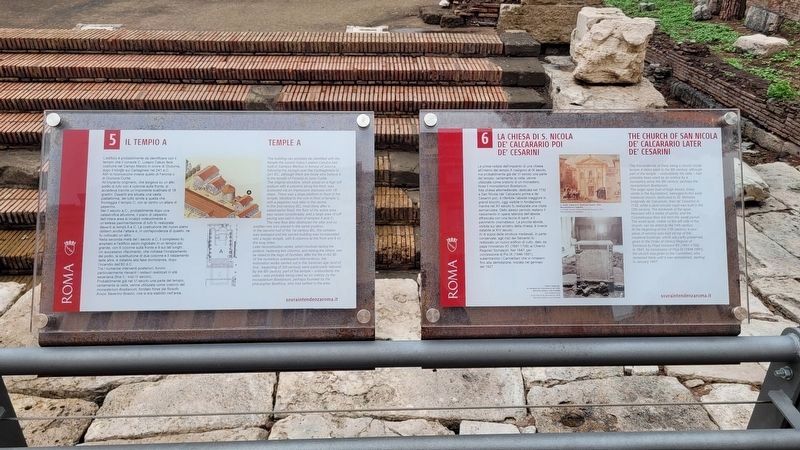
1. Il Tempio A / Temple A Marker

L'edificio è probabilmente da identificare con il tempio che il console C. Lutazio Catulo fece costruire nel Campo Marzio in onore di Giuturna, dopo il trionfo sui Cartaginesi nel 241 a.C. Altri vi riconoscono invece quello di Feronia o di Giunone Curite.
All'impianto originario, che sorgeva su un alto podio di tufo con 4 colonne sulla fronte, si accedeva tramite un'imponente scalinata di 18 gradini. Davanti era situata una vasta piattaforma, del tutto simile a quella che fronteggia il tempio C, con al centro un altare di peperino.
Nel II secolo a.C., probabilmente dopo una catastrofica alluvione, il piano di calpestio dell'intera area si innalzò notevolmente e un'estesa pavimentazione di tufo fu realizzata davanti ai templi A e C. La costruzione del nuovo piano obliterò anche l'altare e, in corrispondenza di questo, ne fu collocato un altro.
Nella seconda metà del I secolo a.C. il complesso fu ampliato e l'edificio sacro inglobato in un tempio più grande, con 6 colonne sulla fronte e 9 sui lati lunghi. Un successivo rifacimento, che richiese l'innalzamento del podio, la sostituzione di due colonne
this page online
Tra i numerosi interventi posteriori, furono particolarmente rilevanti i restauri realizzati in età severiana (fine II - inizi III secolo).
Probabilmente già nel VI secolo una parte del tempio, certamente la cella, venne utilizzata come oratorio del monasterium Boetianum, fondato forse dal filosofo Anicio Severino Boezio, che si era stabilito nell'area.
The building can probably be identified with the temple the consul Gaius Lutatius Catulus had built in Campus Martius in honour of Juturna, following the triumph over the Carthaginians in 241 BC, although there are those who believe it is the temple of Feronia or Juno Curite.
The original structure, which stood on a high tuff podium with 4 columns along the front, was accessed via an impressive staircase with 18 steps. There was a large platform in front of the temple, identical to the one in front of temple C, with a peperino rock altar in the centre.
In the 2nd century BC, most likely after a catastrophic flood, the floor of the entire area was raised considerably, and
Photographed by James Hulse, February 28, 2024
2. Il Tempio A / Temple A Marker (left)
In the second half of the 1st century BC, the complex was enlarged and the sacred building was incorporated into a larger temple, with 6 columns at the front and 9 on the long sides.
Later reconstruction works, which involved raising the podium, replacing two columns, and raising the others, can be dated to the reign of Domitian, after the fire in AD 80. Of the numerous subsequent interventions, the restoration works carried out in the Severian age (end of 2nd - beginning of 3rd century) were particularly relevant. By the 6th century, part of the temple - undoubtedly the cella was probably being used as an oratory by the monasterium Boetianum, perhaps founded by the philosopher Boethius, who had settled in the area.
Erected by City of Rome. (Marker Number 5.)
Topics. This historical marker is listed in this topic list: Anthropology & Archaeology. A significant historical year for this entry is 241 BCE.
Location. 41° 53.741′ N, 12° 28.621′ E. Marker is in Roma, Lazio (Latium,
Photographed by James Hulse, February 28, 2024
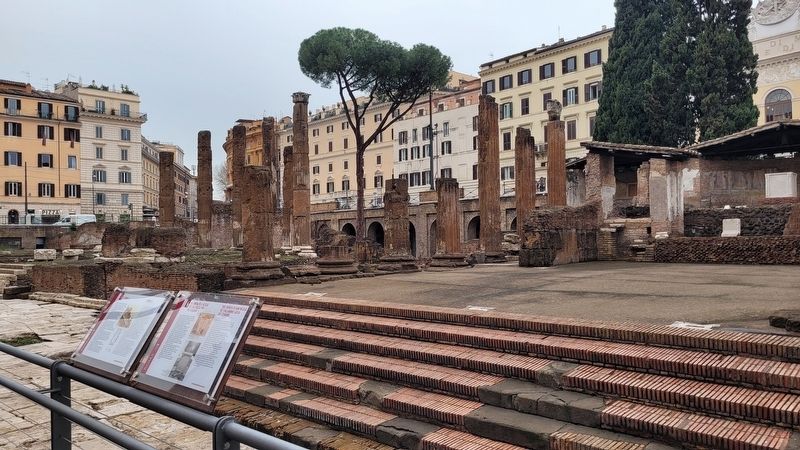
3. The view of the two markers and Temple A

Regionally, it is in Europe, the European Union, the Schengen Area, a coastal Mediterranean country, and the Western World. Historically, it finds itself in what was once the Roman Empire.
Other nearby markers. At least 8 other markers are within walking distance of this marker: La Chiesa Di S. Nicola De' Calcarario Poi De' Cesarini (here, next to this marker); Il Tempio B / Temple B (within shouting distance of this marker); Il Campo Marzio / Campus Martius (within shouting distance of this marker); Inquadramento Topografico / Topographical Overview (within shouting distance of this marker); La Curia Di Pompeo / The Curia of Pompey (within shouting distance of this marker); Le Demolizioni e lo Scavo / Demolitions and Excavations
Photographed by James Hulse, February 28, 2024
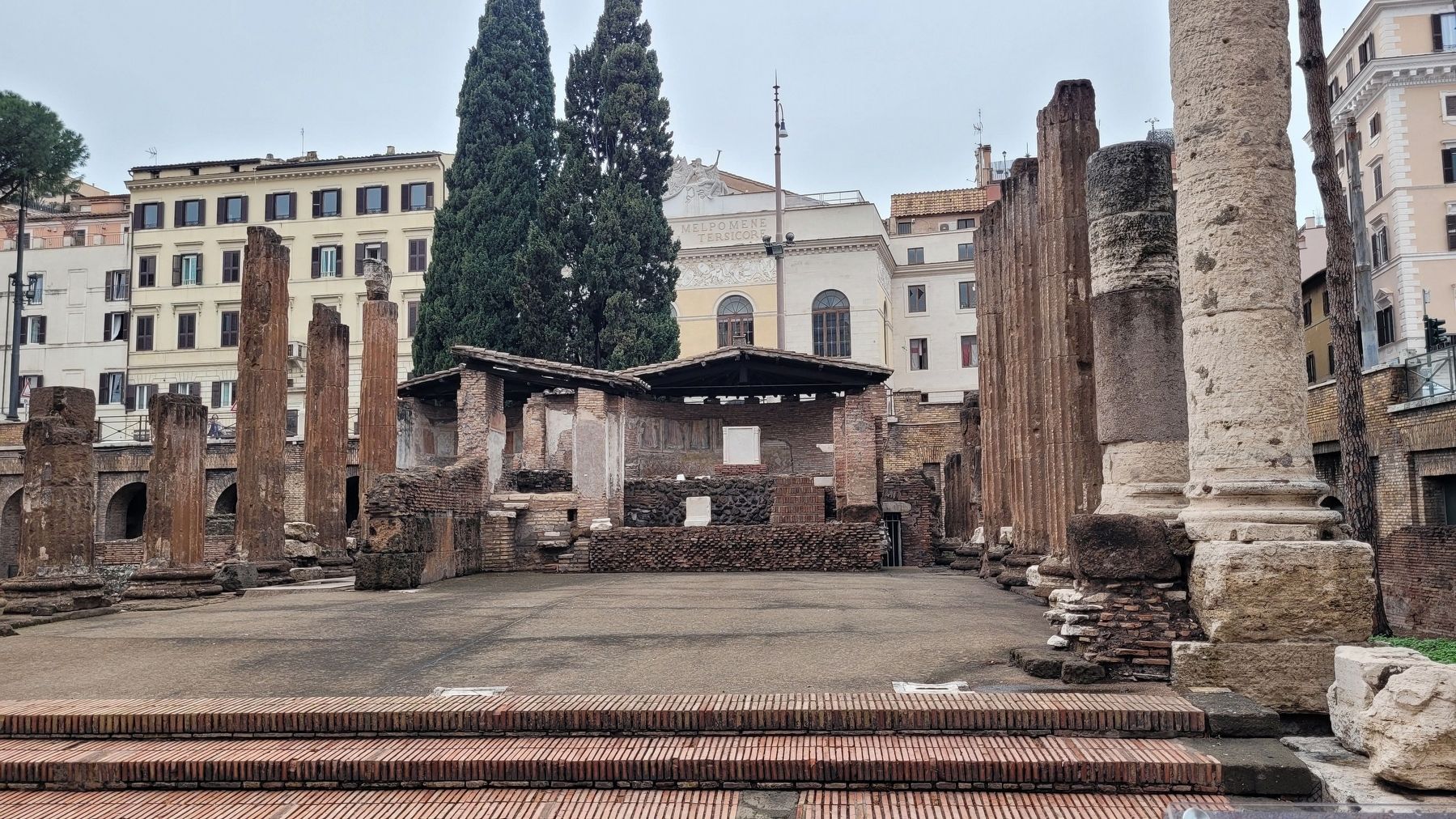
4. The archeological site of Temple A and Church of San Nicola
More about this marker. There is a small entry fee to visit the Largo di Torre Argentina archeological site.
Also see . . . Capitoline Superintendency for Cultural Heritage. (Submitted on February 20, 2025, by James Hulse of Medina, Texas.)
Credits. This page was last revised on February 22, 2025. It was originally submitted on February 19, 2025, by James Hulse of Medina, Texas. This page has been viewed 131 times since then and 25 times this year. Photos: 1, 2, 3, 4. submitted on February 22, 2025, by James Hulse of Medina, Texas.
