
Rione IX Pigna in Roma in Città metropolitana di Roma Capitale, Latium, Rome, Italy — Central Italy (Tyrrhenian Coast)
La Curia Di Pompeo
⎯⎯⎯
The Curia of Pompey
Photographed by James Hulse, February 28, 2024
1. La Curia Di Pompeo / The Curia of Pompey Marker

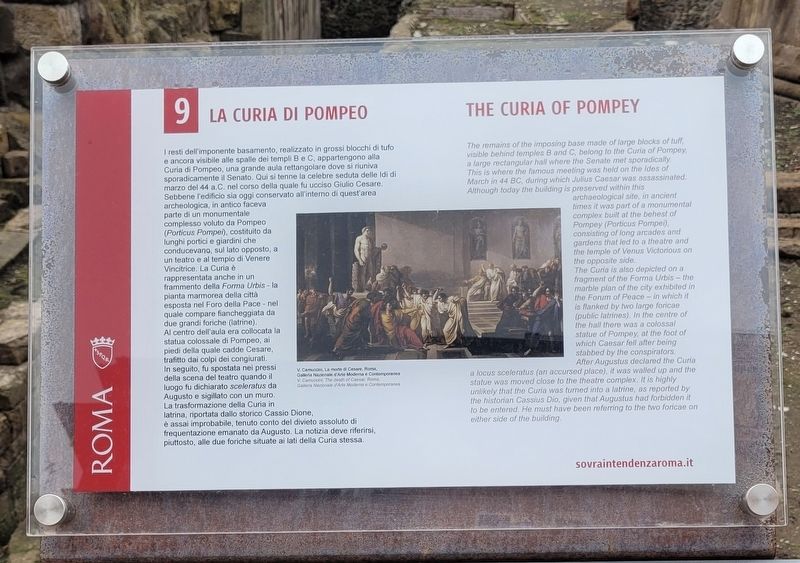
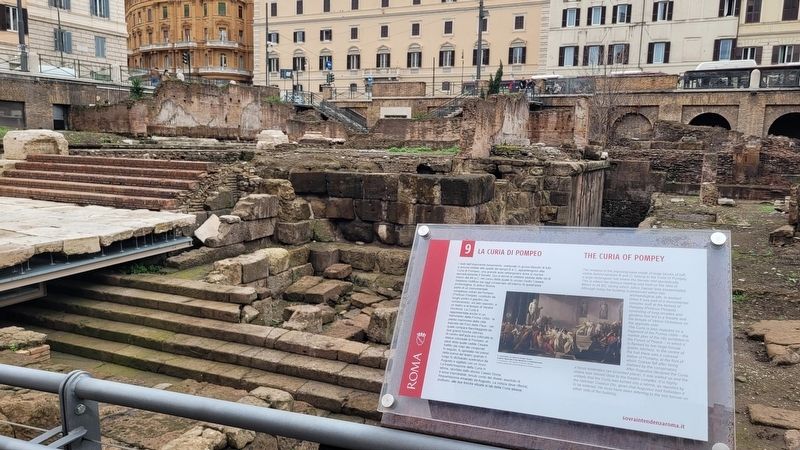
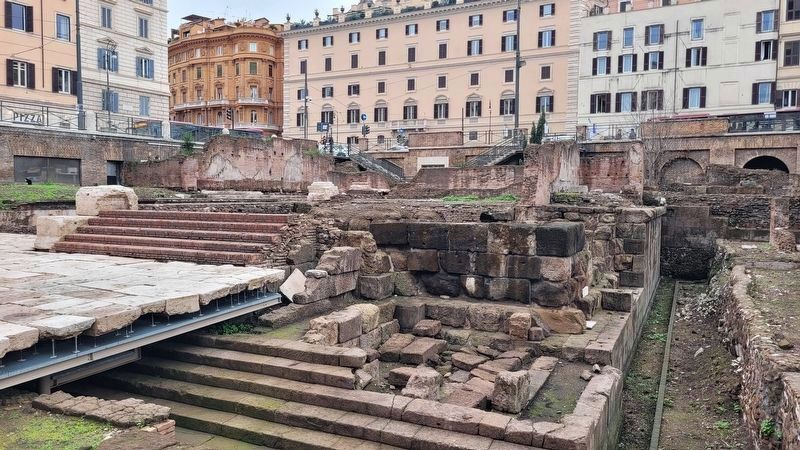
I resti dell'imponente basamento, realizzato in grossi blocchi di tufo e ancora visibile alle spalle dei templi B e C, appartengono alla Curia di Pompeo, una grande aula rettangolare dove si riuniva sporadicamente il Senato. Qui si tenne la celebre seduta delle Idi di marzo del 44 a.C. nel corso della quale fu ucciso Giulio Cesare. Sebbene l'edificio sia oggi conservato all'interno di quest'area archeologica, in antico faceva parte di un monumentale complesso voluto da Pompeo (Porticus Pompei), costituito da lunghi portici e giardini che conducevano, sul lato opposto, a un teatro e al tempio di Venere Vincitrice. La Curia è rappresentata anche in un frammento della Forma Urbis - la pianta marmorea della città esposta nel Foro della Pace - nel quale compare fiancheggiata da due grandi foriche (latrine). Al centro dell'aula era collocata la statua colossale di Pompeo, ai piedi della quale cadde Cesare, trafitto dai colpi dei congiurati. In seguito, fu spostata nei pressi della scena del teatro quando il luogo fu dichiarato sceleratus da Augusto e sigillato con un muro. La trasformazione della Curia in latrina, riportata dallo storico Cassio Dione, è assai improbabile, tenuto conto del divieto assoluto di frequentazione emanato da Augusto. La notizia deve riferirsi, piuttosto, alle due foriche situate ai lati della Curia stessa.
Didascalie
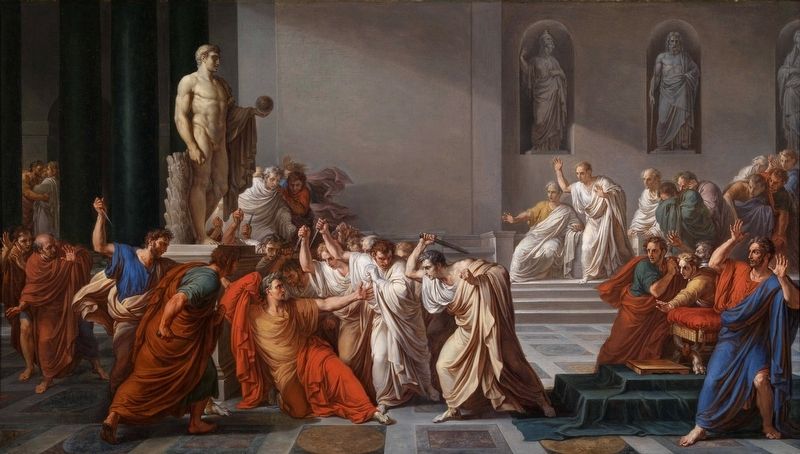
(Foto #1) V. Camuccini, La morte di Cesare, Roma, Galleria Nazionale d'Arte Moderna e Contemporanea
The remains of the imposing base made of large blocks of tuff, visible behind temples B and C, belong to the Curia of Pompey, a large rectangular hall where the Senate met sporadically. This is where the famous meeting was held on the Ides of March in 44 BC, during which Julius Caesar was assassinated. Although today the building is preserved within this archaeological site, in ancient times it was part of a monumental complex built at the behest of Pompey (Porticus Pompei), consisting of long arcades and gardens that led to a theatre and the temple of Venus Victorious on the opposite side.
The Curia is also depicted on a fragment of the Forma Urbis - the marble plan of the city exhibited in the Forum of Peace - in which it is flanked by two large foricae (public latrines). In the centre of the hall there was a colossal statue of Pompey, at the foot of which Caesar fell after being stabbed by the conspirators. After Augustus declared the Curia a locus sceleratus (an accursed place), it was walled up and the statue was moved close to the theatre complex. It is highly unlikely that the Curia was turned into a latrine, as reported by the historian Cassius Dio, given that Augustus had forbidden it to be entered. He must have been referring to the two foricae on either side of the building.
Captions
(Photo #1) V. Camuccini, The death of Caesar, Roma, Galleria Nazionale d'Arte Moderna e Contemporanea
Erected by City
this page online
Topics and series. This historical marker is listed in this topic list: Anthropology & Archaeology. In addition, it is included in the If You've Got to Go... series list. A significant historical date for this entry is March 15, 44 CE.
Location. 41° 53.712′ N, 12° 28.624′ E. Marker is in Roma, Lazio (Latium, Rome), in Città metropolitana di Roma Capitale. It is in Rione IX Pigna. It is at the intersection of Via di S. Nicola de' Cesarini and Largo di Torre Argentina on Via di S. Nicola de' Cesarini. The marker is located in the Largo di Torre Argentina archeological site. Touch for map. Marker is in this post office area: Roma, Lazio 00186, Italy. Touch for directions.

Regionally, it is in Europe, the European Union, the Schengen Area, a coastal Mediterranean country, and the Western World. Historically, it finds itself in what was once the Byzantine Empire and specifically also the Roman Empire.
Other nearby markers. At least 8 other markers are within walking distance of this marker: Le Demolizioni e lo Scavo / Demolitions and Excavations (a few steps from this marker); Il Tempio C / Temple C (a few steps
Photographed by James Hulse, February 28, 2024
2. The Curia of Pompey and Marker
More about this marker. There is a small entry fee to visit the Largo di Torre Argentina archeological site.
Also see . . .
1. Capitoline Superintendency for Cultural Heritage. (Submitted on February 20, 2025, by James Hulse of Medina, Texas.)
2. Julius Caesar. Wikipedia
Gaius Julius Caesar (12 July 100 BC – 15 March 44 BC) was a Roman general and statesman. A member of the First Triumvirate, Caesar led the Roman armies in the Gallic Wars before defeating his political rival Pompey in a civil war, and subsequently became dictator from 49 BC until his assassination in 44 BC. He played a critical role(Submitted on February 22, 2025, by James Hulse of Medina, Texas.)in the events that led to the demise of the Roman Republic and the rise of the Roman Empire.Photographed by James Hulse, February 28, 20243. A section of the foundation of the Curia of Pompey where Julius Caesar was assassinated
Public Domain - Artist Vincenzo Camuccini - Wikipedia Commons, circa 1805
4. The assassination of Julius Caesar, led by Brutus, by the Senate
Credits. This page was last revised on February 22, 2025. It was originally submitted on February 20, 2025, by James Hulse of Medina, Texas. This page has been viewed 215 times since then and 50 times this year. Photos: 1, 2, 3, 4. submitted on February 22, 2025, by James Hulse of Medina, Texas.
