
Rione IX Pigna in Roma in Città metropolitana di Roma Capitale, Latium, Rome, Italy — Central Italy (Tyrrhenian Coast)
Il Tempio C
⎯⎯⎯
Temple C
Photographed by James Hulse, February 28, 2024
1. Il Tempio C / Temple C Marker

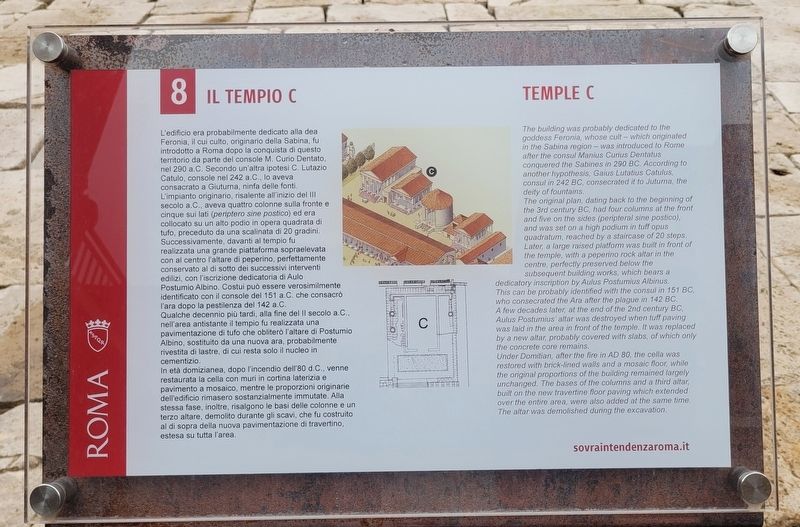
L'edificio era probabilmente dedicato alla dea Feronia, il cui culto, originario della Sabina, fu introdotto a Roma dopo la conquista di questo territorio da parte del console M. Curio Dentato, nel 290 a.C. Secondo un'altra ipotesi C. Lutazio Catulo, console nel 242 a.C., lo aveva consacrato a Giuturna, ninfa delle fonti. L'impianto originario, risalente all'inizio del III secolo a.C., aveva quattro colonne sulla fronte e cinque sui lati (periptero sine postico) ed era collocato su un alto podio in opera quadrata di tufo, preceduto da una scalinata di 20 gradini. Successivamente, davanti al tempio fu realizzata una grande piattaforma sopraelevata con al centro l'altare di peperino, perfettamente conservato al di sotto dei successivi interventi edilizi, con l'iscrizione dedicatoria di Aulo Postumio Albino. Costui può essere verosimilmente identificato con il console del 151 a.C. che consacrò l'ara dopo la pestilenza del 142 a.C. Qualche decennio più tardi, alla fine del Il secolo a.C., nell'area antistante il tempio fu realizzata una pavimentazione di tufo che obliterò l'altare di Postumio Albino, sostituito
this page online
In età domizianea, dopo l'incendio dell'80 d.C., venne restaurata la cella con muri in cortina laterizia e pavimento a mosaico, mentre le proporzioni originarie dell'edificio rimasero sostanzialmente immutate. Alla stessa fase, inoltre, risalgono le basi delle colonne e un terzo altare, demolito durante gli scavi, che fu costruito al di sopra della nuova pavimentazione di travertino, estesa su tutta l'area.
The building was probably dedicated to the goddess Feronia, whose cult - which originated in the Sabina region - was introduced to Rome after the consul Manius Curius Dentatus conquered the Sabines in 290 BC. According to another hypothesis, Gaius Lutatius Catulus, consul in 242 BC, consecrated it to Juturna, the deity of fountains.
The original plan, dating back to the beginning of the 3rd century BC, had four columns at the front and five on the sides (peripteral sine postico), and was set on a high podium in tuff opus quadratum, reached by a staircase of 20 steps. Later, a large raised platform was built in front
Photographed by James Hulse, February 28, 2024
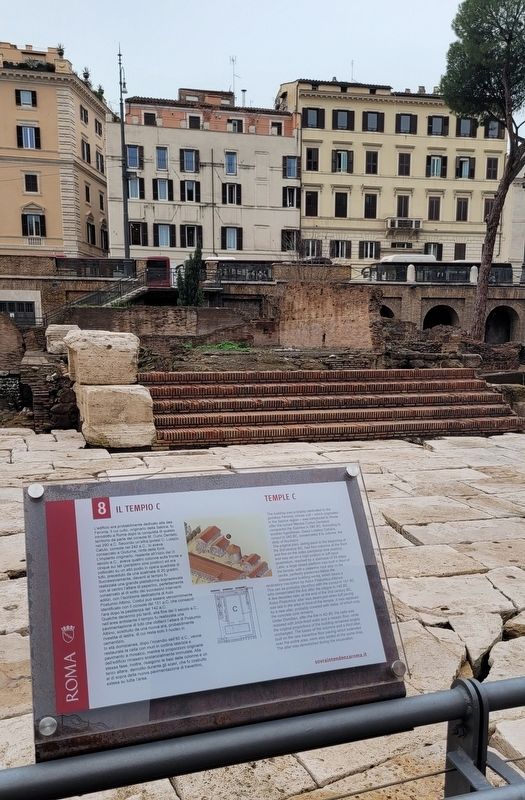
2. The view of Temple C and Marker
Under Domitian, after the fire in AD 80, the cella was restored with brick-lined walls and a mosaic floor, while the original proportions of the building remained largely unchanged. The bases of the columns and a third altar, built on the new travertine floor paving which extended over the entire area, were also added at the same time. The altar was demolished during the excavation.
Erected by City of Rome. (Marker Number 8.)
Topics. This historical marker is listed in this topic list: Anthropology & Archaeology. A significant historical year for this entry is 290 BCE.
Location. 41° 53.705′ N, 12° 28.625′ E.
Photographed by James Hulse, February 28, 2024
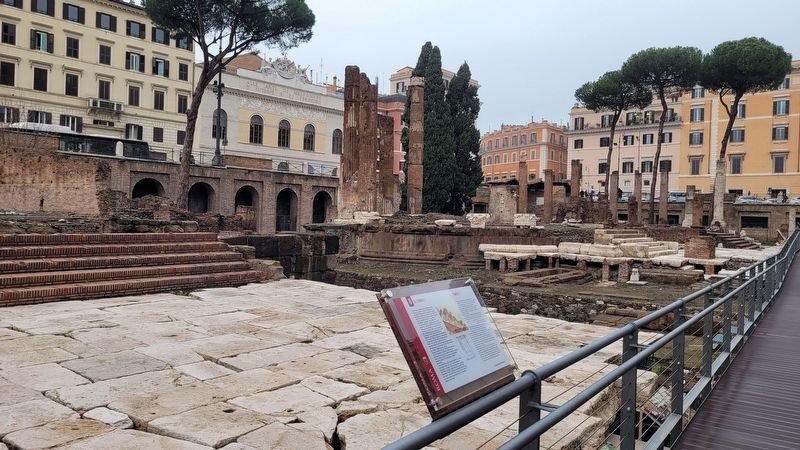
3. The view of Temple C and Marker from the boardwalk

Regionally, it is in Europe, the European Union, the Schengen Area, a coastal Mediterranean country, and the Western World. Historically, it finds itself in what was once the Roman Empire.
Other nearby markers. At least 8 other markers are within walking distance of this marker: La Curia Di Pompeo / The Curia of Pompey (a few steps from this marker); Le Demolizioni e lo Scavo / Demolitions and Excavations (a few steps from this marker); Il Tempio D / Temple D (a few steps from this marker); Inquadramento Topografico / Topographical Overview (within shouting distance of this marker); Il Campo Marzio / Campus Martius (within shouting distance of this marker); Il Tempio B / Temple B (within shouting distance of this marker); Il Tempio A / Temple A (within shouting
Photographed by James Hulse, February 28, 2024
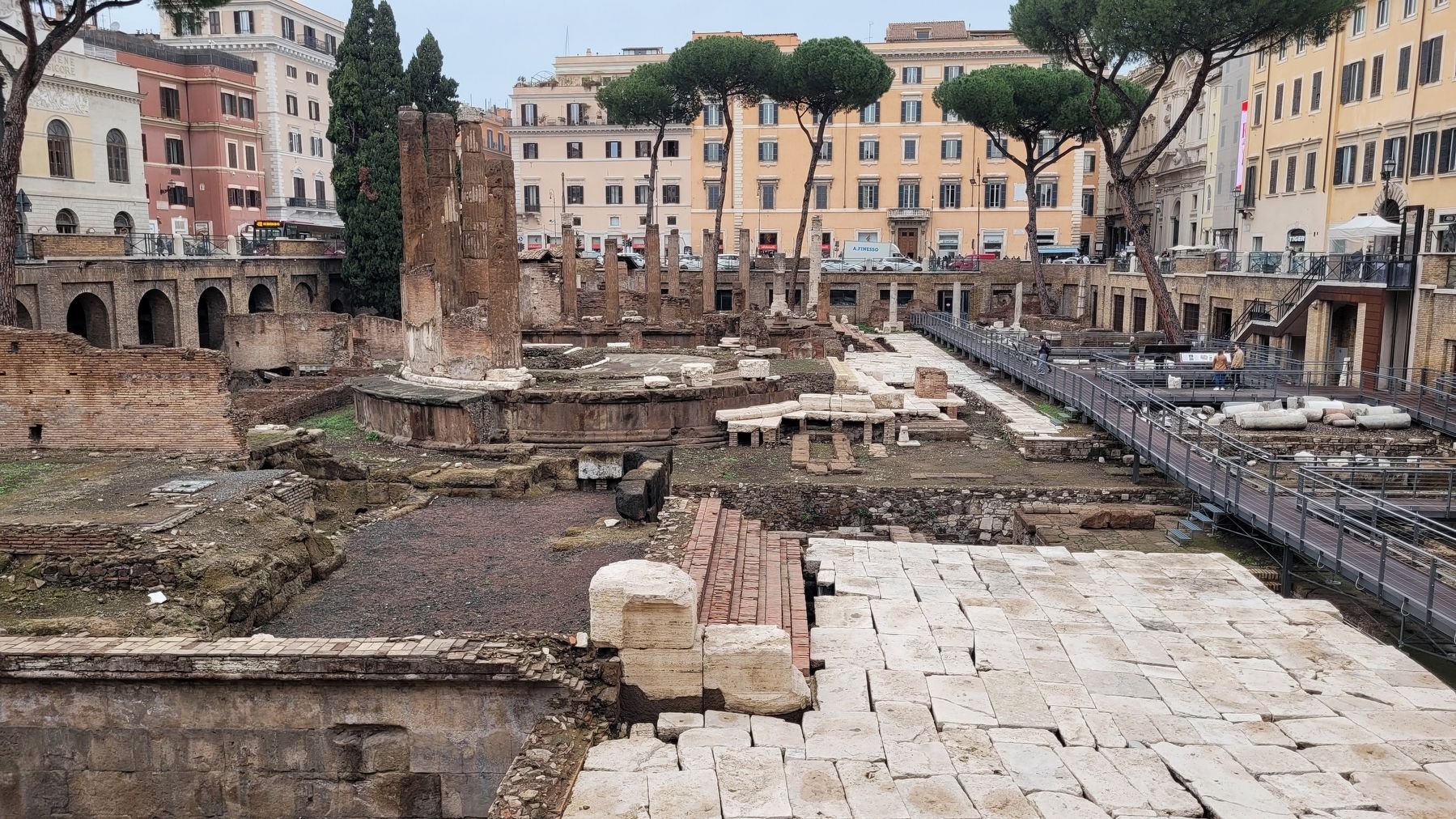
4. The view of Temple C in the foreground from the street level
More about this marker. There is a small entry fee to visit the Largo di Torre Argentina archeological site.
Also see . . . Capitoline Superintendency for Cultural Heritage. (Submitted on February 20, 2025, by James Hulse of Medina, Texas.)
Credits. This page was last revised on February 22, 2025. It was originally submitted on February 20, 2025, by James Hulse of Medina, Texas. This page has been viewed 134 times since then and 12 times this year. Photos: 1, 2, 3, 4. submitted on February 22, 2025, by James Hulse of Medina, Texas.
