Malden in Kanawha County, West Virginia — The American South (Appalachia)
The Necessary Ingredient
Malden's Salt Works

Photographed by Don Morfe, August 3, 2012
1. The Necessary Ingredient Marker
In the decades before the Civil War, this region, called the Kanawha Salines, had a booming salt industry. Salt extraction created vast wealth here, and by 1846, this area had led the nation with 3.2 million bushels produced. During the Civil War, salt was a necessary ingredient for the preservation of meat for the armies. The salt works here at Malden were especially important to the Confederacy.
Salt businesses relied on slaves, owned or leased, and the workers face difficult conditions. Many jobs were dangerous…mining the coal to boil the brine was especially so. Slaves toiled at the 52 furnaces that lined the Kanawha River for ten miles above Charleston. By 1850, 3,140 slaves lived among the 12,001 white inhabitants, and more than half of the slaves worked in the salt operations.
Many salt-works owners lived here in Malden, while others built large estates along the Kanawha River in Charleston to escape the heat and pollution of the furnaces. Several of the houses still stand on Kanawha Boulevard. By 1861, the salt industry here was in decline because of the development of salt fields farther west, as well as
this page online
(Sidebars)
In 1853, saltmaker Richard Lovell estimated the employment of hands at his two salt furnaces as: 14 coal diggers; 5 wheelers [moved coal to mine mouth]; 4 haulers [moved coal by team on rail tramway to furnace]; 3 kettle tenders [boiled brine to recover salt]; 1 or 2 cat hole [coal ash repository] cleaners; 6 engineers [ran steam engines to pump brine from well]; 2 salt lifters and wheelers [moved salt to packing shed]; 7 "jim arounds" and packers [general laborers, firemen packed salt into barrels]; 2 blacksmiths; 1 "negro man sort of manager."
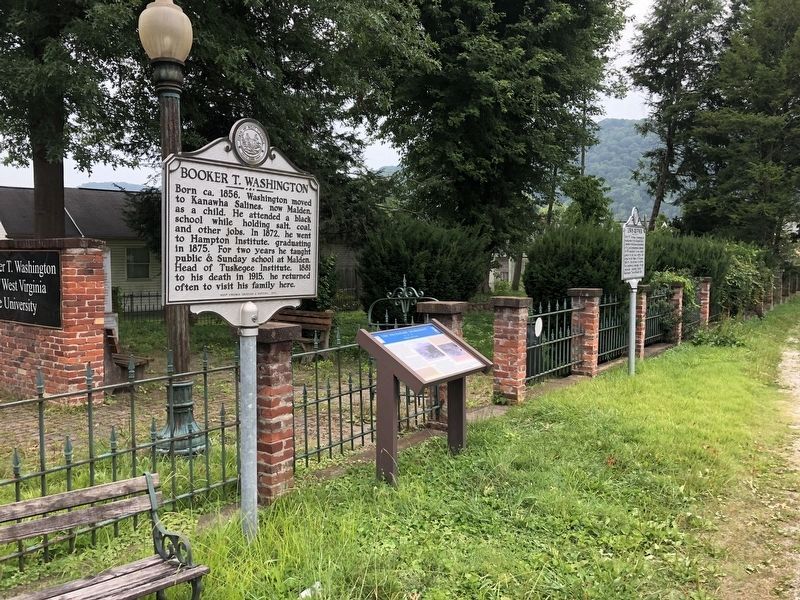
Born into slavery on a Virginia farm, nine-year old Booker T. Washington moved to Malden with his family in 1865 after the war ended. He packed salt, mined coal, and worked for the wealthy Ruffner family. His labors spurred his thirst for an education. Washington became a prominent educator and leading spokesman for African Americans from 1895 until his death in 1915. Booker returned here often to visit his sister, Amanda Johnson. The nearby site of her brick house is now West Virginia State University Park.
(captions)
Brooks
Booker T. Washington's boyhood home in Malden; His sister, Amanda Johnsen, is standing in the doorway. Today, a modern reconstruction of this dwelling is located behind the African Zion Baptist Church on Malden Drive; this is the church that Washington and his family attended - Courtesy West Virginia & Regional History Collection
Erected by West Virginia Civil War Trails.
Topics and series. This historical marker is listed in these topic lists: African Americans • War, US Civil. In addition, it is included in the Historically Black Colleges and Universities, and the West Virginia Civil War Trails series lists. A significant historical year for this entry is 1846.
Location. This marker has been replaced by another marker nearby. It was located near 38° 17.931′ N, 81° 33.462′ W. Marker was in Malden, West Virginia, in Kanawha County. It was at the intersection of Malden Drive (County Route 60/6) and Cypress Drive, on the right when traveling south on Malden Drive. Touch for map.
Photographed by Don Morfe, August 3, 2012
3. The Necessary Ingredient Marker
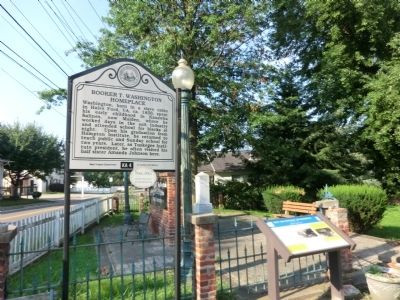
This view is of the featured marker in and its previous nearby marker.

Regionally, this marker was in Greater Charleston Area. It was also in the American South, specifically in the Upper South, in Appalachia, and specifically in Southern Appalachia. Globally, it was in North America, the Western Hemisphere, the Western World, and the Anglosphere. Historically, it found itself in what was once the territory of the Mississippian Culture.
Other nearby markers. At least 8 other markers are within 2 miles of this location, measured as the crow flies: Booker T. Washington / Malden (here, next to this marker); Lewis Ruffner (here, next to this marker); a different marker also named Necessary Ingredient (here, next to this marker); Booker T. Washington (here, next to this marker); African Zion Baptist Church (about 300 feet away, measured in a direct line); Rev. Ruffner's Grave (about 800 feet away); Ruffner Well (approx. ¼ mile away); Burning Spring Monument (approx. 2 miles away). Touch for a list and map of all markers in Malden.
Another marker is no longer nearby. Malden / Booker T. Washington Homeplace (was here, next to this marker but has been replaced with another marker now near it).
Related marker. Click here for another marker that is related to this marker. New Replacement CWT Marker At This Location titled "Necessary Ingredient".
Credits. This page was last revised on February 21, 2025. It was originally submitted on September 3, 2012, by Don Morfe of Baltimore, Maryland. This page has been viewed 1,042 times since then and 37 times this year. Last updated on February 20, 2025, by Mark Parker of Hickory, North Carolina. Photos: 1. submitted on September 3, 2012, by Don Morfe of Baltimore, Maryland. 2. submitted on August 5, 2021, by Devry Becker Jones of Washington, District of Columbia. 3. submitted on September 3, 2012, by Don Morfe of Baltimore, Maryland. • Bernard Fisher was the editor who published this page.
