Rione IX Pigna in Roma in Città metropolitana di Roma Capitale, Latium, Rome, Italy — Central Italy (Tyrrhenian Coast)
Le Demolizioni e lo Scavo
⎯⎯⎯
Demolitions and Excavations
Photographed by James Hulse, February 28, 2024
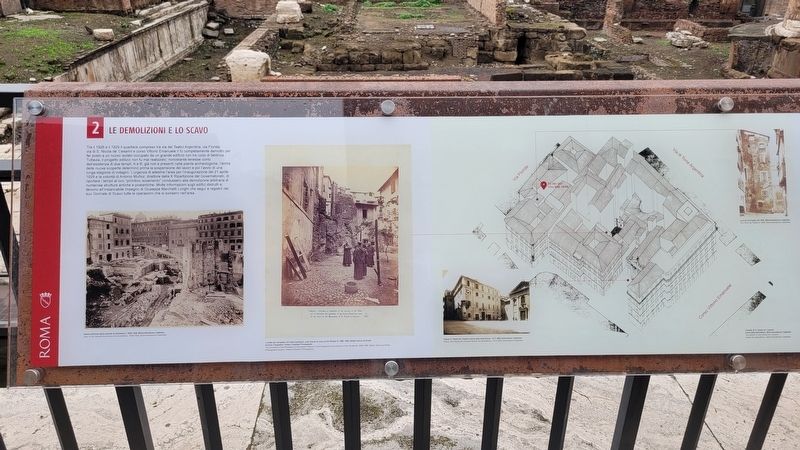
1. Le Demolizioni e lo Scavo / Demolitions and Excavations Marker (left side of the marker)

Tra il 1926 e il 1929 il quartiere compreso tra via del Teatro Argentina, via Florida, via di S. Nicola de' Cesarini e corso Vittorio Emanuele II fu completamente demolito per far posto a un nuovo isolato occupato da un grande edificio con tre corpi di fabbrica. Tuttavia, il progetto edilizio non fu mai realizzato: nonostante tenesse conto dell'esistenza di due templi, A e B, già noti e presenti nelle piante archeologiche, l'entità delle nuove scoperte determinò prima la sospensione dei lavori e poi l'avvio di una lunga stagione di indagini. L'urgenza di allestire l'area per l'inaugurazione del 21 aprile 1929 e la volontà di Antonio Muñoz, direttore della X Ripartizione del Governatorato, di riportare i templi al loro "primitivo isolamento" condussero alla demolizione arbitraria di numerose strutture antiche e postantiche. Molte informazioni sugli edifici distrutti si devono all'instancabile impegno di Giuseppe Marchetti Longhi che seguì e registrò nel suo Giornale di Scavo tutte le operazioni che si svolsero nell'area.
Didascalie
(Foto #1) Veduta dell'area sacra durante le demolizioni, 1926-1928, ©Sovrintendenza Capitolina
(Foto #2) Il cortile del monastero dei Padri Somaschi: sullo sfondo le colonne del Tempio B, 1860-1880, British School at Rome, Archivio Fotografico, Parker Collection Photographs
(Foto #3) Piazza S. Nicola de Cesarini prima delle demolizioni, 1915, ©Sovrintendenza Capitolina
(Foto #4) La torre del Papito nel 1905, ©Sovrintendenza Capitolina
(Foto #5) L'isolato di S. Nicola de' Cesarini prima delle demolizioni, ©Sovrintendenza Capitolina
(Foto #6) Veduta dell'area sacra durante le demolizioni, 1925-1928, ©Sovrintendenza Capitolina
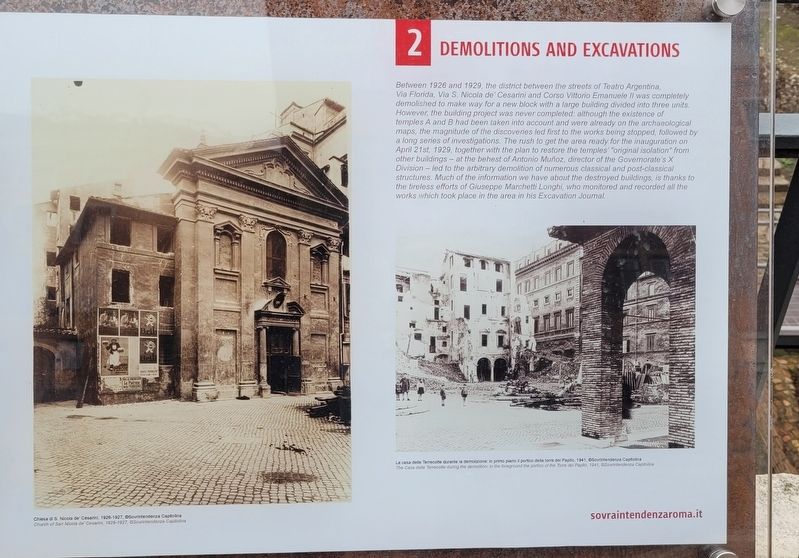
(Foto #7) Chiesa di S. Nicola de' Cesarini, 1926-1927, ©Sovrintendenza Capitolina
(Foto #8) La casa delle Terrecotte durante la demolizione: in primo piano il portico della torre del Papito, 1941, ©Sovrintendenza Capitolina
Between
this page online
Captions
(Photo #1) View of the Sacred Area during the demolitions, 1926-1928, ©Sovrintendenza Capitolina
(Photo #2) The courtyard of the Monastery of Somascan Fathers: in the background the columns of the Temple B, 1860-1880, British School at Rome, Photographic Archive, Parker Collection Photographs
(Photo #3) Piazza San Nicola de' Cesarini before the demolitions, 1915, ©Sovrintendenza Capitolna
(Photo #4) The Torre del Papito in 1905, ©Sovrintendenza Capitolina
(Photo #5) The district of San Nicola de Cesarini before the demolitions, ©Sovrintendenze Capitolina
(Photo #6) View of the Sacred Area during the demolitions, 1926-1928, ©Sovrintendenza Capitolina
(Photo #7) Church of San Nicola de' Cesarini, 1926-1927, ©Sovrintendenza Capitolina
(Photo #8) The Casa delle Terrecotte during the demolition: in the foreground the portico of the Torre del Papito, 1941, ©Sovrintendenza Capitolina
Erected by City
Photographed by James Hulse, February 28, 2024
2. Le Demolizioni e lo Scavo / Demolitions and Excavations Marker (right side of the marker)
Topics. This historical marker is listed in this topic list: Anthropology & Archaeology. A significant historical date for this entry is April 21, 1929.
Location. 41° 53.712′ N, 12° 28.631′ E. Marker is in Roma, Lazio (Latium, Rome), in Città metropolitana di Roma Capitale. It is in Rione IX Pigna. It is at the intersection of Via di San Nicola de' Cesarini and Via Florida on Via di San Nicola de' Cesarini. The marker is located in the Largo di Torre Argentina archeological site. Touch for map. Marker is at or near this postal address: Via di S Nicola de' Cesarini 14-1, Roma, Lazio 00186, Italy. Touch for directions.

Regionally, it is in Europe, the European Union, the Schengen Area, a coastal Mediterranean country, and the Western World. Historically, it finds itself in what was once the Roman Empire.
Other nearby markers. At least 8 other markers are within walking distance of this marker: La Curia Di Pompeo / The Curia of Pompey (a few steps from this marker); Il Tempio C / Temple C (a few steps from this marker); Inquadramento Topografico / Topographical Overview (a few steps from this marker); Il Campo Marzio / Campus Martius
Photographed by James Hulse, February 28, 2024
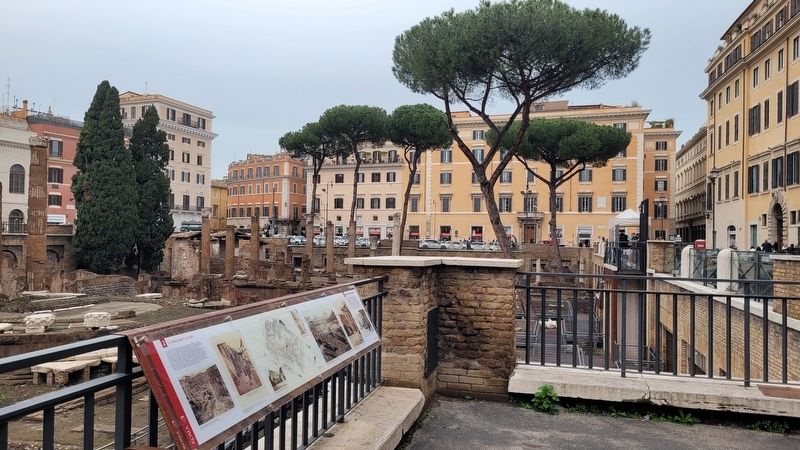
3. The view of the Demolitions and Excavations Marker in the archaeological site
More about this marker. There is a small entry fee to visit the Largo di Torre Argentina archeological site.
Also see . . . Capitoline Superintendency for Cultural Heritage. (Submitted on February 20, 2025, by James Hulse of Medina, Texas.)

Photographed by James Hulse, February 28, 2024
4. The view of the Largo di Torre Argentina archeological site from the marker
Credits. This page was last revised on February 23, 2025. It was originally submitted on February 20, 2025, by James Hulse of Medina, Texas. This page has been viewed 181 times since then and 26 times this year. Photos: 1, 2, 3, 4. submitted on February 23, 2025, by James Hulse of Medina, Texas.
