St. George in Washington County, Utah — The American Mountains (Southwest)
The Name “Dixie”
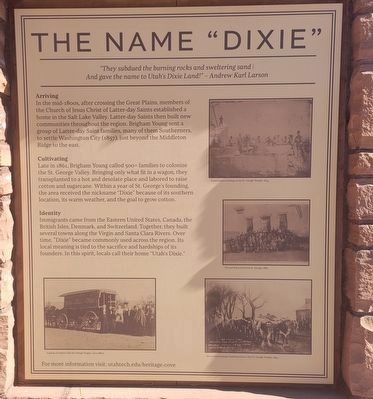
Photographed by Jeremy Snow, February 23, 2025
1. The Name Dixie Marker
"They subdued the burning rocks and sweltering sand! And gave the name to Utah's Dixie Land!" - Andrew Karl Larson
Arriving
In the mid-1800s, after crossing the Great Plains, members of the Church of Jesus Christ of Latter-day Saints established a home in the Salt Lake Valley. Latter-day Saints then built new communities throughout the region. Brigham Young sent a group of Latter-day Saint families, many of them Southerners, to settle Washington City (1857). just beyond the Middleton Ridge to the east.
Cultivating
Late in 1861, Brigham Young called 300 families to colonize the St. George Valley. Bringing only what fit in a wagon, they transplanted to a hot and desolate place and labored to raise cotton and sugarcane. Within a year of St. George's founding the area received the nickname "Dixie" because of its southern location, its warm weather, and the goal to grow cotton.
Identity
Immigrants came from the Eastern United States, Canada, the British Isles, Denmark, and Switzerland. Together, they built several towns along the Virgin and Santa Clara Rivers. Over time. "Dixie became commonly used across the region.
this page online
For more information visit: utahtech.edu/heritage-cove
Topics. This historical marker is listed in these topic lists: Immigration • Settlements & Settlers. A significant historical year for this entry is 1861.
Location. 37° 6.241′ N, 113° 33.92′ W. Marker is in St. George, Utah, in Washington County. It can be reached from East 300 North. Located in the Heritage Cove just east of the Utah Tech University Gardner Student Center. Touch for map. Marker is at or near this postal address: 975 E 300 North, Saint George UT 84770, United States of America. Touch for directions.

Regionally, this marker is in Color Country. It is also in the American Southwest, in the Mountain West, and on the Colorado Plateau. Globally, it is in North America, the Rocky Mountains, the Western Hemisphere, the Western World, and the Anglosphere. Historically, it finds itself in what was once New Spain and also Mexico’s Alta California.
Other nearby markers. At least 8 other markers are within walking distance of this
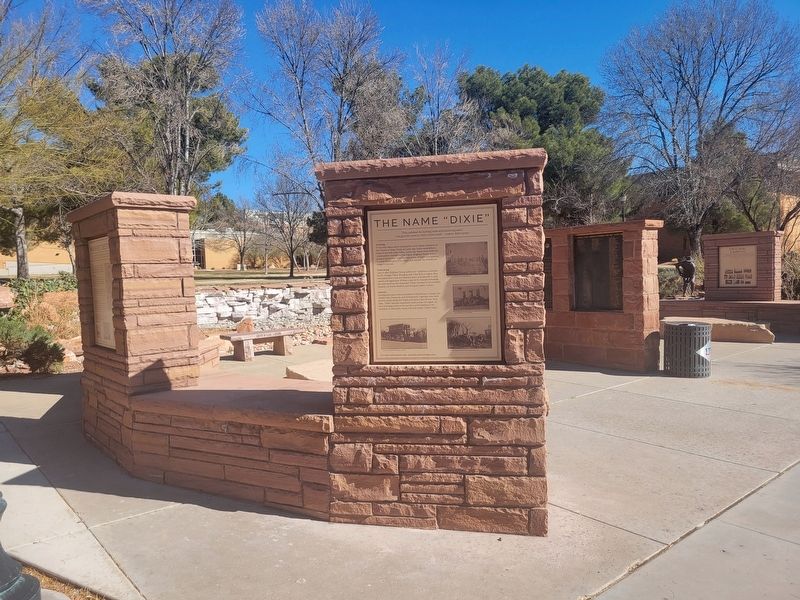
Photographed by Jeremy Snow, February 23, 2025
2. The Name Dixie Marker
Credits. This page was last revised on February 24, 2025. It was originally submitted on February 23, 2025, by Jeremy Snow of Cedar City, Utah. This page has been viewed 157 times since then and 56 times this year. Photos: 1, 2. submitted on February 23, 2025, by Jeremy Snow of Cedar City, Utah. • Andrew Ruppenstein was the editor who published this page.
