St. George in Washington County, Utah — The American Mountains (Southwest)
First Peoples
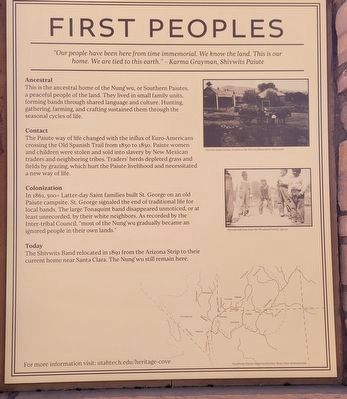
Photographed by Jeremy Snow, February 23, 2025
1. First Peoples Marker
"Our people have been here from time immemorial. We know the land. This is our home. We are tied to this earth."- Karma Grayman, Shivwits Paiute
Ancestral
This is the ancestral home of the Nung'wu, or Southern Paiutes, a peaceful people of the land. They lived in small family units, forming bands through shared language and culture. Hunting, gathering, farming, and crafting sustained them through the seasonal cycles of life.
Contact
The Paiute way of life changed with the influx of Euro-Americans crossing the Old Spanish Trail from 1830 to 1850. Paiute women and children were stolen and sold into slavery by New Mexican traders and neighboring tribes. Traders' herds depleted grass and fields by grazing, which hurt the Paiute livelihood and necessitated a new way of life.
Colonization
In 1861, 300+ Latter-day Saint families built St. George on an old Paiute campsite. St. George signaled the end of traditional life for local bands. The large Tonaquint band disappeared unnoticed, or at least unrecorded, by their white neighbors. As recorded by the Inter-tribal Council, "most of the Nung'wu gradually became an
this page online
Today
The Shivwits Band relocated in 1891 from the Arizona Strip to their current home near Santa Clara. The Nung'wu still remain here.
For more information visit: utahtech.edu/heritage-cove
Topics. This historical marker is listed in this topic list: Indigenous Peoples and Communities. A significant historical year for this entry is 1830.
Location. 37° 6.242′ N, 113° 33.917′ W. Marker is in St. George, Utah, in Washington County. It can be reached from East 300 North. Located in the Heritage Cove just east of the Utah Tech University Gardner Student Center. Touch for map. Marker is at or near this postal address: 975 E 300 North, Saint George UT 84770, United States of America. Touch for directions.

Regionally, this marker is in Color Country. It is also in the American Southwest, in the Mountain West, and on the Colorado Plateau. Globally, it is in North America, the Rocky Mountains, the Western Hemisphere, the Western World, and the Anglosphere. Historically, it finds itself in what was once New Spain and also Mexico’s Alta California.
Other nearby markers. At least 8 other markers
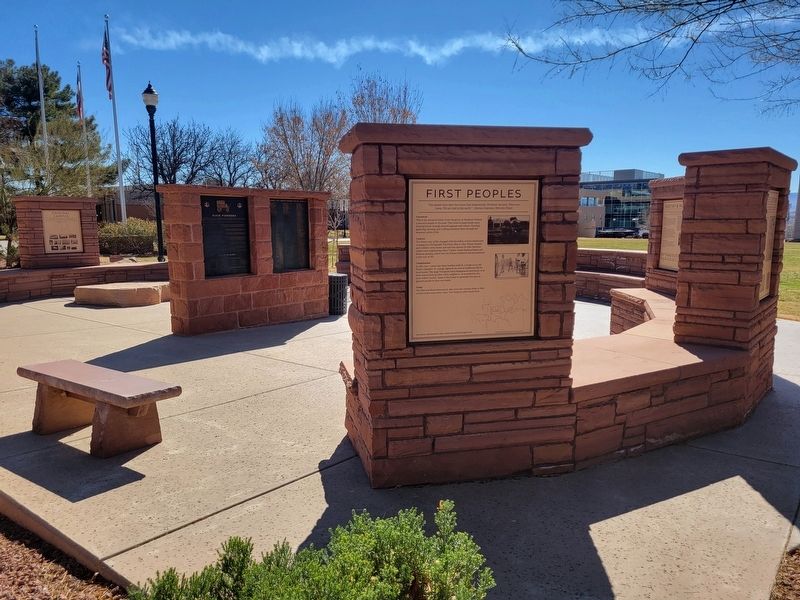
Photographed by Jeremy Snow, February 23, 2025
2. First Peoples Marker
Credits. This page was last revised on February 27, 2025. It was originally submitted on February 23, 2025, by Jeremy Snow of Cedar City, Utah. This page has been viewed 117 times since then and 23 times this year. Photos: 1, 2. submitted on February 23, 2025, by Jeremy Snow of Cedar City, Utah. • Andrew Ruppenstein was the editor who published this page.
