
Ludford in Shropshire, England, United Kingdom — Northwestern Europe (the British Isles)
Ludford Corner
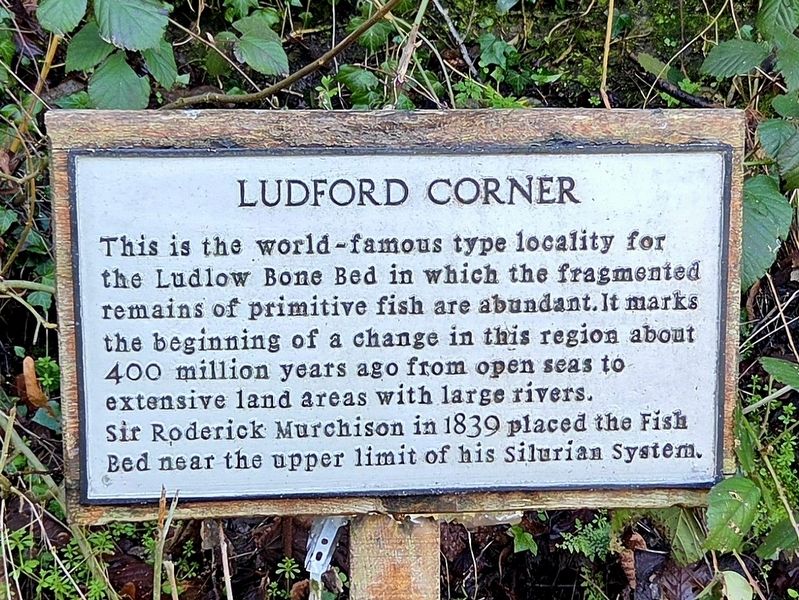
Photographed by Stephen Palmer, February 25, 2025
1. Ludford Corner Marker
This is the world-famous type locality for the Ludlow Bone Bed in which the fragmented remains of primitive fish are abundant. It marks the beginning of a change in this region about 400 million years ago from open seas to extensive land areas with large rivers. Sir Roderick Murchison in 1839 placed the Fish Bed near the upper limit of his Silurian System.
Topics. This historical marker is listed in these topic lists: Natural Features • Paleontology. A significant historical year for this entry is 1839.
Location. 52° 21.782′ N, 2° 43.058′ W. Marker is in Ludford, England, in Shropshire. It is at the intersection of Whitcliffe Road and Overton Road, on the right when traveling south on Whitcliffe Road. Marker is at the junction of Overton Road and Whitcliffe Road. Touch for map. Marker is at or near this postal address: 1 Whitcliffe Road, Ludford, England SY8 2HB, United Kingdom. Touch for directions.

Regionally, this marker is in England’s Midlands. It is also on the British Marches. Globally, it is on the Atlantic Ocean, in the North Atlantic Region, in Europe, in Atlantic Europe, on one of the
this page online
Other nearby markers. At least 8 other markers are within walking distance of this marker: The Broad Gate (approx. 0.3 kilometers away); Mary Edwards (approx. 0.4 kilometers away); No 49 Broad Street (approx. 0.4 kilometers away); Sir Caesar Hawkins (approx. 0.4 kilometers away); No 13 Broad Street (approx. half a kilometer away); Nos 56-58 Broad Street (approx. half a kilometer away); Dinham Hall (approx. half a kilometer away); The Croft (approx. half a kilometer away).
Also see . . . Geology (Friends of Whitcliff Common). Excerpt:
The banks of the Teme contain a number of geological sites of world importance, with the name ‘Ludlow’ being given to the period of geological time used throughout the world for strata laid down between 423 and 419 million years ago, towards the end of the period known as the Silurian.(Submitted on February 25, 2025.)
One of these, the Ludlow Bone Bed, is a layer of dark sand containing numerous remains of primitive fish, especially their scales, along with plant debris and insects. At the timeof its discovery this was believed to be the earliest evidence for life on land and taken as the base of the Devonian Period…Photographed by Stephen Palmer, February 25, 20252. Ludford Corner Marker

Credits. This page was last revised on February 25, 2025. It was originally submitted on February 25, 2025, by Stephen Palmer of Ascot, England. This page has been viewed 82 times since then and 8 times this year. Photos: 1, 2. submitted on February 25, 2025, by Stephen Palmer of Ascot, England. • Andrew Ruppenstein was the editor who published this page.
