Igel in Trier-Saarburg, Rhineland-Palatinate, Germany — Central Europe
Igel
Photographed by Andrew Ruppenstein, February 4, 2025
1. Igel Marker

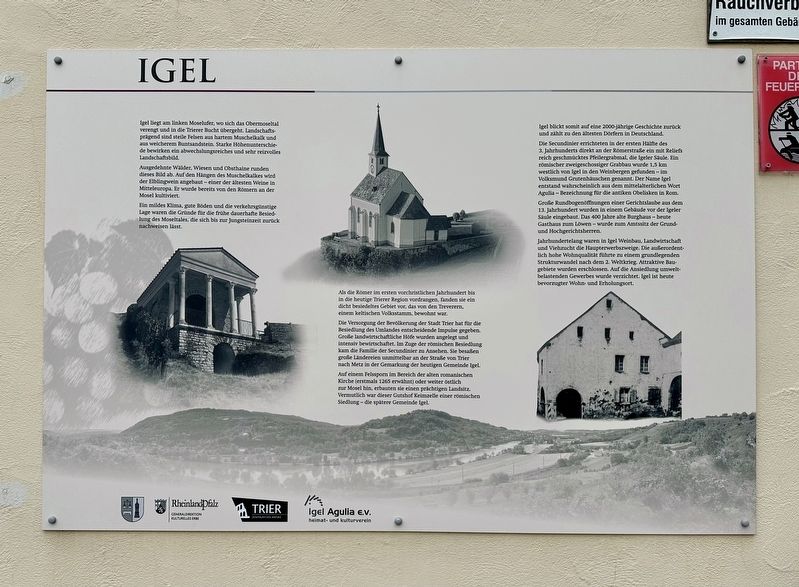
Ausgedehnte Wälder, Wiesen und Obsthaine runden dieses Bild ab. Auf den Hängen des Muschelkalkes wird der Elblingwein angebaut - einer der ältesten Weine in Mitteleuropa. Er wurde bereits von den Römern an der Mosel kultiviert.
Ein mildes Klima, gute Böden und die verkehrsgünstige Lage waren die Gründe für die frühe dauerhafte Besied lung des Moseltales, die sich bis zur Jungsteinzeit zurück nachweisen lässt.
Als die Römer im ersten vorchristlichen Jahrhundert bis in die heutige Trierer Region vordrangen, fanden sie ein dicht besiedeltes Gebiet vor, das von den Treveren. einem keltischen Volksstamm, bewohnt war.
Die Versorgung der Bevölkerung der Stadt Trier hat für die Besiedlung des Umlandes entscheidende Impulse gegeben. Große landwirtschaftliche Höfe wurden angelegt und intensiv bewirtschaftet.
this page online
Auf einem Felssporn im Bereich der alten romanischen Kirche (erstmals 1265 erwähnt) oder weiter östlich zur Mosel hin, erbauten sie einen prächtigen Landsitz. Vermutlich war dieser Gutshof Keimzelle einer römischen Siedlung - die spätere Gemeinde Igel.
Igel blickt somit auf eine 2000-jährige Geschichte zurück und zählt zu den ältesten Dörfern in Deutschland.
Die Secundinier errichteten in der ersten Hälfte des 3. Jahrhunderts direkt an der Römerstraße ein mit Reliefs reich geschmücktes Pfeilergrabmal, die Igeler Säule. Ein römischer zweigeschossiger Grabbau wurde 1,5 km westlich von Igel in den Weinbergen gefunden - im Volksmund Grutenhäuschen genannt. Der Name Igel entstand wahrscheinlich aus dem mittelalterlichen Wort Agulia - Bezeichnung für die antiken Obelisken in Rom.
Große Rundbogenöffnungen einer Gerichtslaube aus dem 13. Jahrhundert wurden in einem Gebäude vor der Igeler Säule eingebaut. Das 400 Jahre alte
Photographed by Andrew Ruppenstein, February 4, 2025
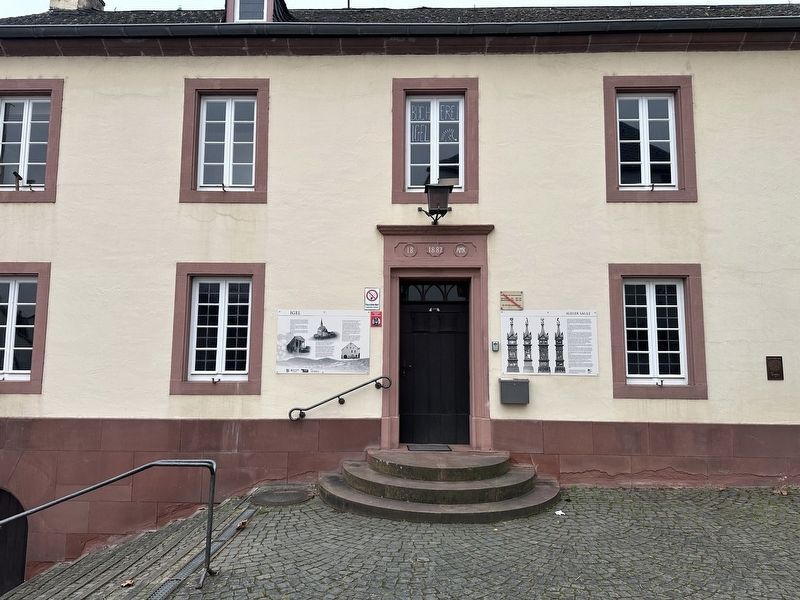
2. Igel Marker - wide view
Jahrhundertelang waren in Igel Weinbau, Landwirtschaft, und Viehzucht die Haupterwerbszweige. Die außerordentlich hohe Wohnqualität führte zu einem grundlegenden Strukturwandel nach dem 2. Weltkrieg. Attraktive Baugebiete wurden erschlossen. Auf die Ansiedlung umweltbelastenden Gewerbes wurde verzichtet. Igel ist heute bevorzugter Wohn- und Erholungsort.
Igel is located on the left bank of the Moselle, where the Upper Moselle valley narrows and merges into the Bay of Trier. The landscape is characterized by steep cliffs made of hard shell limestone and softer red sandstone. Strong differences in altitude create a varied and very attractive landscape.
Extensive forests, meadows and orchards complete this picture. Elbling wine is grown on the slopes of the Muschelkalk - one of the oldest wines in Central Europe. It was already cultivated by the Romans on the Moselle.
A mild climate, good soil and the convenient location were the reasons for the early permanent settlement of the Moselle valley, which can be traced
Photographed by Andrew Ruppenstein, February 4, 2025
3. Igel Marker - wider view
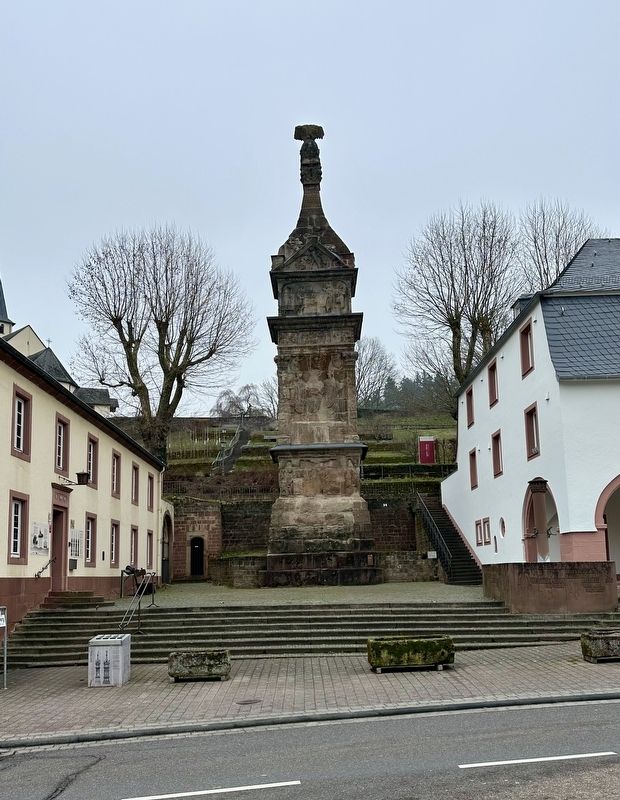
A wider view, with the marker visible on the left on the side of the town hall, and the Igel Column, a Roman funerary column (mentioned on the marker), in the center.
When the Romans advanced into the Trier region in the first century BC, they found a densely populated area inhabited by the Treveri, a Celtic tribe.
Supplying the population of the city of Trier provided a decisive impetus for the settlement of the surrounding area. Large agricultural farms were established and intensively cultivated. In the course of the Roman settlement, the Secundini family rose to prominence. They owned large estates directly on the road from Trier to Metz in the area of today's municipality of Igel.
They built a magnificent country estate on a rocky outcrop in the area of the old Romanesque church (first mentioned in 1265) or further east towards the Moselle. This estate was probably the nucleus of a Roman settlement - the later municipality of Igel.
Igel can therefore look back on 2000 years of history and is one of the oldest villages in Germany.
In the first half of the 3rd century, the Secundini erected a pillar tomb richly decorated with reliefs, the Igel Column, directly on the Roman road. A Roman two-storey tomb was found 1.5 km west of Igel in the vineyards - popularly known as the Grutenhäuschen. The name Igel probably comes from the medieval word Agulia - the name for the ancient obelisks in Rome.
Large round-arched openings of a courthouse from the 13th century were built into a building in front of the Igel Column. The 400-year-old castle house - today the Löwen Inn - became the official residence of the landowners and high court lords.
For centuries, wine-growing, agriculture and livestock farming were the main sources of income in Igel. The extraordinarily high quality of living led to a fundamental structural change after the Second World War. Attractive building areas were developed. The establishment of environmentally harmful businesses was avoided. Igel is now a popular place to live and relax.
Erected by Igel Agulia e.V.
Topics. This historical marker is listed in these topic lists: Agriculture • Notable Places.
Location. 49° 42.542′ N, 6° 32.967′ E. Marker is in Igel, Rheinland-Pfalz (Rhineland-Palatinate), in Trier-Saarburg. It is on Trierer Straße, on the right when traveling west. The marker is on the east side of the Igel town hall. Touch for map. Marker is at or near this postal address: Trierer Straße 39, Igel RP 54298, Germany. Touch for directions.

Regionally, this marker is in the German Rhineland and in the Moselle Valley. Globally, it is in Europe, the European Union, Atlantic Europe, Central Europe, the Schengen Area, Western Europe, and the Western World. Historically, it finds itself in what was once the Roman Empire, the Holy Roman Empire, and the former West Germany.
Other nearby markers. At least 8 other markers are within 8 kilometers of this marker, measured as the crow flies: Igeler Säule / Igel Column (here, next to this marker); Goetheplatz / Goethe Square (here, next to this marker); a different marker also named Igeler Säule / Igel Column (within shouting distance of this marker); Umfeldgestaltung Igeler Säule / Design of the Igel Column Surroundings (within shouting distance of this marker); Burghaus/Gasthaus “zum Löwen” / Castle House/Inn “zum Löwen” (about 90 meters away, measured in a direct line); Otto Rienermann (approx. 3.4 kilometers away in Luxembourg); Wartime Refuge Memorial (approx. 3.7 kilometers away in Luxembourg); Karl Marx (approx. 8 kilometers away). Touch for a list and map of all markers in Igel.
Also see . . . Dorfgeschichte (Igel Agulia e.V., in German). The local cultural/historical society’s history of the town. (Submitted on February 25, 2025.)
Credits. This page was last revised on February 25, 2025. It was originally submitted on February 25, 2025, by Andrew Ruppenstein of Lamorinda, California. This page has been viewed 123 times since then and 23 times this year. Photos: 1, 2, 3. submitted on February 25, 2025, by Andrew Ruppenstein of Lamorinda, California.
