Castro Pretorio in Roma in Città metropolitana di Roma Capitale, Latium, Rome, Italy — Central Italy (Tyrrhenian Coast)
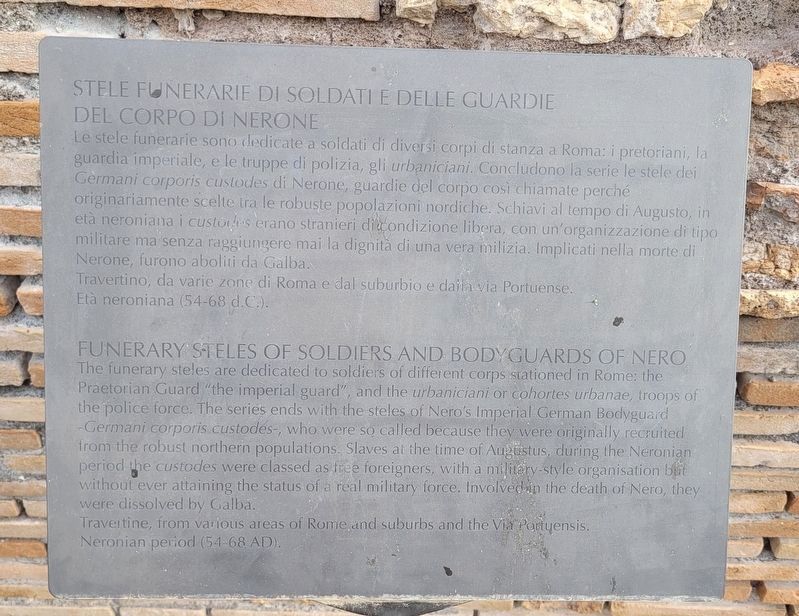
Stele Funerarie di Soldati e Delle Guardie del Corpo di Nerone
Funerary Steles of Soldiers and Bodyguards of Nero
Photographed by James Hulse, March 1, 2024
1. Funerary Steles of Soldiers and Bodyguards of Nero Marker

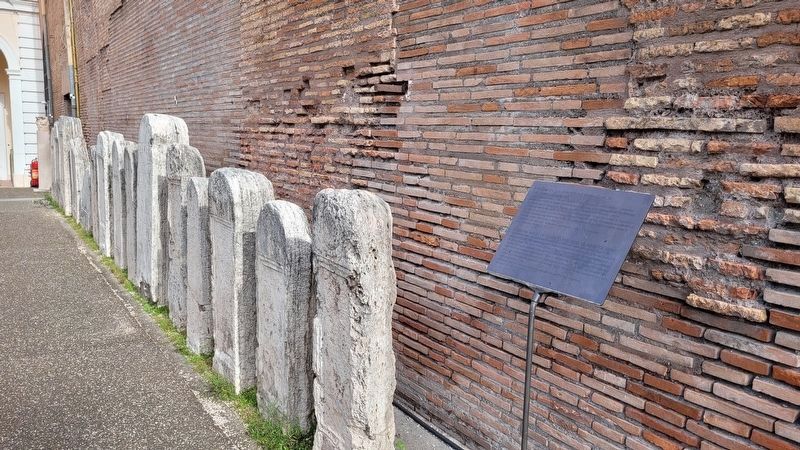
Le stele funerarie sono dedicate a soldati di diversi corpi di stanza a Roma: i pretoriani, la guardia imperiale, e le truppe di polizia, gli urbaniciani. Concludono la serie le stele dei Germani corporis custodes di Nerone, guardie del corpo così chiamate perché originariamente scelte tra le robuste popolazioni nordiche. Schiavi al tempo di Augusto, in eta neroniana i custodes erano stranieri di condizione libera, con un'organizzazione di tipo militare ma senza raggiungere mai la dignità di una vera milizia. Implicati nella morte di Nerone, furono aboliti da Galba.
Travertino, da varie zone di Roma e dal suburbio e daila via Portuense.
Età neroniana (54-68 d.C.).
The funerary steles are dedicated to soldiers of different corps stationed in Rome: the Praetorian Guard "the imperial guard", and the urbaniciani or cohortes urbanae, troops of the police force. The series ends with the steles of Nero's Imperial German Bodyguard -Germani corporis custodes-, who were so called because they were originally recruited from the robust northern populations. Slaves at the time of Augustus, during the
this page online
Travertine, from various areas of Rome and suburbs and the Via Partuensis.
Neronian period (54-68 AD).
Topics. This historical marker is listed in this topic list: Anthropology & Archaeology.
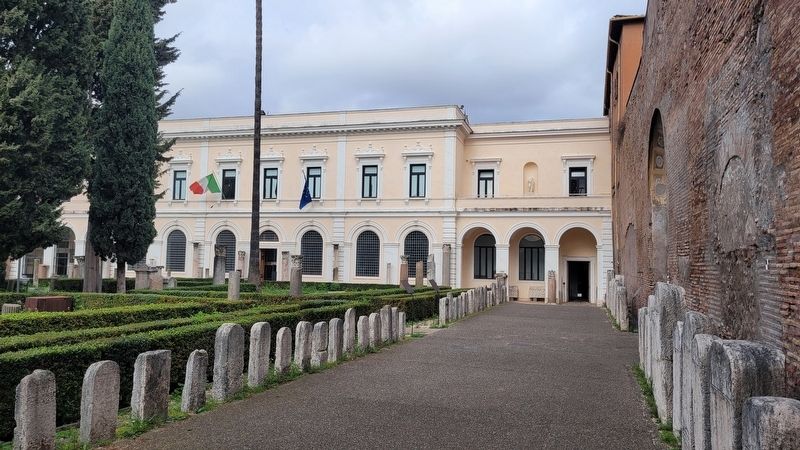
Location. 41° 54.215′ N, 12° 29.955′ E. Marker is in Roma, Lazio (Latium, Rome), in Città metropolitana di Roma Capitale. It is in Castro Pretorio. It is at the intersection of Viale Enrico de Nicola and Piazza dei Cinquecento on Viale Enrico de Nicola. The marker is located on the museum grounds of the Baths of Diocletian. Touch for map. Marker is at or near this postal address: Viale Enrico de Nicola 78, Roma, Lazio 00185, Italy. Touch for directions.

Regionally, it is in Europe, the European Union, the Schengen Area, a coastal Mediterranean country, and the Western World. Historically, it finds itself in what was once the Roman Empire.
Other nearby markers. At least
Photographed by James Hulse, March 1, 2024
2. The view of the Funerary Steles of Soldiers and Bodyguards of Nero with marker
More about this marker. There is a small fee to visit the Baths of Diocletian National Roman Museum.
Also see . . . Baths of Diocletian. Wikipedia
The Baths of Diocletian (Latin: Thermae Diocletiani, Italian: Terme di Diocleziano) were public baths in ancient Rome. Named after emperor Diocletian and built from AD 298 to 306, they were the largest of the imperial baths. The project was originally commissioned by Maximian(Submitted on March 1, 2025, by James Hulse of Medina, Texas.)upon his return to Rome in the autumn of 298 and was continued after his and Diocletian's abdication under Constantius, father of Constantine.Photographed by James Hulse, March 1, 20243. The view of the marble Funerary Steles in the garden
Credits. This page was last revised on March 2, 2025. It was originally submitted on March 1, 2025, by James Hulse of Medina, Texas. This page has been viewed 181 times since then and 20 times this year. Photos: 1, 2, 3. submitted on March 2, 2025, by James Hulse of Medina, Texas.
