Castro Pretorio in Roma in Città metropolitana di Roma Capitale, Latium, Rome, Italy — Central Italy (Tyrrhenian Coast)
Cratere Colossale
⎯⎯⎯
Colossal Krater
Photographed by James Hulse, March 1, 2024
1. Cratere Colossale / Colossal Krater Marker

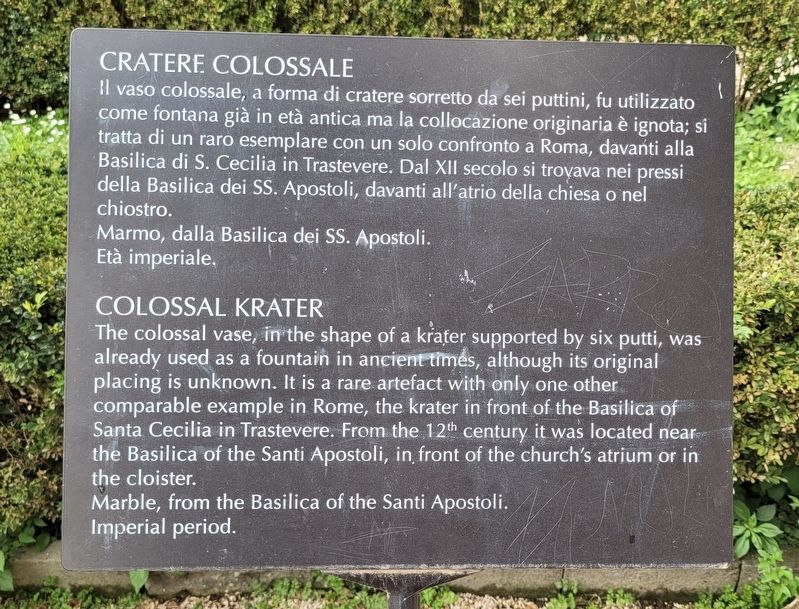
Il vaso colossale, a forma di cratere sorretto da sei puttini, fu utilizzato come fontana già in età antica ma la collocazione originaria è ignota; si tratta di un raro esemplare con un solo confronto a Roma, davanti alla Basilica di S. Cecilia in Trastevere. Dal XII secolo si trovava nei pressi della Basilica dei SS. Apostoli, davanti all'atrio della chiesa o nel chiostro.
Marmo, dalla Basilica dei SS. Apostoli.
Età imperiale.
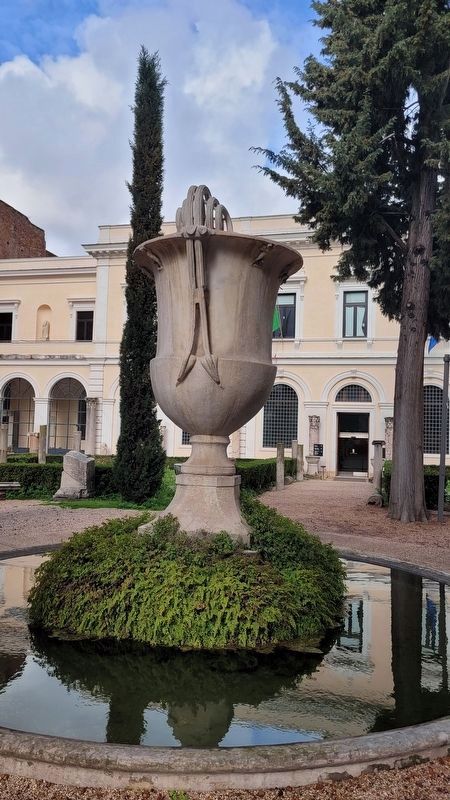
The colossal vase, in the shape of a krater supported by six putti, was already used as a fountain in ancient times, although its original placing is unknown. It is a rare artefact with only one other comparable example in Rome, the krater in front of the Basilica of Santa Cecilia in Trastevere. From the 12th century it was located near the Basilica of the Santi Apostoli, in front of the church's atrium or in the cloister.
Marble, from the Basilica of the Santi Apostoli.
Imperial period.
Topics. This historical marker is listed in these topic lists: Anthropology & Archaeology • Architecture.
Location. 41° 54.199′ N, 12° 29.939′ E.
this page online

Regionally, it is in Europe, the European Union, the Schengen Area, a coastal Mediterranean country, and the Western World. Historically, it finds itself in what was once the Roman Empire.
Other nearby markers. At least 8 other markers are within walking distance of this marker: Cippi Funerali / Tomb Markers (a few steps from this marker); Grandi Altari Funerari Iscritti / Large Inscribed Funerary Altars (a few steps from this marker); Altari Funerari Iscritti / Inscribed Funerary Altars (within shouting distance of this marker); Il Giardivο / The Garden (within shouting distance of this marker); a different marker also named Altari Funerari Iscritti / Inscribed Funerary Altars (within shouting distance of this
Photographed by James Hulse, March 1, 2024
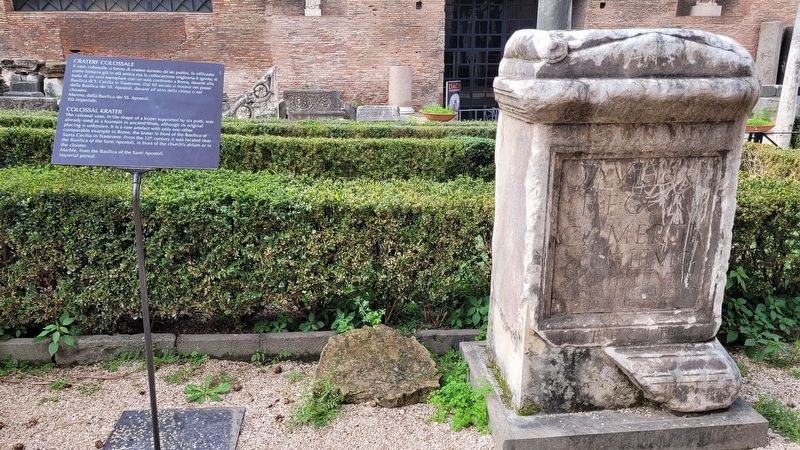
2. Cratere Colossale / Colossal Krater Marker
More about this marker. There is a small fee to visit the Baths of Diocletian National Roman Museum.
Also see . . . Baths of Diocletian. Wikipedia
The Baths of Diocletian (Latin: Thermae Diocletiani, Italian: Terme di Diocleziano) were public baths in ancient Rome. Named after emperor Diocletian and built from AD 298 to 306, they were the largest of the imperial baths. The project was originally commissioned by Maximian upon his return to Rome in the autumn of 298 and was continued after his and Diocletian's abdication under Constantius, father of Constantine.(Submitted on March 2, 2025, by James Hulse of Medina, Texas.)
Photographed by James Hulse, March 1, 2024
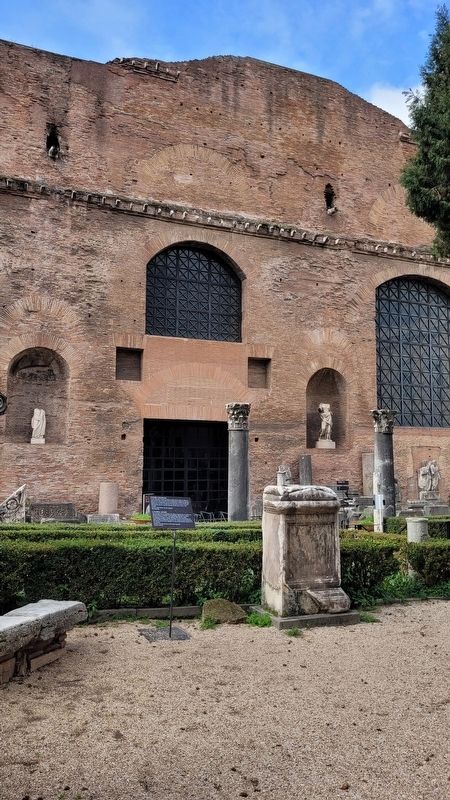
3. Cratere Colossale / Colossal Krater Marker
Photographed by James Hulse, March 1, 2024
4. The colossal vase
Credits. This page was last revised on March 4, 2025. It was originally submitted on March 2, 2025, by James Hulse of Medina, Texas. This page has been viewed 248 times since then and 49 times this year. Photos: 1, 2, 3, 4. submitted on March 4, 2025, by James Hulse of Medina, Texas.
