Castro Pretorio in Roma in Città metropolitana di Roma Capitale, Latium, Rome, Italy — Central Italy (Tyrrhenian Coast)
Le Colossali Teste Animali del Chiostro di Michelangelo
The Colossal Animal Heads of the Michelangelo's Cloister
Photographed by James Hulse, March 1, 2024
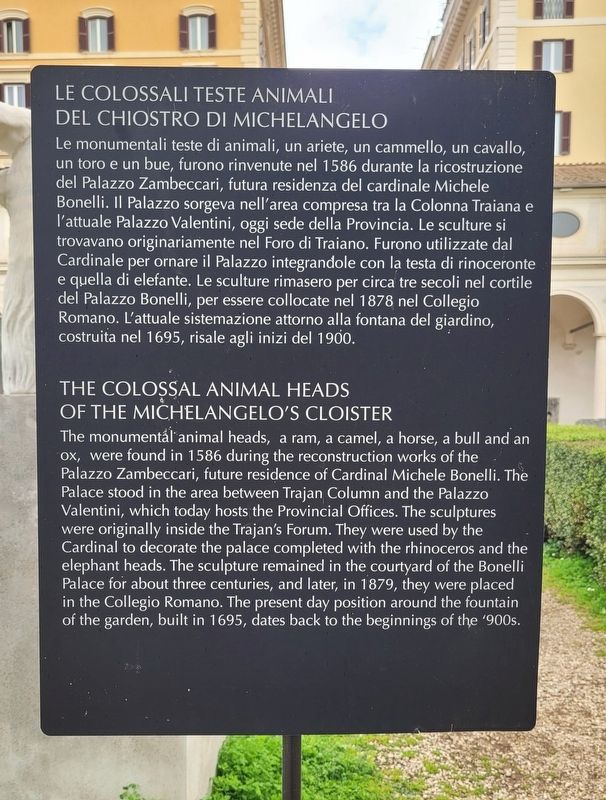
1. Le Colossali Teste Animali del Chiostro di Michelangelo Marker

Le monumentali teste di animali, un ariete, un cammello, un cavallo, un toro e un bue, furono rinvenute nel 1586 durante la ricostruzione del Palazzo Zambeccari, futura residenza del cardinale Michele Bonelli. Il Palazzo sorgeva nell'area compresa tra la Colonna Traiana e l'attuale Palazzo Valentini, oggi sede della Provincia. Le sculture si trovavano originariamente nel Foro di Traiano. Furono utilizzate dal Cardinale per ornare il Palazzo integrandole con la testa di rinoceronte e quella di elefante. Le sculture rimasero per circa tre secoli nel cortile del Palazzo Bonelli, per essere collocate nel 1878 nel Collegio Romano. L'attuale sistemazione attorno alla fontana del giardino, costruita nel 1695, risale agli inizi del 1900.
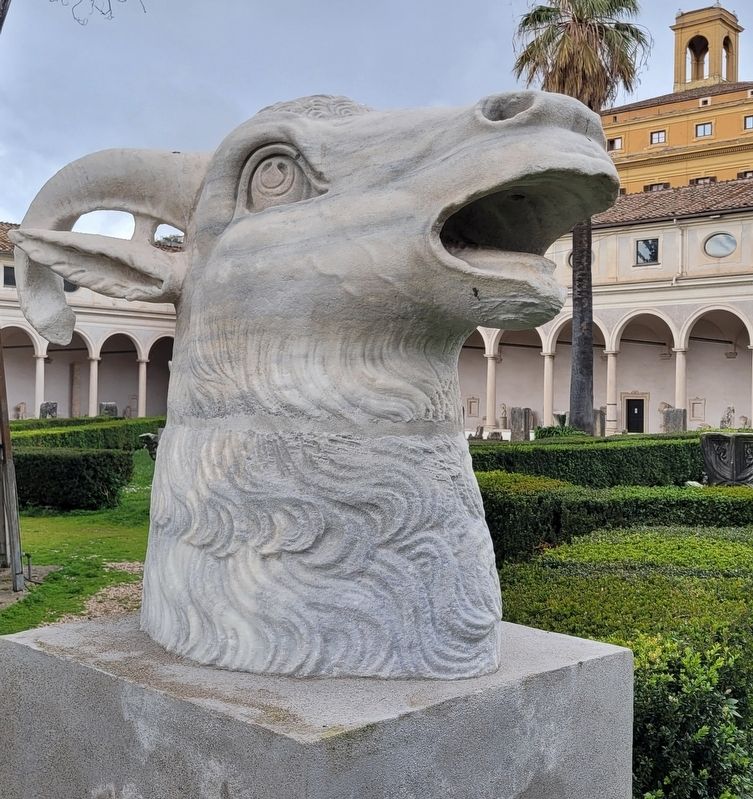
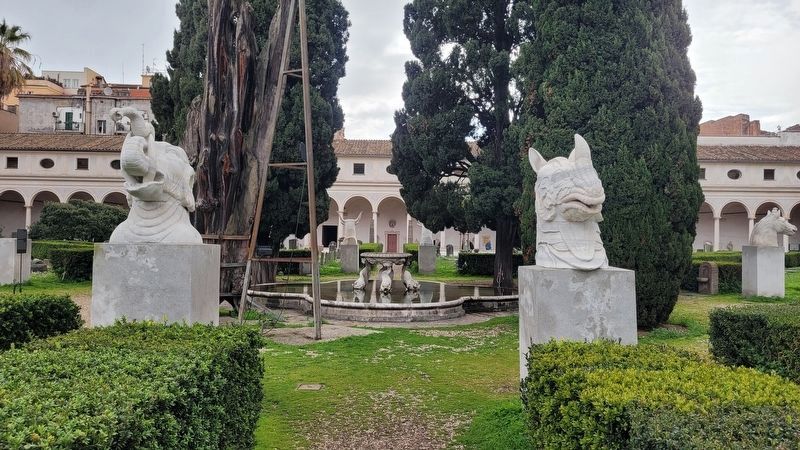
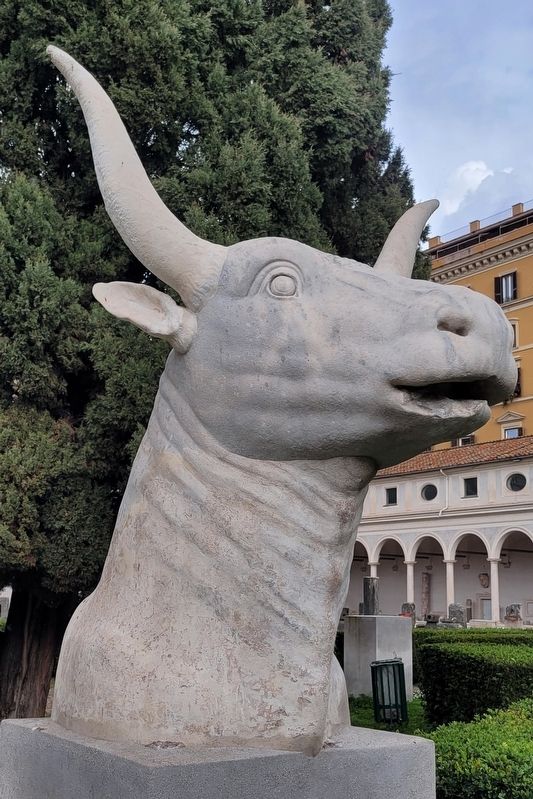
The monumental animal heads, a ram, a camel, a horse, a bull and an ox, were found in 1586 during the reconstruction works of the Palazzo Zambeccari, future residence of Cardinal Michele Bonelli. The Palace stood in the area between Trajan Column and the Palazzo Valentini, which today hosts the Provincial Offices. The sculptures were originally inside the Trajan's
this page online
Topics. This historical marker is listed in this topic list: Anthropology & Archaeology. A significant historical year for this entry is 1586.
Location. 41° 54.26′ N, 12° 29.906′ E. Marker is in Roma, Lazio (Latium, Rome), in Città metropolitana di Roma Capitale. It is in Castro Pretorio. It is at the intersection of Viale Enrico de Nicola and Piazza dei Cinquecento on Viale Enrico de Nicola. The marker is located on the museum grounds of the Baths of Diocletian. Touch for map. Marker is at or near this postal address: Viale Enrico de Nicola 78, Roma, Lazio 00185, Italy. Touch for directions.

Regionally, it is in Europe, the European Union, the Schengen Area, a coastal Mediterranean country, and the Western World. Historically, it finds itself in what was

Photographed by James Hulse, March 1, 2024
2. The Ram head and marker
Other nearby markers. At least 8 other markers are within walking distance of this marker: Sarcofagi / Sarcophagi (about 90 meters away, measured in a direct line); Aula VIII / Hall VIII (about 90 meters away); Vasche / Basins (about 90 meters away); Portale di Villa Panzani / Gateway of Villa Panzani (about 90 meters away); Stele Funerarie di Soldati e Delle Guardie del Corpo di Nerone (about 90 meters away); Cippi Funerari / Tomb Markers (about 120 meters away); Stele Funeraril / Funerary Steles (about 120 meters away); Grandi Altari Funerari Iscritti / Large Inscribed Funerary Altars (about 120 meters away). Touch for a list and map of all markers in Roma.
More about this marker. There is a small fee to visit the Baths of Diocletian National Roman Museum.
Also see . . . Baths of Diocletian. Wikipedia
The Baths of Diocletian (Latin: Thermae Diocletiani, Italian: Terme di Diocleziano) were public baths in ancient Rome. Named after emperor Diocletian and built from AD 298 to 306, they were the largest of the imperial baths. The project was originally commissioned by Maximian upon his return(Submitted on March 2, 2025, by James Hulse of Medina, Texas.)to Rome in the autumn of 298 and was continued after his and Diocletian's abdication under Constantius, father of Constantine.Photographed by James Hulse, March 1, 20243. Closeup of the Ram
Photographed by James Hulse, March 1, 2024
4. The rhinoceros and the elephant heads

Photographed by James Hulse, March 1, 2024
5. Closeup of the Horse
Photographed by James Hulse, March 1, 2024
6. Closeup of the Bull
Credits. This page was last revised on March 4, 2025. It was originally submitted on March 2, 2025, by James Hulse of Medina, Texas. This page has been viewed 226 times since then and 59 times this year. Photos: 1, 2, 3, 4, 5, 6. submitted on March 4, 2025, by James Hulse of Medina, Texas.
