Castro Pretorio in Roma in Città metropolitana di Roma Capitale, Latium, Rome, Italy — Central Italy (Tyrrhenian Coast)
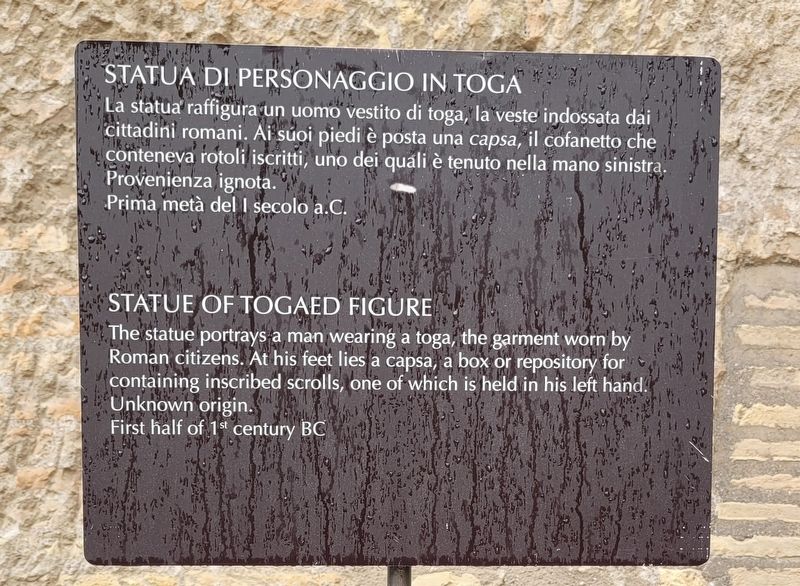
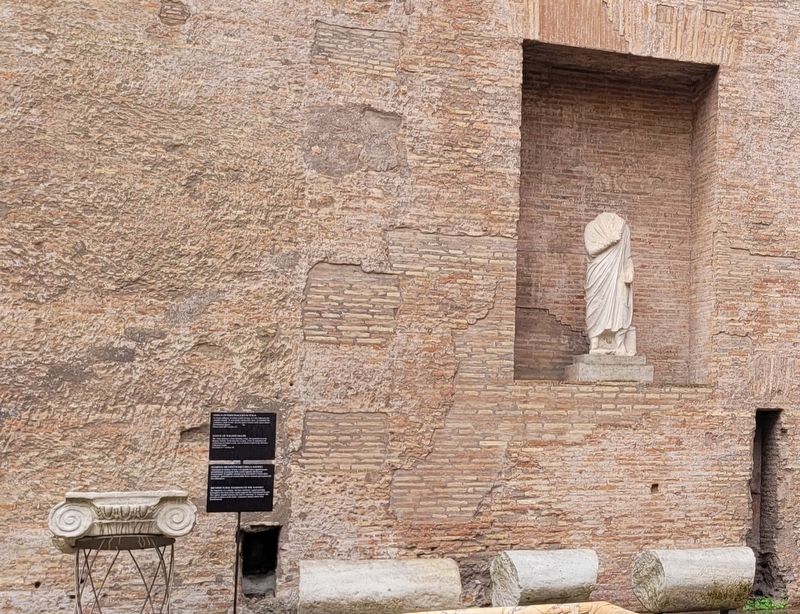
Statua di Personaggio in Toga
⎯⎯⎯
Statue of Togaed Figure
Photographed by James Hulse, March 1, 2024
1. Statua di Personaggio in Toga / Statue of Togaed Figure Marker

La statua raffigura un uomo vestito di toga, la veste indossata dai cittadini romani. Ai suoi piedi è posta una capsa, il cofanetto che conteneva rotoli iscritti, uno dei quali è tenuto nella mano sinistra.
Provenienza ignota.
Prima metà del I secolo a.C.
The statue portrays a man wearing a toga, the garment worn by Roman citizens. At his feet lies a capsa, a box or repository for containing inscribed scrolls, one of which is held in his left hand.
Unknown origin.
First half of 1st century BC
Topics. This historical marker is listed in this topic list: Anthropology & Archaeology.
Location. 41° 54.189′ N, 12° 29.892′ E. Marker is in Roma, Lazio (Latium, Rome), in Città metropolitana di Roma Capitale. It is in Castro Pretorio. It is at the intersection of Viale Enrico de Nicola and Piazza dei Cinquecento on Viale Enrico de Nicola. The marker is located on the museum grounds of the Baths of Diocletian. Touch for map. Marker is at or near this postal address: Viale Enrico de Nicola 78, Roma, Lazio 00185, Italy. Touch for directions.

Regionally,
this page online
Other nearby markers. At least 8 other markers are within walking distance of this marker: Elementi Architettonici Della Natatio / Architectural Elements of the Natatio (here, next to this marker); Elemento Architettonici delle Terme di Diocleziano (here, next to this marker); Portale della Certosa / The Charterhouse Gateway (a few steps from this marker); Natatio (a few steps from this marker); Portale di Villa Panzani / Gateway of Villa Panzani (within shouting distance of this marker); Vasche / Basins (within shouting distance of this marker); Aula VIII / Hall VIII (within shouting distance of this marker); Cippi Funerali / Tomb Markers (within shouting distance of this marker). Touch for a list and map of all markers in Roma.
More about this marker. There is a small fee to visit the Baths of Diocletian National Roman Museum.
Also see . . . Baths of Diocletian. Wikipedia
The Baths of Diocletian (Latin: Thermae Diocletiani, Italian:(Submitted on March 2, 2025, by James Hulse of Medina, Texas.)Terme di Diocleziano) were public baths in ancient Rome. Named after emperor Diocletian and built from AD 298 to 306, they were the largest of the imperial baths. The project was originally commissioned by Maximian upon his return to Rome in the autumn of 298 and was continued after his and Diocletian's abdication under Constantius, father of Constantine.Photographed by James Hulse, March 1, 20242. The Statue of Togaed Figure and Marker (top marker)
Credits. This page was last revised on March 4, 2025. It was originally submitted on March 2, 2025, by James Hulse of Medina, Texas. This page has been viewed 102 times since then and 18 times this year. Photos: 1, 2. submitted on March 4, 2025, by James Hulse of Medina, Texas.
