Grand Marais in Cook County, Minnesota — The American Midwest (Upper Plains)
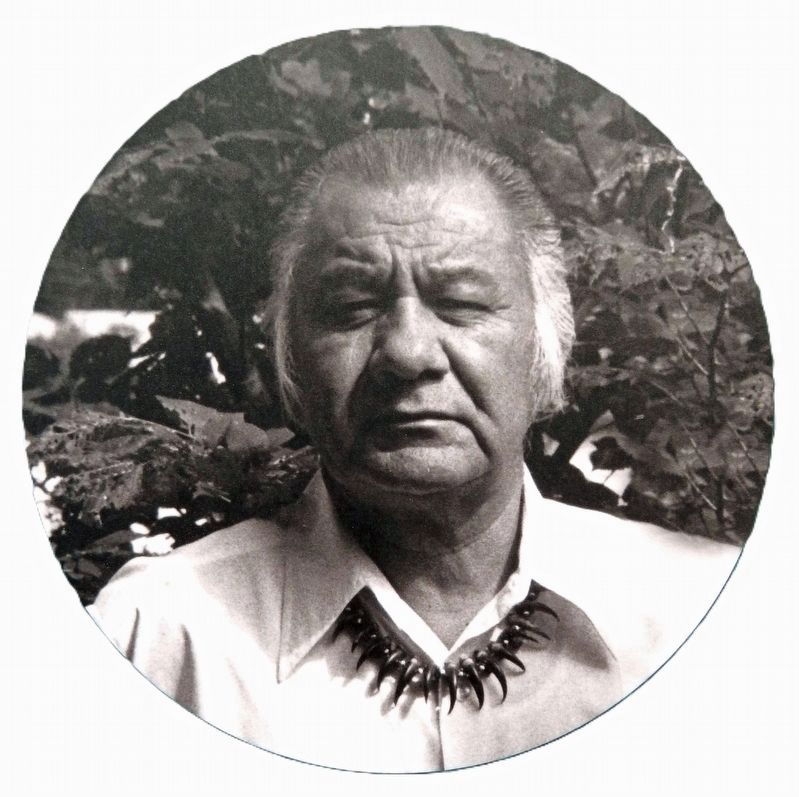
George Morrison

Photographed by Cosmos Mariner, June 22, 2024
1. George Morrison Marker
“I seek the power of the rock, the magic of the water, the religion of the tree, the color of the wind, and the enigma of the horizon.”
~George Morrison
George Morrison was a visionary, modern artist from the North Shore. He was given two Ojibwe names by Grand Portage elder Walter Caribou: Wah-wah-ta-ga-nah-gah-boo, Standing in the Northern Lights and Gwe-ki-ge-nah-gah-boo, Turning the Feather Around.
A teacher and inspiration for many, George was the first Native artist to have their work displayed at the White House, when Bill Clinton accepted his Red Totem in 1997. You can see another of George's Red Totems at Sawtooth Mountain Clinic in Grand Marais.
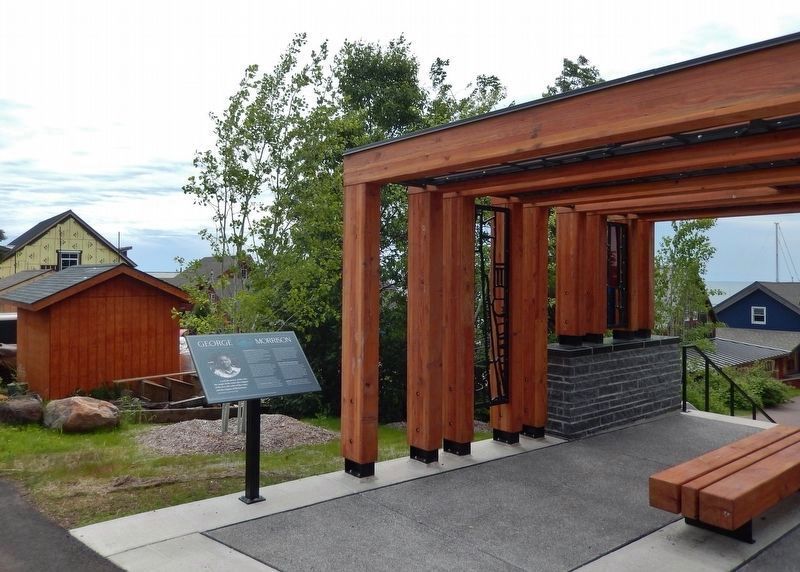
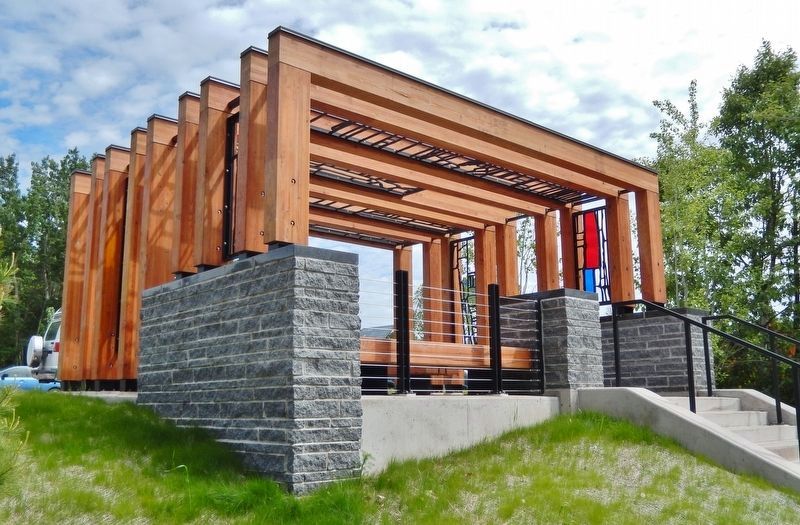
George's work with found, beach objects was the inspiration for the sculptural panels within the arbor here at the Overlook Landing. Inspired by Gichi-gamiing, the shapes and rhythms of the natural world are always present in George's work. He defined himself as “an artist who happened to be Indian,” saying, “Gradually, the landscape themes crept through into my art. The indirect influences of land, water, and wood. I have never tried to prove that I was Indian by doing baskets,
this page online
Born in 1919 at Nishkwakwansing — where the trees meet the water. Chippewa City was a fishing village, one mile east of Grand Marais where George grew up with eleven siblings. George and his brother Bernard were sent to BIA boarding school in Hayward, Wisconsin for a time. He returned to Grand Marais, and after graduating in 1938, studied at the Minneapolis School of Art.
Red Rock in Grand Portage is where George lived out his life and artistic vision, a place of reverence and beauty.
Topics and series. This historical marker is listed in these topic lists: Arts, Letters, Music • Education • Indigenous Peoples and Communities. In addition, it is included in the Former U.S. Presidents: #42 William Jefferson "Bill" Clinton series list. A significant historical year for this entry is 1919.
Location. 47° 44.95′ N, 90° 20.472′ W. Marker is in Grand Marais, Minnesota, in Cook County. It can be reached from Voyageur Highway (State Highway 61) just east of 6th Avenue West, on the right when traveling east. The marker is located at the Overlook Landing along the Gitchi Gami State Trail on the south side of Minnesota
Photographed by Victor A. Bloomfield
2. Marker detail: George Morrison
Courtesy Minnesota Historical Society.

Regionally, this marker is on the Boundary Waters Canoe Area Wilderness, in the Arrowhead Region, in the Iron Range, and in the North Shore. It is also in the American Midwest and in the Corn Belt. Globally, it is in North America, in the Great North Woods, on the Great Lakes, on Lake Superior’s North Shore, in the Western Hemisphere, in the Western World, and in the Anglosphere. Historically, it finds itself in what was once the Viceroyalty of New France, Rupert’s Land, the territory of the Mississippian Culture, and the Northwest Territory.
Other nearby markers. At least 8 other markers are within walking distance of this marker: Fish House Replica (about 600 feet away, measured in a direct line); The NEEGEE (about 600 feet away); Smokehouse (about 600 feet away); The Fishing Tug NeeGee (about 600 feet away); Geology of Minnesota (approx. 0.2 miles away); The Grand Marais Harbor (approx. 0.2 miles away); Pulpwood Rafting (approx. 0.4 miles away); Bally Blacksmith Shop (approx. 0.4
Photographed by Cosmos Mariner, June 22, 2024
3. George Morrison Marker
The marker is on the left, beside the Overlook Landing arbor.
Also see . . . George Morrison (Wikipedia).
Excerpt: George Morrison (September 30, 1919 – April 17, 2000) was an Ojibwe abstract painter and sculptor from Minnesota. Morrison's work is associated with the Abstract Expressionist movement in the United States.(Submitted on March 4, 2025, by Cosmos Mariner of Cape Canaveral, Florida.)
Between the 1940s through the 1960s, he worked and exhibited alongside Willem de Kooning, Franz Kline, and Jackson Pollock, among other contemporary American artists in New York City. Between 1970 and 1983, George Morrison taught studio art and Native American studies at the University of Minnesota. After retiring from teaching in 1983, he lived and worked at his home and studio in Grand Portage Indian Reservation by Lake Superior until his death in 2000.
In 2020, he became the first Native American artist to be included in the New York School collection of the National Gallery of Art in Washington, D.C. In 2022, Morrison's work was honored by the United States Postal Service with the release of a forever stamp series featuring five of his paintings.
Photographed by Cosmos Mariner, June 22, 2024
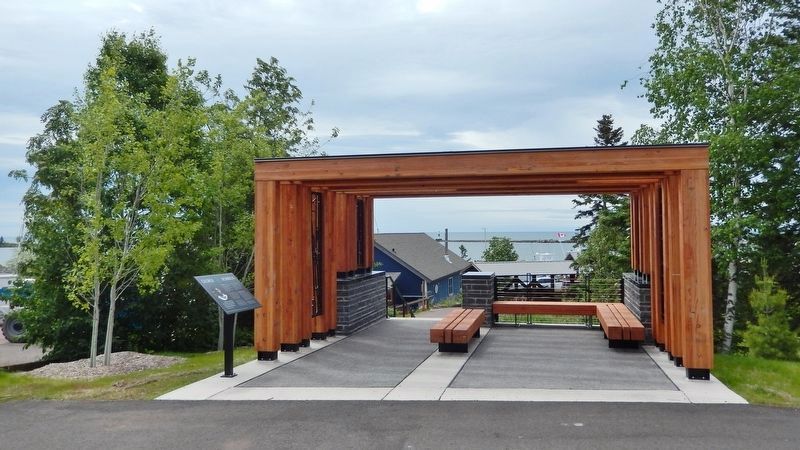
4. Overlook Landing
Looking south from the Gitchi Gami State Trail. Grand Marais Harbor can be seen in the distant background.
Photographed by Cosmos Mariner, June 22, 2024
5. George Morrison-inspired Arbor
Credits. This page was last revised on March 4, 2025. It was originally submitted on March 3, 2025, by Cosmos Mariner of Cape Canaveral, Florida. This page has been viewed 269 times since then and 50 times this year. Photos: 1. submitted on March 3, 2025, by Cosmos Mariner of Cape Canaveral, Florida. 2, 3, 4, 5. submitted on March 4, 2025, by Cosmos Mariner of Cape Canaveral, Florida.
