Downtown in Colorado Springs in El Paso County, Colorado — The American Mountains (Southwest)
tavachi : sun

Photographed by Cosmos Mariner, August 17, 2024
1. tavachi : sun Marker
(northwest corner of the Tava Quad)
(northwest corner of the Tava Quad)
The Nuúchi (Ute) People are the first inhabitants of this region, and are comprised of seven bands that historically lived here and in nearby areas of the Southwest: the Mouache and Caputa in the south; Weenuchiu to the west; the Parianuche, Yamparika, and Uintah to the north; and the Tabegauche in the central mountains.
Tavachi is the Nuúchi word for sun, which they believe is a powerful holy being that created all life. The Tabeguache refer to themselves as the "People of Sun Mountain" and called the majestic peak to the west Tavà Kaavi, or "sun mountain." Sun Mountain is sacred to the Nuúchi, and is where they once dwelled, hunted and gathered, and performed ceremonial traditions.
In the mid-19th century, the Nuúchi were constantly pressured to give up their land by white government agents, miners, and settlers. They finally agreed to a series of treaties that restricted them to reservations on a portion of their original homelands, but the U.S. government has not yet ratified the treaties. Though most of their land base was stolen and reduced over the centuries, the Nuúchi still live in vibrant and thriving communities
this page online
In 2019, the college named the entire greenspace you see before you Tava Quad in honor of the Nuúchi and in support and celebration of all Indigenous/Native People who come to learn, work, and live in the mountain's shadow. Colorado College currently sits on the unceded territory of the Nuúchi and the Abáachi Didé (Jicarilla Apache), Hinóno’éíno’ (Arapaho), Nūmūnūū (Comanche), and Tsétséhéstàhese (Cheyenne) Peoples, among other tribes who once called this region home.
Topics. This historical marker is listed in this topic list: Indigenous Peoples and Communities.
Location. 38° 50.917′ N, 104° 49.393′ W. Marker is in Colorado Springs, Colorado, in El Paso County. It is in Downtown. It can be reached from North Cascade Avenue just south of Uintah Street, on the right when traveling north. The marker is located beside the walkway on the north side of the Tava Quad, which is roughly at the center of the Colorado College campus. Touch for map. Marker is at or near this postal

Courtesy of Jeremy Wade Shockley/ The Southern Ute Drum
2. Marker detail: Nuúchi women perform in the tribe's annual Bear Dance
A ceremonial tradition to usher in the spring, 2019.

Regionally, this marker is in Colorado’s Front Range and in Pikes Peak Region. It is also in the American Mountain West. Globally, it is in North America, the Rocky Mountains, the Western Hemisphere, the Western World, and the Anglosphere. Historically, it finds itself in what was once the Comanchería.
Other nearby markers. At least 8 other markers are within walking distance of this marker: Palmer Hall (within shouting distance of this marker); Charles Leaming Tutt Jr. (about 300 feet away, measured in a direct line); Shove Memorial Chapel (about 400 feet away); Arthur House (about 700 feet away); Cutler Hall (about 700 feet away); Montgomery Hall (about 800 feet away); Lennox House (about 800 feet away); Ticknor Hall (about 800 feet away). Touch for a list and map of all markers in Colorado Springs.
More about this marker. There are three versions of this marker. Each one is placed at a different location around Colorado College’s Tava Quad. The photos on each marker are unique, but the inscription

Photographed by Cosmos Mariner, August 17, 2024
3. tavachi : sun Marker
(northwest corner of the Tava Quad)
(northwest corner of the Tava Quad)
Looking southeast through the Tava Quad.
Also see . . . Ute People (Wikipedia).
Excerpt: Historically, the Utes belonged to almost a dozen nomadic bands, who came together for ceremonies and trade. They also traded with neighboring tribes, including Pueblo peoples.(Submitted on March 5, 2025, by Cosmos Mariner of Cape Canaveral, Florida.)
The Utes' first contact with Europeans was with the Spanish in the 18th century. The Utes had already acquired horses from neighboring tribes by the late 17th century. They had limited direct contact with the Spanish but participated in regional trade.
Sustained contact with Euro-Americans began in 1847 with the arrival of the Mormons to the American West and the gold rushes of the 1850s. Utes fought to protect their homelands from invaders, and Brigham Young convinced U.S. President Abraham Lincoln to forcibly remove Utes in Utah to an Indian Reservation in 1864. Colorado Utes were forced onto a reservation in 1881.
Aside from their home domain, there were sacred places in present-day Colorado. The Tabeguache Ute's name for Pikes Peak is Tavakiev, meaning sun mountain. Living a nomadic hunter-gatherer lifestyle, summers were spent in the Pikes Peak area mountains,which was considered by other tribes to be the domain of the Utes. Pikes Peak was a sacred ceremonial area for the band.Photographed by Cosmos Mariner, August 17, 20244. tavachi : sun Marker
(southeast corner of the Tava Quad)


Denver Public Library; Western History Photographic Collections
5. Marker detail: Nuúchi men and a woman at their camp near Old Zoo Park, Colorado Springs
Tavà Kaavi (Pikes Peak) rises in the background, 1906.

Photographed by Cosmos Mariner, August 17, 2024
6. tavachi : sun Marker
(southeast corner of the Tava Quad)
(southeast corner of the Tava Quad)
Looking northwest through the Tava Quad.

Photographed by Cosmos Mariner, August 17, 2024
7. tavachi : sun Marker
(southwest corner of the Tava Quad)
(southwest corner of the Tava Quad)

Denver Public Library; Western History Photographic Collections
8. Marker detail: Group of Nuúchi People
Including “Buckskin Charley,” Chief of the Mouache Band (back row, second from left), 1899.
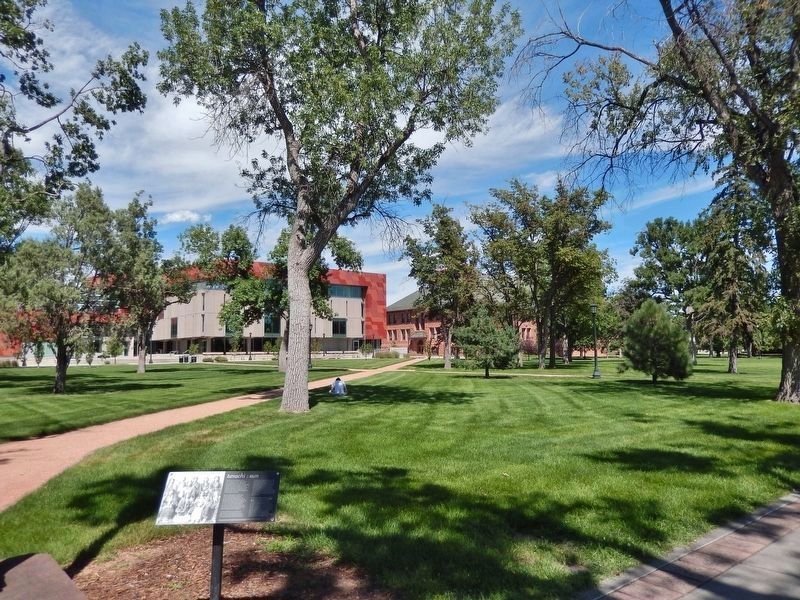
Photographed by Cosmos Mariner, August 17, 2024
9. tavachi : sun Marker
(southwest corner of the Tava Quad)
(southwest corner of the Tava Quad)
Looking northeast through the Tava Quad.
Credits. This page was last revised on August 2, 2025. It was originally submitted on March 5, 2025, by Cosmos Mariner of Cape Canaveral, Florida. This page has been viewed 214 times since then and 50 times this year. Photos: 1, 2, 3, 4, 5, 6, 7, 8, 9. submitted on March 5, 2025, by Cosmos Mariner of Cape Canaveral, Florida.
Editor’s want-list for this marker. The other markers on the quad. (Each should have its own profile.) • Can you help?
