Toms Brook in Shenandoah County, Virginia — The American South (Mid-Atlantic)
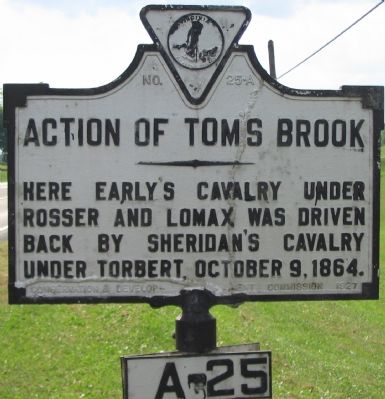
Action of Toms Brook

Photographed by Guy White, May 15, 2026
1. Action of Toms Brook Marker
Erected 1927 by Conservation & Development Commission. (Marker Number A-25.)
Topics and series. This historical marker is listed in this topic list: War, US Civil. In addition, it is included in the Virginia Department of Historic Resources (DHR) series list. A significant historical date for this entry is October 9, 1864.
Location. 38° 56.525′ N, 78° 26.81′ W. Marker is in Toms Brook, Virginia, in Shenandoah County. It is on Valley Pike (U.S. 11), on the right when traveling south. Touch for map. Marker is in this post office area: Toms Brook VA 22660, United States of America. Touch for directions.

Regionally, this marker is in the Shenandoah Valley. It is also in the American South, specifically in the Upper South, and in the Mid-Atlantic. Globally, it is in North America, the Western Hemisphere, the Western World, and the Anglosphere. Historically, it finds itself in what was once the territory of the Mississippian Culture, one of the original Thirteen Colonies, one of the Confederate States of America,
this page online
Other nearby markers. At least 8 other markers are within 4 miles of this marker, measured as the crow flies: A different marker also named Toms Brook (approx. 0.6 miles away); Shenandoah County Farm and Alms House (approx. 0.8 miles away); Battle of Fisher's Hill (approx. 2.3 miles away); "Snapp House" (approx. 2.4 miles away); a different marker also named Battle of Fisher's Hill (approx. 3.2 miles away); a different marker also named Battle of Fisher's Hill (approx. 3.3 miles away); The Vulnerable Left Flank (approx. 3.4 miles away); Crook's Attack (approx. 3½ miles away).
Other markers no longer nearby. Toms Brook (was approx. 0.4 miles away but has been replaced with another marker now near it); Fisher’s Hill (was approx. 3.4 miles away but has been permanently removed); a different marker also named Fisher’s Hill (was approx. 3.4 miles away but has been permanently removed).
More about this marker. The marker is labeled with both the "old" and "new" sequence numbers of "25-A" on the marker text plate, and "A-25" on the plate below the marker. The submitter has opted to use the designation
Photographed by Craig Swain, October 7, 2007
2. Action of Toms Brook Marker
Related markers. Click here for a list of markers that are related to this marker. To better understand the relationship, study each marker in the order shown.
Also see . . . Battle of Toms Brook. From The Civil War in the Shenandoah Valley. (Submitted on October 13, 2007, by Craig Swain of Leesburg, Virginia.)
Additional commentary.
1. Early's Cavalry
Rosser commanded the "Laurel Brigade" which had originally been Ashby's cavalry. The unit had seen action in the Shenandoah Valley from 1861, and widely considered as one of the best available in the Army of Northern Virginia. However, by 1864 the Federal cavalry had grown in size, confidence, and competency, thus was often getting the better of the Confederates. Toms Brook was an example of that. Confederate General Jubal Early, commanding the southern forces in the Valley in 1864, had grown to disdain his cavalry as ineffective. After the battle of Toms Brook which precipitated "the Woodstock Races" (See related marker), Early would comment, "I never knew the laurel was a
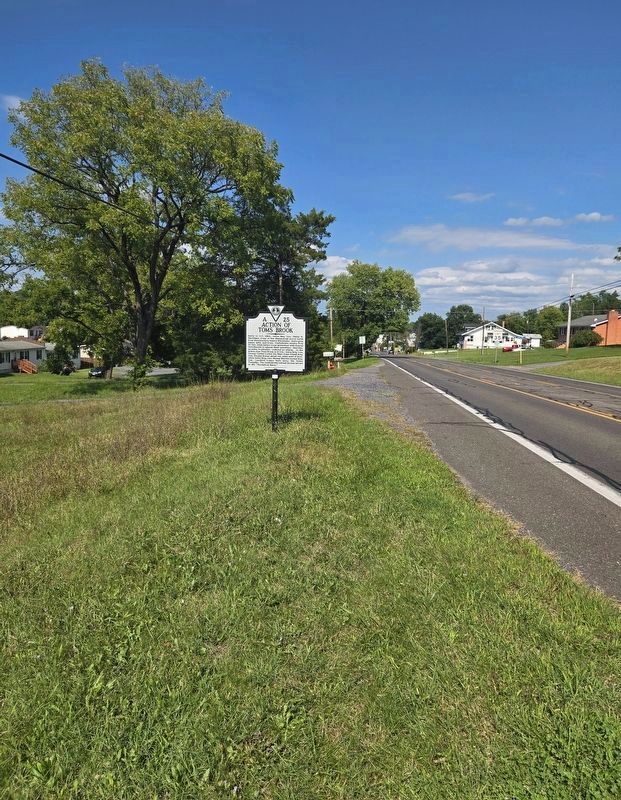
Photographed by Bradley Owen, August 29, 2026
3. Action of Toms Brook Marker
View is looking north.
— Submitted October 13, 2007, by Craig Swain of Leesburg, Virginia.
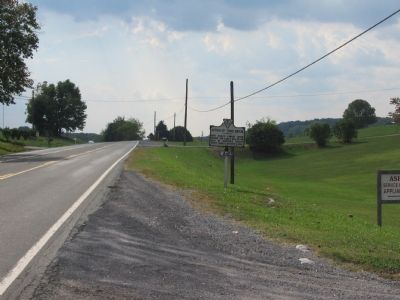
Photographed by Craig Swain, October 7, 2007
4. Action of Toms Brook Marker
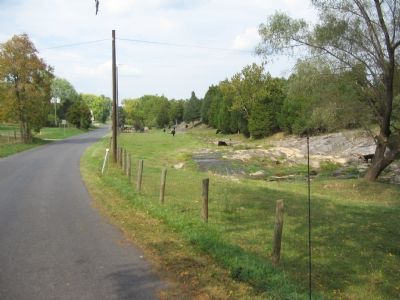
Photographed by Craig Swain, October 7, 2007
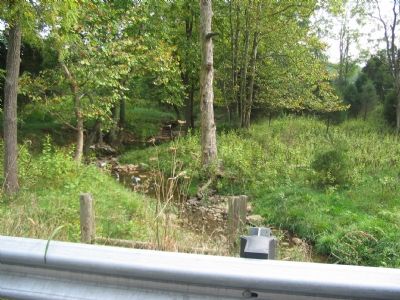
5. Toms Brook
Seen just to the west of the marker, Toms Brook did not present a major impediment to movement at the time, but did geographically separate the two forces at the start of the battle.
Photographed by Craig Swain, October 7, 2007
6. Custer and Rosser
Some two and a half miles west, where Back Road (County Route 623) crosses Toms Brook, Federals under Gen. Custer and Confederates under Gen. Rosser clashed. Both sides fought dismounted, taking cover behind the many stone walls along the farms and pastures in the vicinity. Part of Gen. Merritt's Federals were detached to support Custer, enabling an extension of the Union lines, eventually outflanking Rosser's Confederates. Rosser first attempted to refuse his left to counter this threat. This shortly turned into a general retreat when pressed from both front and flanks by the combined Federal force. All the while, Gen. Lomax's Confederate cavalry was similarly pressed to retreat by Federal forces along the Valley Pike (US 11).
Credits. This page was last revised on September 1, 2026. It was originally submitted on October 13, 2007, by Craig Swain of Leesburg, Virginia. This page has been viewed 2,340 times since then and 59 times this year. Last updated on March 5, 2025, by Carl Gordon Moore Jr. of North East, Maryland. Photos: 1. submitted on May 16, 2026, by Guy White of Annandale, Virginia. 2. submitted on October 13, 2007, by Craig Swain of Leesburg, Virginia. 3. submitted on September 1, 2026, by Bradley Owen of Morgantown, West Virginia. 4, 5, 6. submitted on October 13, 2007, by Craig Swain of Leesburg, Virginia. • Bernard Fisher was the editor who published this page.
