Near Boiling Spring Lakes in Brunswick County, North Carolina — The American South (South Atlantic)
Stamp Act
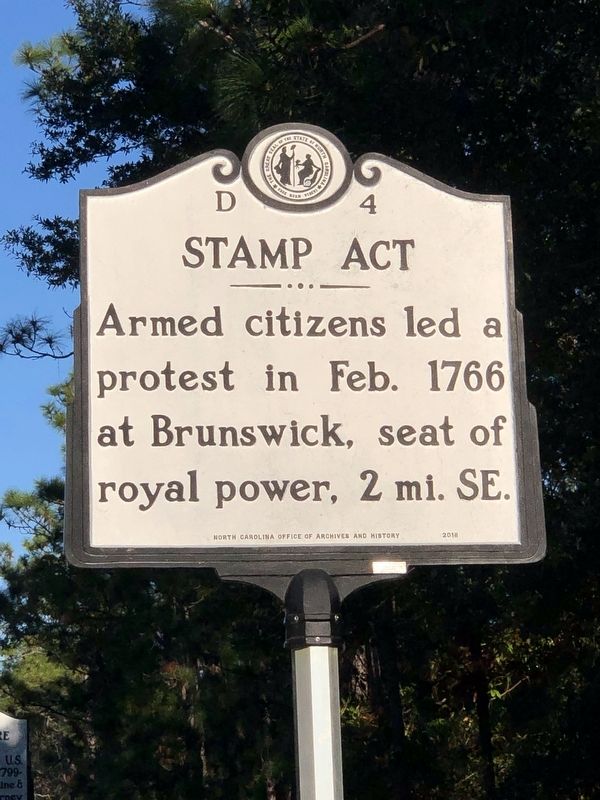
Photographed by Duane and Tracy Marsteller, November 25, 2024
1. Stamp Act Marker
Erected 2018 by North Carolina Office of Archives and History. (Marker Number D-4.)
Topics and series. This historical marker is listed in these topic lists: Colonial Era • Government & Politics. In addition, it is included in the North Carolina Division of Archives and History series list. A significant historical month for this entry is February 1766.
Location. 34° 3.791′ N, 77° 57.906′ W. Marker is near Boiling Spring Lakes, North Carolina, in Brunswick County. It is on River Road Southeast (North Carolina Route 133) south of Orton Road Southeast, on the left when traveling south. Touch for map. Marker is in this post office area: Winnabow NC 28479, United States of America. Touch for directions.

Regionally, this marker is in the Coastal Plain and on the Cape Fear Coast. It is also in the American South, specifically in the Upper South, in the Tidewater, and on the Eastern Seaboard. Globally, it is in the North Atlantic Region, North America, the Western Hemisphere, the Western World, and the Anglosphere. Historically,
this page online
Other nearby markers. At least 8 other markers are within 2 miles of this marker, measured as the crow flies: Alfred Moore (a few steps from this marker); St. Philips Church (within shouting distance of this marker); Orton Plantation (approx. 0.3 miles away); Spanish Attack (approx. 0.6 miles away); Arthur Dobbs (approx. 0.7 miles away); Brunswick (approx. 0.7 miles away); Fort Anderson (approx. ¾ mile away); Russellborough (approx. 1.6 miles away).
Also see . . . Early Revolutionaries. Brunswick Town holds the distinction in American history of being the site of one of the first armed resistances to British colonial policies, including taxation and other legislation that the American colonists felt infringed upon their freedoms as British citizens. One such hated legislation was the Stamp Act in 1765. (North Carolina Division of State Historic Sites and Properties) (Submitted on March 5, 2025, by Duane and Tracy Marsteller of Murfreesboro, Tennessee.)
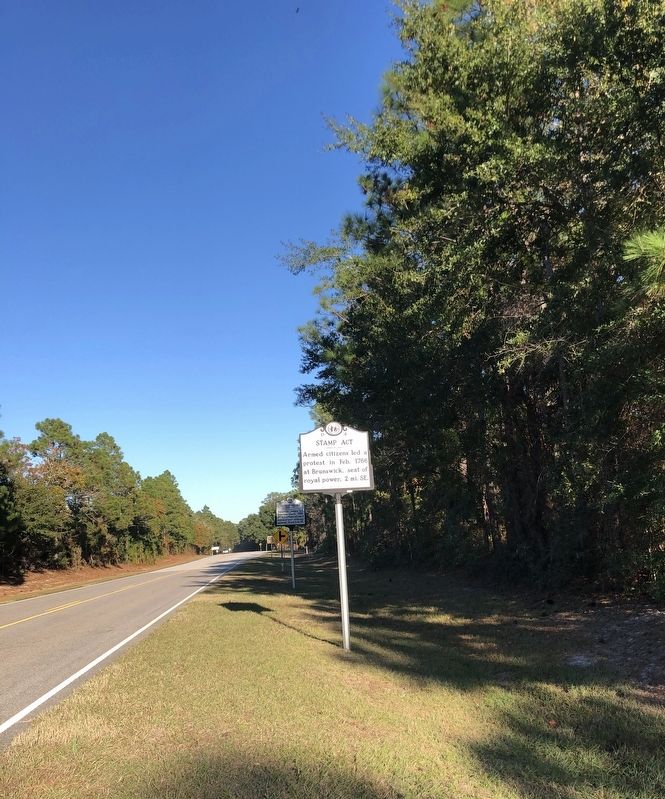
Photographed by Duane and Tracy Marsteller, November 25, 2024
2. Stamp Act Marker
Credits. This page was last revised on March 5, 2025. It was originally submitted on March 5, 2025, by Duane and Tracy Marsteller of Murfreesboro, Tennessee. This page has been viewed 150 times since then and 15 times this year. Photos: 1, 2. submitted on March 5, 2025, by Duane and Tracy Marsteller of Murfreesboro, Tennessee.
