Downtown in Asheville in Buncombe County, North Carolina — The American South (South Atlantic)
Historical Black Churches in Asheville
1832-1898
| — | Black Cultural Heritage Trail | — |

Photographed by Mark Parker, March 4, 2025
1. Historical Black Churches in Asheville Marker. Mt Zion Baptist Church in the background
Churches and schools have always been vital public institutions in Black communities. Church picnics, suppers, and food and clothing drives foster community support. While Jim Crow laws and segregation denied Black citizens equal rights, church leaders advanced civil rights through sermons, voter registration drives, and interdenominational collaboration.
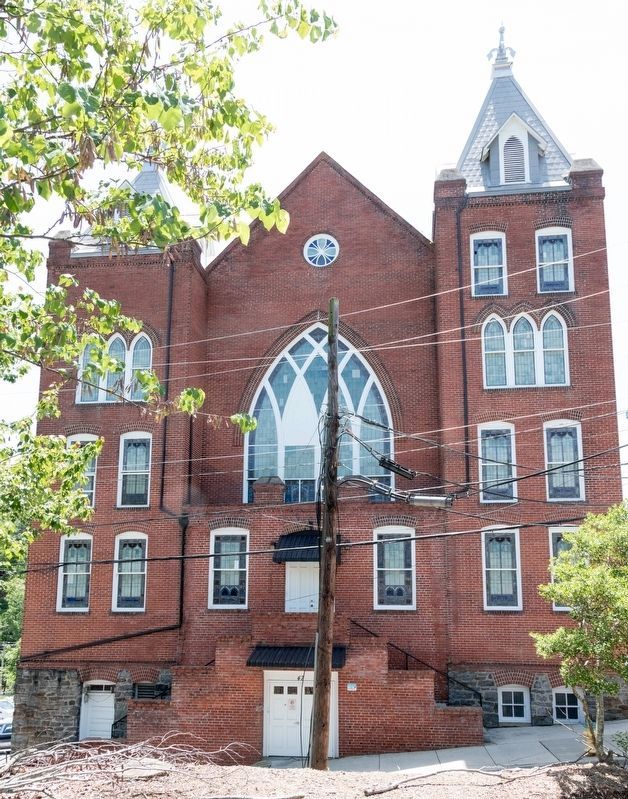
Mt. Zion Missionary Baptist Church was founded in 1880 by Reverend Robert Rumley. Its second minister, J.R. Nelson, negotiated to purchase property for a new church at the corner of Spruce and Eagle streets. In 1919, master brick mason James Vester Miller, a formerly enslaved man, completed the building for the congregation.
Early churches with Black congregants founded in Asheville
• 1832: Trinity Chapel now St. Matthias Episcopal Church
• 1867: Nazareth First Baptist Church
• 1868: Hopkins Chapel AME Zion Church
• 1880: Mt Zion Missionary Baptist Church
• 1887: Berry Temple United Methodist Church & St James AME Church
• 1891 Calvary Presbyterian Church
• 1898 Rock Hill Missonary Baptist Church
[Captions:]
Top: This photo depicts a man at a church
this page online
1950 Scenes like this were common as church congregations socialized after the service in Asheville (ca. 1950). Isaiah Rice Photograph Collection, D. Hiden Ramsey Library Special Collections, University of North Carolina Asheville, Asheville, NC
1958 This photo shows a view of the area around Mt. Zion Missionary Baptist Church from the top of City Hall (1958). Isaiah Rice Photograph Collection, D. Hiden Ramsey Library Special Collections, University of North Carolina Asheville, Asheville, NC
1960s This photo depicts a couple dressed for church in Asheville (ca. 1960s). Isaiah Rice Photograph Collection, D. Hiden Ramsey Library Special Collections, University of North Carolina Asheville, Asheville, NC
2021 Hopkins Chapel AME Zion Church was the second of the four churches constructed in the East End neighborhood by builder and brick artisan James Vester Miller. Photo courtesy of Reggie Tidwell (Marker Number D-3.)
Topics and series. This historical

Photographed by J. J. Prats, May 17, 2025
2. Historical Black Churches in Asheville Marker
Location. 35° 35.654′ N, 82° 32.975′ W. Marker is in Asheville, North Carolina, in Buncombe County. It is in Downtown. It is at the intersection of Eagle Street and South Spruce Street, on the right when traveling west on Eagle Street. Touch for map. Marker is at or near this postal address: 40 Eagle St, Asheville NC 28801, United States of America. Touch for directions.

Regionally, this marker is in the Mountains. It is also in the American South, specifically in the Upper South, in Appalachia, and specifically in Southern Appalachia. Globally, it is in North America, the Western Hemisphere, the Western World, and the Anglosphere. Historically, it finds itself in what was once the original Cherokee Nation, the territory of the Mississippian Culture, one of the original Thirteen Colonies, one of the Confederate States
Photographed by J. J. Prats, May 17, 2025
3. Mt. Zion Missionary Baptist Church of Asheville
Other nearby markers. At least 8 other markers are within walking distance of this marker: Mt. Zion Missionary Baptist Church (within shouting distance of this marker); "The Block" (within shouting distance of this marker); The YMI & William and Georgia Roland (about 300 feet away, measured in a direct line); James Vester Miller (about 300 feet away); Brick Artisan (about 300 feet away); Asheville's Enslaved People (about 400 feet away); Young Men’s Institute (about 400 feet away); Stephens - Lee H.S. Educates Legends and Heroes (about 400 feet away). Touch for a list and map of all markers in Asheville.
Credits. This page was last revised on July 16, 2025. It was originally submitted on March 5, 2025, by Mark Parker of Hickory, North Carolina. This page has been viewed 327 times since then and 44 times this year. Photos: 1. submitted on March 5, 2025, by Mark Parker of Hickory, North Carolina. 2, 3. submitted on June 2, 2025, by J. J. Prats of Powell, Ohio. • Devry Becker Jones was the editor who published this page.
