East End in Asheville in Buncombe County, North Carolina — The American South (South Atlantic)
Isaac Dickson and the Historical East End Neighborhood
| — | Black Cultural Heritage Trail | — |
Photographed by Terry Price, January 26, 2024
1. Isaac Dickson and the Historical East End Neighborhood Marker
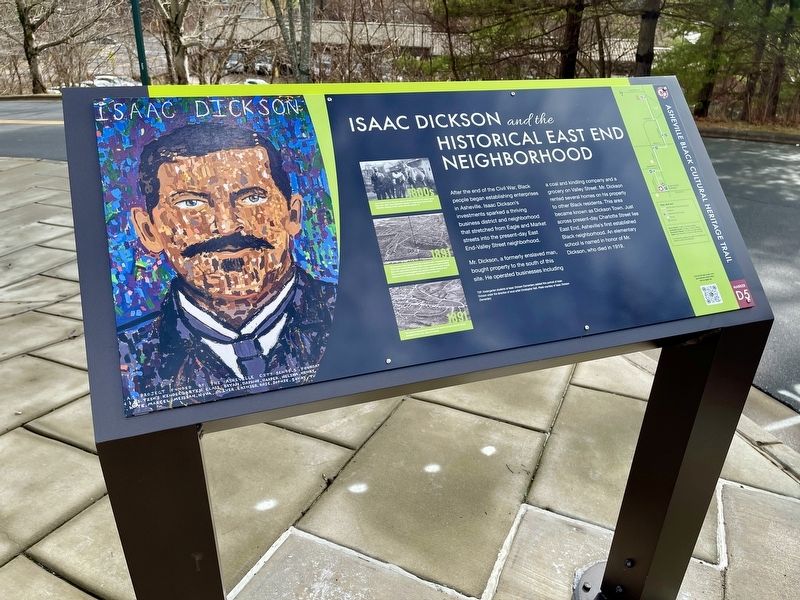
After the end of the Civil War, Black people began establishing enterprises in Asheville. Isaac Dickson's investments sparked a thriving business district and neighborhood that stretched from Eagle and Market streets into the present-day East End-Valley Street neighborhood.
Mr. Dickson, a formerly enslaved man, bought property to the south of this site. He operated businesses including a coal and kindling company and a grocery on Valley Street. Mr. Dickson rented several homes on his property to other Black residents. This area became known as Dickson Town. Just across present-day Charlotte Street lies East End, Asheville's first established Black neighborhood. An elementary school is named in honor of Mr. Dickson, who died in 1919.
(Kindergarten students at Isaac Dickson Elementary painted this portrait of Isaac Dickson under the direction of local artist Christopher Holt.)
Erected by Ashville Black Cultural Heritage Trail. (Marker Number D5.)
Topics. This historical marker is listed in these topic lists: African Americans • Civil Rights • Education • Industry & Commerce. A significant historical year for this entry is 1876.
Location. 35° 35.552′ N,
this page online

Regionally, this marker is in the Mountains. It is also in the American South, specifically in the Upper South, in Appalachia, and specifically in Southern Appalachia. Globally, it is in North America, the Western Hemisphere, the Western World, and the Anglosphere. Historically, it finds itself in what was once the original Cherokee Nation, the territory of the Mississippian Culture, one of the original Thirteen Colonies, one of the Confederate States of America, and the Antebellum South.
Other nearby markers. At least 8 other markers are within walking distance of this marker: Triangle Park Mural (within shouting distance of this marker); Railroad Workers (within shouting distance of this marker); Isaac And Delia Dickson (within shouting distance
Photographed by J. J. Prats, May 17, 2025
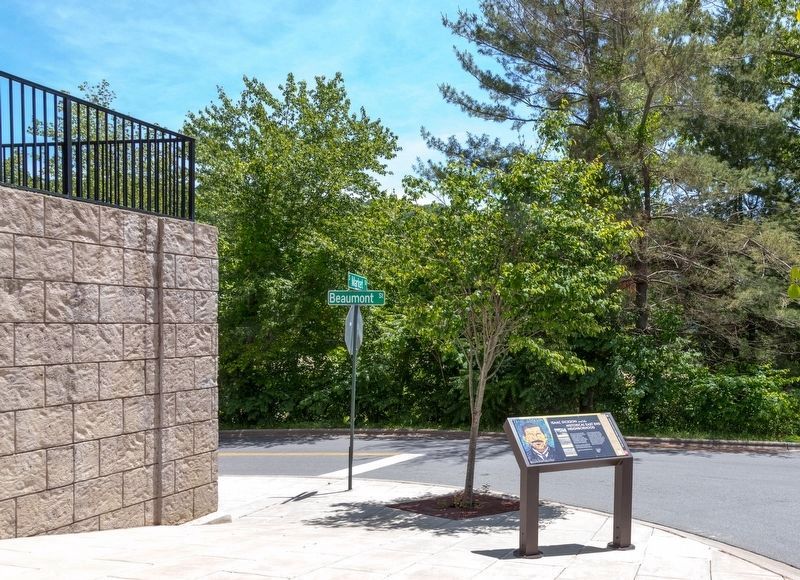
2. Isaac Dickson and the Historical East End Neighborhood Marker
Credits. This page was last revised on June 2, 2025. It was originally submitted on January 29, 2024, by Terry Price of Asheville, North Carolina. This page has been viewed 456 times since then and 37 times this year. Last updated on March 6, 2025, by Mark Parker of Hickory, North Carolina. Photos: 1. submitted on January 29, 2024, by Terry Price of Asheville, North Carolina. 2. submitted on June 2, 2025, by J. J. Prats of Powell, Ohio. • Devry Becker Jones was the editor who published this page.
Editor’s want-list for this marker. Wide shot of marker and its surroundings. • Can you help?
