Pocatello in Bannock County, Idaho — The American West (Mountains)
Gateway to the Pacific Northwest
| — | Portneuf Gap-Gittins Cutoff Historic Loop | — |

Photographed by Cosmos Mariner, July 10, 2024
1. Gateway to the Pacific Northwest Marker
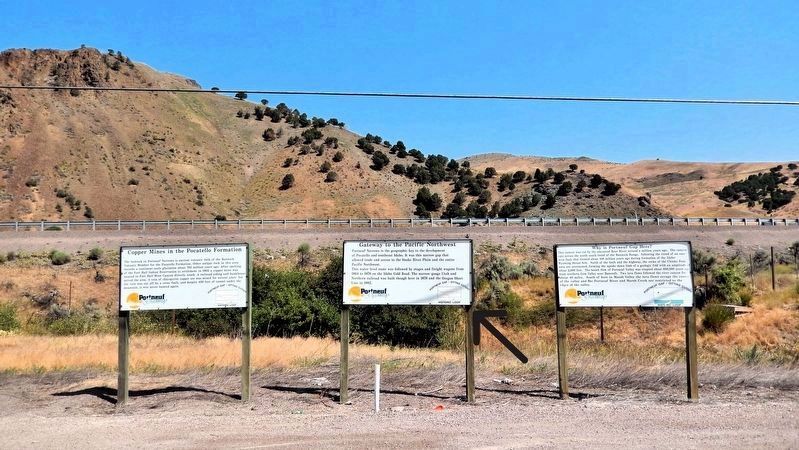
Portneuf Narrows is the geographic key to the development of Pocatello and southeast Idaho. It was this narrow gap that allowed trade and access to the Snake River Plain and the entire Pacific Northwest.
This water-level route was followed by stages and freight wagons from 1864 to 1878 on the Idaho Gold Road. The narrow-gauge Utah and Northern railroad was built through here in 1878 and the Oregon Short Line in 1882.
Erected by Portneuf Greenway.
Topics. This historical marker is listed in these topic lists: Industry & Commerce • Railroads & Streetcars • Roads & Vehicles. A significant historical year for this entry is 1864.
Location. 42° 47.743′ N, 112° 20.911′ W. Marker is in Pocatello, Idaho, in Bannock County. It is on South 5th Avenue (Old U.S. 91) 0.3 miles west of North Blackrock Canyon Road, on the right when traveling west. The marker is located in a pull-out on the north side of the highway. Touch for map. Marker is in this post office area: Pocatello ID 83204, United States of America. Touch for directions.

Regionally, this marker is in Bear River Country. It is also in the American Mountain West.
this page online
Other nearby markers. At least 8 other markers are within 5 miles of this marker, measured as the crow flies: Copper Mines in the Pocatello Formation (here, next to this marker); Why is Portneuf Gap Here? (here, next to this marker); Utah and the Northern Railway (approx. 0.8 miles away); Port of Entry (approx. 0.8 miles away); Oregon Short Line & Union Pacific (approx. 0.8 miles away); Idaho's 1st Railroad (approx. 4.4 miles away); Fort Hall (approx. 4.9 miles away); Old Fort Hall (approx. 4.9 miles away). Touch for a list and map of all markers in Pocatello.
Related markers. Click here for a list of markers that are related to this marker. Portneuf Gap-Gittins Cutoff Historic Loop
Also see . . .
1. The Idaho Gold Road.
Excerpt: Before railroads were built there were stage lines and freight wagons. As trade increased between the Mormon settlements in Utah and the mines in Montana to the north, Ben Holladay, opened in 1864, a stagecoach service along the "Idaho Gold Road" from Corinne, Utah to Virginia City, Montana,(Submitted on March 7, 2025, by Cosmos Mariner of Cape Canaveral, Florida.)via Eagle Rock. South of the Snake River two stage routes existed, the Bannock Road, which went northwest from Malad into Hawkins Basin and Arbon Valley, and the Portneuf Road followed by Holladay's stages, which went north, following present-day Interstate 15. The success of these stage lines plus the decision by the Mormon Church to build rails northward from Salt Lake City to Montana opened Idaho to the railroad era of the turn of the century.Photographed by Cosmos Mariner, July 10, 20242. Gateway to the Pacific Northwest MarkerLooking north; this is the center one of three related markers located at this pull-out on the old highway. Interstate 15 parallels in the background.
2. A Brief Introduction to Idaho.
Excerpt: The great river systems of the American west were the routes of Native American trails for hundreds of years before the advent of Europeans. They became railroad routes in the late 19th century. When the Utah & Northern Railway was constructed, it followed the path of the Bear River north to Cache Valley, and then the Lake Bonneville Flood route north to Portneuf Narrows, the site of Pocatello Junction, and the Snake River Plain. From there the railroad followed the Snake River north to Eagle Rock (Idaho Falls), and then the basalt lava plain to Monida Pass and Montana. The Oregon Short Line mainly followed the Oregon Trail from east to west across Idaho. Where the immigrants' wagons headed north at Soda Point to avoid the Gem Valley lava field, the rails headed directly across Gem Valley and down the lava-filled Portneuf River Canyon past Lava Hot Springs and Inkom to Portneuf Narrows.(Submitted on March 7, 2025, by Cosmos Mariner of Cape Canaveral, Florida.)
Credits. This page was last revised on July 2, 2025. It was originally submitted on March 6, 2025, by Cosmos Mariner of Cape Canaveral, Florida. This page has been viewed 264 times since then and 31 times this year. Photos: 1, 2. submitted on March 7, 2025, by Cosmos Mariner of Cape Canaveral, Florida.
