Near Homosassa in Citrus County, Florida — The American South (South Atlantic)
Etna Turpentine Camp
(1898-1926)
Photographed by Tim Fillmon, March 2, 2025
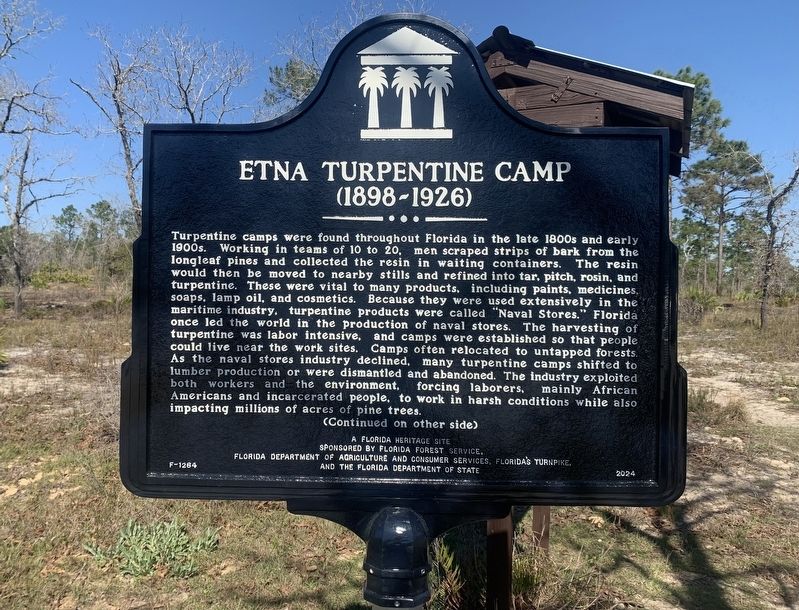
1. Etna Turpentine Camp Marker, Side One
Turpentine camps were found throughout Florida in the late 1800s and early 1900s. Working in teams of 10 to 20, men scraped strips of bark from the longleaf pines and collected the resin in waiting containers. The resin would then be moved to nearby stills and refined into tar, pitch, rosin, and turpentine. These were vital to many products, including paints, medicines. soaps, lamp oil, and cosmetics. Because they were used extensively in the maritime industry. turpentine products were called "Naval Stores." Florida once led the world in the production of naval stores. The harvesting of turpentine was labor intensive, and camps were established so that people could live near the work sites. Camps often relocated to untapped forests. As the naval stores industry declined, many turpentine camps shifted to lumber production or were dismantled and abandoned. The industry exploited both workers and the environment, forcing laborers, mainly African Americans and incarcerated people, to work in harsh conditions while also impacting millions of acres of pine trees.
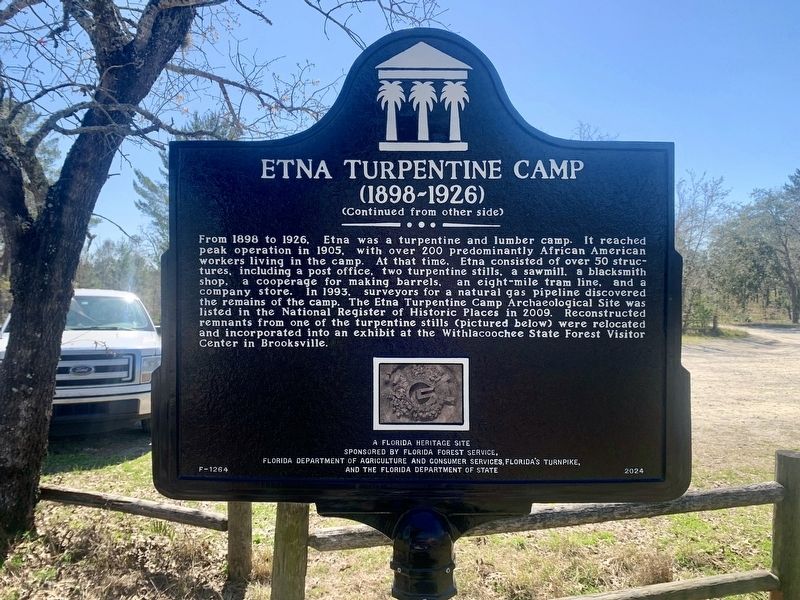
From 1898 to 1926, Etna was a turpentine and lumber camp.
this page online
A Florida Heritage Site
Erected 2024 by Florida Forest Service, Florida Department of Agriculture and Consumer Services, Florida Turnpike, and the Florida Department of State. (Marker Number F-1264.)
Topics. This historical marker is listed in these topic lists: African Americans • Agriculture • Settlements & Settlers. A significant historical year for this entry is 1898.
Location. 28° 43.205′ N, 82° 29.631′ W. Marker is near Homosassa,
Photographed by Tim Fillmon, March 2, 2025
2. Etna Turpentine Camp Marker, Side Two

Regionally, this marker is on the Gulf Coast. It is also in the American South and on the Gulf Coast. Globally, it is in the North Atlantic Region, North America, a Gulf of Mexico state, the Western Hemisphere, the Western World, and the Anglosphere. Historically, it finds itself in what was once New Spain, the territory of the Mississippian Culture, one of the Confederate States of America, and the Antebellum South.
Other nearby markers. At least 8 other markers are within 9 miles of this marker, measured as the crow flies: Saint Stanislaus Chapel (approx. 6.8 miles away); Stage Stand Cemetery (approx. 7.1 miles away); Florida Boom Sidewalk (approx. 7.7 miles away); David Levy Yulee (approx. 8.2 miles away); Removing the Juice from the Cane (approx. 8.2 miles
Photographed by Tim Fillmon, March 2, 2025
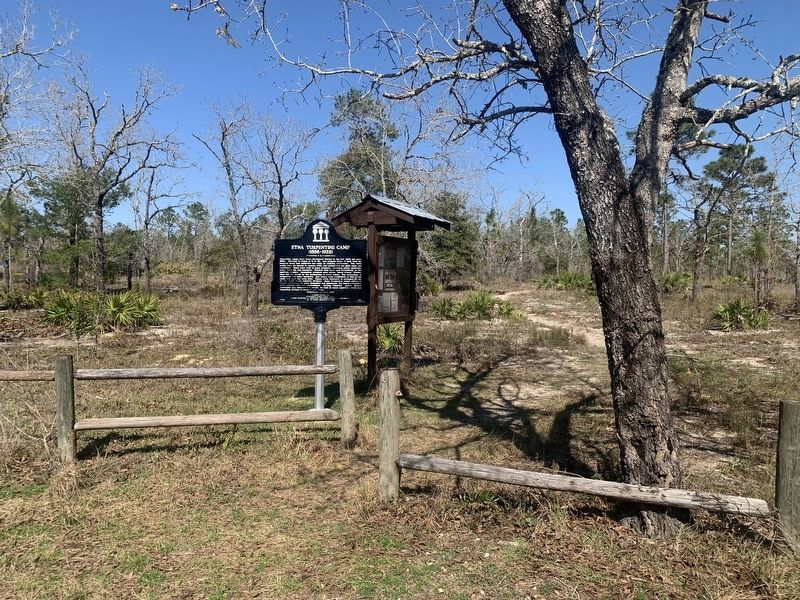
3. Etna Turpentine Camp Marker
Also see . . . Etna Turpentine Camp. (Submitted on March 9, 2025, by Tim Fillmon of Webster, Florida.)

Photographed by Tim Fillmon, March 2, 2025
4. Etna Turpentine Camp Marker Location
Credits. This page was last revised on June 29, 2025. It was originally submitted on March 9, 2025, by Tim Fillmon of Webster, Florida. This page has been viewed 1,000 times since then and 236 times this year. Photos: 1, 2, 3, 4. submitted on March 9, 2025, by Tim Fillmon of Webster, Florida.
