Monti in Roma in Città metropolitana di Roma Capitale, Latium, Rome, Italy — Central Italy (Tyrrhenian Coast)
Museo Nazionale del Palazzo di Venezia
⎯⎯⎯
National Museum of Palazzo Venezia
Photographed by James Hulse, June 24, 2023
1. Museo Nazionale del Palazzo di Venezia / National Museum of Palazzo Venezia Marker

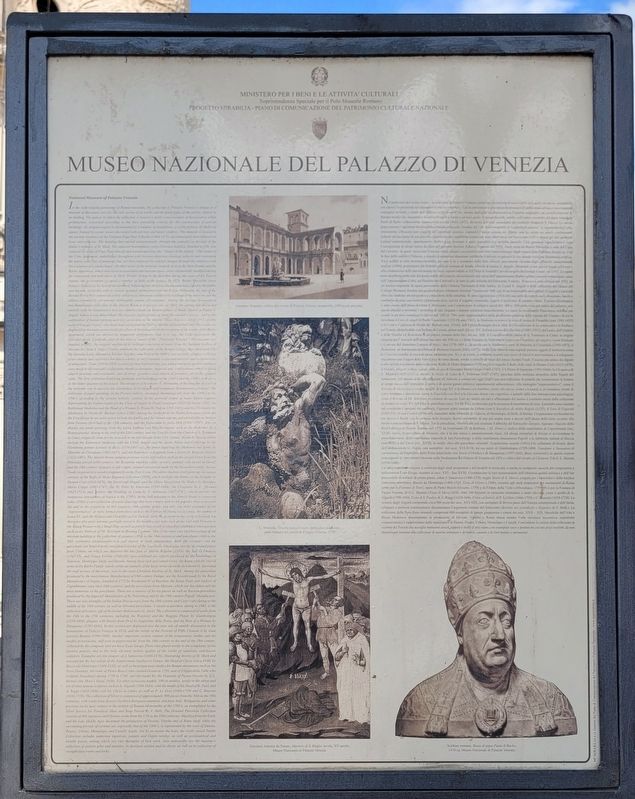
Nel panorama dei musei romani, la collezione di Palazzo Venezia costituisce un unicum di museo delle arti applicate per la varietà delle sue opere e la preziosità dei manufatti d'arte ivi contenuti. Già il contenitore è una rara testimonianza d'architettura urbana rinascimentale concepita secondo i criteri dell'edilizia civile di quell'età: alcune medaglie ne documentano l'aspetto originario, un castello-fortezza di stampo medievale, inquadrato da torri con merli e finestre ad arco acuto. Il museo ha sede, infatti, nell'antica residenza del papa veneziano Paolo II Barbo collezionista appassionato e colto (1461-1471), divenuta poi sede ininterrotta dei cardinali titolari di S. Marco. Lo stesso papa restaura l'omonima basilica paleocristiana adiacente, fondata nel 336, trasformandola in "cappella di palazzo". L'appartamento Cybo, interamente affrescato con soggetti del repertorio classico, ospitante l'intera sezione dei dipinti, non ha subito nei secoli cambiamenti radicali ad eccezione di una piccola cappella mentre modifiche sostanziali sono intervenute nel Novecento (1916) in tutti gli altri ambienti (salone
this page online
Photographed by James Hulse, June 24, 2023
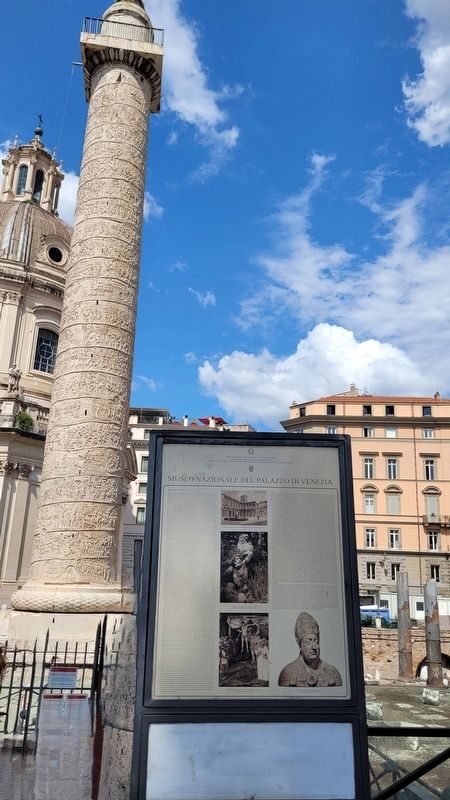
2. The marker is located in front of Trajan's Column
Photographed by James Hulse, June 24, 2023
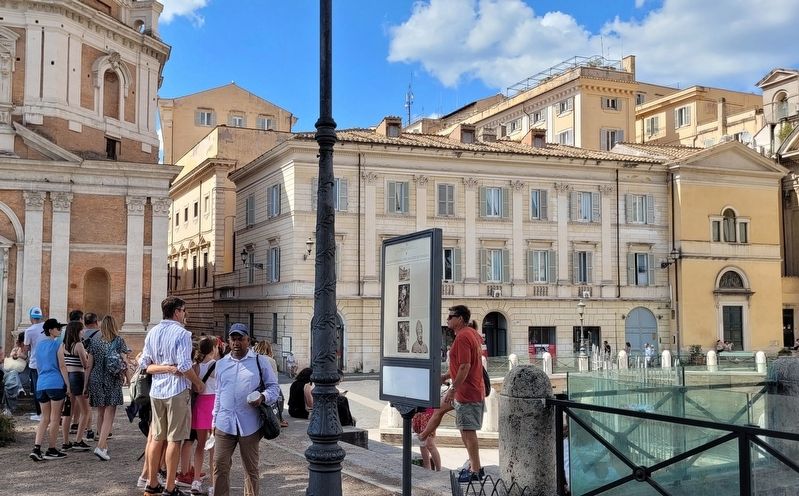
3. The view of the marker along the pathway
Un'altra importante sezione è costituita dagli studi preparatori e dai modelli in terracotta -e anche in cartapesta- raccolti dal compositore e collezionista Evan Gorga, risalenti ai secc. XVI - fine XVIII. Costituiscono le rare testimonianze dell'altissima qualità stilistica e dell'iter processuale di scultori di primo piano, come J. Sansovino (1486-1570, targhe Storie di S. Marco, eseguiti per i bassorilievi della basilica veneziana omonima), Baccio da Montelupo (1469-1535, Testa di Cristo, c.1506), insieme agli studi preparatori per monumenti di Roma come per la Fontana di Trevi, opere di Pietro Bracci (Oceano, 1759) e di Filippo della Valle (Abbondanza, 1759-60) o per la Fontana di Piazza Navona, di G.L. Bernini (Testa di Moro, 1654). Altri 100 bozzetti in terracotta rimandano a nomi rilevanti, come a quello di A. Algardi (1598-1654, Testa di S. Paolo), di A. Raggi (1624-1686, Cristo al limbo), di P. Le Gros (1666-1719) e C. Rusconi (1658-1728). La sezione degli Argenti comprende circa 800 pezzi dei secc. XVI-XIX, con esemplari di diversi paesi dell'Europa settentrionale e dell'Italia: reliquiari e preziose testimonianze documentano l'argenteria romana del Settecento (Servizio per pontificale e Zuppiere di V. Belli.). La collezione delle Porcellane orientali comprende 400 esemplari di fattura giapponese e cinese dei secc. XVII-XIX. Maioliche dell'Alto e Basso Medioevo documentano la produzione di Orvieto. Viterbo e Roma stessa mentre l'arte ceramica successiva, soprattutto cinquecentesca è rappresentata dalle manifatture di Deruta, Pesaro, Urbino, Montelupo e Castelli. Concludono la varietà della collezione la sezione dei Tessuti che accoglie numerosi arazzi, tappeti e stoffe d'arte copta, con esemplari sacri e profani tra cui rari pizzi merletti, da non dimenticare insieme alla collezione di antiche armature e di mobili, cassoni e di ferri battuti e serramenti.
Didascalie
Anonimo francese, veduta del cortile di Palazzo Venezia, acquerello, 1850 (coll privata)
C. Monaldi, Venezia sposa il mare, particolare scultoreo della fontana del cortile di Palazzo Venezia, 1730
Giovanni Antonio da Pesaro, Martirio di S. Biagio, tavola, XV secolo, Museo Nazionale di Palazzo Venezia
Scultore romano, Busto di papa Paolo II Barbo, 1470 ca, Museo Nazionale di Palazzo Venezia
National Museum of Palazzo Venezia
In the wide-ranging panorama of Roman museums, the collection at Palazzo Venezia is unique as a museum of decorative arts for the rich variety of its works and the great value of the artistic objects in its holding. The palace in which the collection is housed is itself a rare example of Renaissance urban architecture, conceived according to the then prevailing criteria for the construction of private buildings. Its original aspect is documented by a number of medallions, a castle-fortress of Medieval aspect, framed by corner towers decorated with merlons and lancet windows. The museum is located in the ancient residence of the Venetian Pope Paul II Barbo (1464-1471), an enthusiastic and cultured art lover and collector. The building then served uninterrupted through the centuries as the seat of the titular Cardinals of St. Mark. The adjacent homonymous early-Christian basilica, founded in 336, was restored by order of Pope Paul himself and transformed into the "chapel of the palace". The rooms of the Cybo Apartment, embellished throughout with frescoes depicting classical subjects and contaming the entire collection of paintings, has not been subjected to radical changes through the centuries with the exception of a small chapel. All other areas of the museum, instead, such as the State Rooms and the Barbo Apartment, which now serve as exposition and museum space, were substantially modified during the renovotion that took place in 1916. Worthy of note is the fact that during the years of the Fascist regime, the government occupied a number of halls of the palace. In 1929, Benito Mussolini chose Palazzo Venezia as his Seat of Government: following this decision, the museum was closed to the public and became accessible only to visitors granted permission from the Police. Following the end of the Second World War, numerous public and private donations enriched the holdings of the museum and the palace assumed it present-day multi-genre artistic physiognomy. Among the ceilings decorated in neo-Renaissance style, that of the Altoviti Room is a special case; in 1888, the ceiling was decorated entirely with the Renaissance frescoes detached from the Roman palace of Bindo Altoviti at Piazza S Angelo before it was demolished. The frescoes depict scenes of rural life related to Ceres, and to the celebration of human farming activities according to the months. These frescoes, dated 1553, are the work of Giorgio Vasari, who drew inspiration from the Twelve Months of Hannibal Caro. The works are displayed in the many rooms on the first floor of the palace (with the exception of the rooms of the Barbo Apartment, which are devoted to temporary exhibitions), that it to say, the Cybo Apartment, the Corridor of the Cardinals, and all the historic rooms of the "Palazzetto Venezia". The museum was founded in 1921, the original nucleus of its holdings consisting of works from the National Gallery of Ancient Art, from S. Angelo Castle, and from the collections of the Roman College Museum founded by the German Jesuit Athanasius Kircher. Kircher, who lived in the 1600's, was not only a tireless collector of art objects and curiosities but also a scholar of encyclopaedic scope and interests and a connoisseur of antiquities. From 1924 to 1926, a series of church furnishings was added and many further additions were made to the museum's collections thanks to donations, bequests and confiscations which included church furniture and ornaments, sets of silver, ceramics, and objects of jewellery, all of the greatest value. The first exhibition displaying paintings and furnishings of the 1400's and the 1500's took place in the oldest quarters of the palace. The intention of its curator F. Hermamn, at the time the director of the museum, was to recreate the atmosphere of an elegant and sumptuous Renaissance residence. The collection of panel paintings in the Picture Gallery, arranged chronologically from the 1200's to the 1700's according to the various schools, consists in the pictorial output of many Italian regions. Representing the Veneto region are the Choir of Angels by Paolo Veneziano (1333/58-before 1362), the Enthroned Madonna and the Head of a Woman by Pisanello (before 1395-1455) and the Christ and the Adulteress by Nicolò de Barbari (circa 1516). Among the works from the Entilia Romagna region are the Crucifixion by an artist active in both the Emilia and the Veneto regions and identifiable at Stefano from Ferrara (first half of the 15th century), and the Deposition by Lelio Orsi (1508?-1587). Also on display are panel paintings from the Lazio. Umbrio and Marche regions such as the Redeemer by a Roman painter dating to the end of the 13th century, and the Crucifix from the Church of S. Tommaso ai Cenci, originally done for the Aracoeli in the last decade of the 13th century. Works by Tuscan artists include the Enthroned Modonna with the Child, Angels and the Saints Julian and Catherine by the Florentine painter Lorenzo di Bicci (1370-1405 ca.), the panel depicting the Madonna and Saints by Mariotto di Cristofano (1393-1457), and the Redeemer, a fragment from a fresco by Benozzo Gozzoli (1421-1497). The Altoviti Room contains precious works of jewellery such as the crystal Cross from the Othonian period (10th century); the Byzantine wedding coffer, in ivory, painted with stories of David; and the 14th century reliquary in gilt copper, enamel and crystal made by the Siena-born artist, Jacupo Tondi, to preserve a wooden fragment from the True Cross. The oldest nucleus of oil paintings on canvas consists of the Ruffo di Motta Bagnara cullection (1919), which includes the Dance of the Nymphs by Donato Creti (1613-1678), the David and Abigail and the Moses Saved from the Waters by Giuseppe Maria Crespi (1665-1747), the St Peter by Guercino (1591-1666), the Cleopatra by C. Maratta (1625-1713) and, further, the Wedding at Cana by F. Solimena (1657-1747), which mirrors the sumptuous atmosphere of Naples in the 1700's. In the hall adjacent to the Altoviti Room is conserved today (2005) a rare collection of pastel drawings that bear witness both to the popular interest in court life and to the popularity of this exquisite 18th century genre. Not only are there examples of the "representative" or more formal portraiture such as the Portrait of Maria Leczczyuska, the spouse of Louis XV, and the Woman and Child Dressed in Turkish Attire by an artist in the circle of Liotard, but there are also more intimate portraits suited to the middle-class taste such as the Girl with Flowers or the Young Woman with a Small Dog, as well as pastels that reveal a refined psychological introspection such as the Portrait of Mr. Kinchant in Hunting Costume. One of the most rare and fascinating of the museum holdings is the collection of ceramics (15th to the 18th centuries) and porcelains (18th to the 20th centuries), exceptionally rich and diverse in their manufacture. Both the ceramics and the porcelains are housed in the so-called Corridor of the Cardinals. On display are the decorated plates from Urbino, on which are depicted the Sacrifice of Attilius Regulus (1535), the Bull of Phalaris (1545-55), and Orazio Coclite (1540-45); also exhibited are objects produced by the workshops of Valencia, Montelupo, Delft, and Deruta. Among these rich and varied wares, the Basin with the coat of arms of the Barbo Family stands out as an example of the large series of works that formerly decorated the roof terrace of the tower, next to the early-Christian basilica of St. Mark. Among the porcelains produced by the most famous Manufactures of 18th century Europe, are the biscuits made by the Royal Manufacture of Naples, founded in 1772 by Ferdinand IV of Bourbon, the Saints Peter and Andrew of Capodimonte ware (mid 18th century), and the porcelains from Meissen, which are the oldest and the most numerous of the porcelains. There are a number of Sèvres pieces as well as Russian porcelains produced by the Imperial Manufacture of St. Petersburg and by the 19th century Popoff Manufacture. There are also examples of the Italian Doccia ware from the 19th century and Cozzi ware dating to the middle of the 18th century, as well as Oriental porcelains. A recent acquisition, dating to 1963, is the collection of bronzes, gift of the former Ambassador G. Auriti. The collection is composed of works from the 16th to the 17th centuries, including the Wayfarer and the Bagpipe Player by Giambologna (1529-1608), plaques with Stories from Ovid by Guglielmo della Porta, and the Bust of a Woman by Dusquenoy (1597-1643). In this section are displayed also the rare sets of moulds discovered in the foundations of Palazzo Venezia in 1876, and the reliefs of the Portrait of Pope Clement X by Gian Lorenzo Bernini (1598-1680). Another important section consists of the preparatory studies and the models in terracotta, and even in papier-maché, from the 16th century to the end of the 18th century, collected by the composer and art lover Evan Gorga. These rare pieces testify to the complexity of the creative process and to the truly elevated stylistic quality of the works of numerous well-known sculptors. Examples are the plaques of J. Sansovino (1486-1570), illustrating Stories of St. Mark and executed for the bas-reliefs of the homonymous basilica in Venice; the Head of Christ (circa 1506) by Baccio da Montelupo (1469-1535); as well as the preparatory studies for Roman monuments such as the Trevi Fountain, the work of Pietro Bracci who created Ocean in 1759, and of Filippo della Valle who sculpted Abundance during 1759 to 1760; and the model for the Fountain of Piazza Navona by G.L Bernini (the Moor's Head, 1654). Yet other terracotta models, 100 in number, testify to the talent and art of other famous sculptors such as A. Algardi (1598-1654), with the model of his Head of St. Paul, and A. Raggi (1624-1686) with his Christ in Limbo, as well as P. Le Gros (1666-1719) and C. Rusconi (1658-1728). The collection of Silver is composed of approximately 800 pieces from the 16th to the 19th centuries, with works from diverse Northern European countries and from Italy. Reliquaries and other precious works bear witness to the artistry of Roman silversmiths of the 1700's, as exemplified by the Silver Service for Pontifical Mass and Soup Tureen by V. Belli. The Oriental Porcelain Collection consists of 400 Japanese and Chinese works from the 17th to the 19th centuries. Majolica from the Early and the Late Middle Ages document the production of Orvieto, Viterbo and of Rome itself, while the succeeding periods of ceramic art, especially that of the 1500's, is represented by the ware of Deruta, Pesaro, Urbino, Montelupo, and Castelli. Lastly, but by no means the least, the richly varied Textile Collection includes numerous tapestries, carpets and Coptic textiles, as well as ecclesiastical and secular pieces, among which are rare examples of lace work. Also noteworthy are the museum's collection of ancient arms and armours, its furniture section and its chests, as well as its collection of wrought iron works and locks.
Captions
Anonymous French, View of the courtyard of Palazzo Venezia, watercolor, 1850 (private collection)
C. Monaldi, Venice marries the Sea, sculptural detail of the fountain in the courtyard of Palazzo Venezia, 1730
Giovanni Antonio da Pesaro, Martyrdom of St. Blaise, panel, 15th century, National Museum of Palazzo Venezia
Roman sculptor, Bust of Pope Paul II Barbo, ca. 1470, National Museum of Palazzo Venezia
Erected by Ministero per I Beni e Le Attivita' Culturali Soprintendenza Speciale per Il Polo Museale Romano Progetto Mirabilia - Piano di Comunicazione del Patrimonio Culturale Nazionale.
Topics. This historical marker is listed in these topic lists: Anthropology & Archaeology • Architecture • Arts, Letters, Music. A significant historical year for this entry is 1929.
Location. 41° 53.74′ N, 12° 29.044′ E. Marker is in Roma, Lazio (Latium, Rome), in Città metropolitana di Roma Capitale. It is in Monti. It is at the intersection of no nearby street and Foro Traiano on no nearby street. The marker is near Trajan’s Column. Touch for map. Marker is in this post office area: Roma, Lazio 00187, Italy. Touch for directions.

Regionally, it is in Europe, the European Union, the Schengen Area, a coastal Mediterranean country, and the Western World. Historically, it finds itself in what was once the Roman Empire.
Other nearby markers. At least 8 other markers are within walking distance of this marker: Palazzo Valentini (within shouting distance of this marker); Foro di Traiano / Forum of Trajan (within shouting distance of this marker); Auditoria di Adriano / Hadrian's Auditoria (within shouting distance of this marker); Chiesa di Santa Maria di Loreto / Church of Santa Maria of Loreto (within shouting distance of this marker); Il Vittoriano: Monumento della Celebrazione / The Vittoriano: Monument of Celebration (within shouting distance of this marker); Vittoriano (within shouting distance of this marker); Italian government officially recognized Czech-Slovakia (about 90 meters away, measured in a direct line); Michelangelo’s House (about 90 meters away). Touch for a list and map of all markers in Roma.
More about this marker. There are duplicates of this marker near the museum.
Credits. This page was last revised on May 27, 2026. It was originally submitted on March 11, 2025, by James Hulse of Medina, Texas. This page has been viewed 109 times since then and 14 times this year. Photos: 1, 2, 3. submitted on March 12, 2025, by James Hulse of Medina, Texas.
