Weiden in der Oberpfalz in Weiden i.d. OPf., Bavaria, Germany — Central Europe
Krieg und Pest im 17. Jahrhundert
⎯⎯⎯
War and Plague in the 17th Century
Photographed by James Hulse, February 17, 2024
1. Krieg und Pest im 17. Jahrhundert / War and Plague in the 17th Century Marker

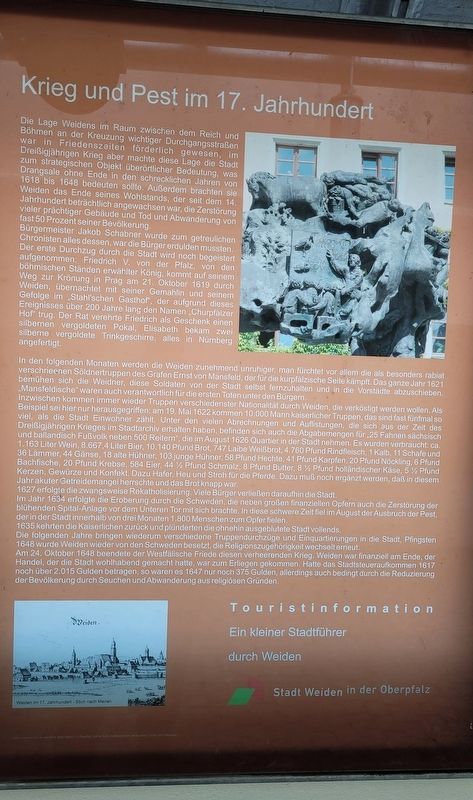
Die Lage Weidens im Raum zwischen dem Reich und Böhmen an der Kreuzung wichtiger Durchgangsstraßen war in Friedenszeiten förderlich gewesen, im Dreißigjährigen Krieg aber machte diese Lage die Stadt zum strategischen Objekt überörtlicher Bedeutung, was Drangsale ohne Ende in den schrecklichen Jahren von 1618 bis 1648 bedeuten sollte. Außerdem brachten sie Weiden das Ende seines Wohlstands, der seit dem 14. Jahrhundert beträchtlich angewachsen war, die Zerstörung vieler prächtiger Gebäude und Tod und Abwanderung von fast 50 Prozent seiner Bevölkerung.
Bürgermeister Jakob Schabner wurde zum getreulichen Chronisten alles dessen, war die Bürger erdulden mussten. Der erste Durchzug durch die Stadt wird noch begeistert aufgenommen: Friedrich V. von der Pfalz, von den böhmischen Ständen erwählter König, kommt auf seinem Weg zur Krönung in Prag am 21. Oktober 1619 durch Weiden, übernachtet mit seiner Gemahlin und seinem Gefolge im Stahl'schen Gasthof, der aufgrund dieses Ereignisses über 200 Jahre lang den Namen „Churpfälzer Hof" trug. Der Rat verehrte Friedrich als Geschenk einen silbernen vergoldeten Pokal, Elisabeth bekam zwei silberne vergoldete Trinkgeschirre, alles in Nürnberg angefertigt.
In den folgenden Monaten werden die Weiden zunehmend unruhiger, man fürchtet vor allem die als besonders rabiat verschrieenen Söldnertruppen des Grafen Ernst von Mansfeld, der für die kurpfälzische Seite kämpft. Das ganze Jahr 1621 bemühen sich die Weidner, diese Soldaten von der Stadt selbst fernzuhalten und in die Vorstädte abzuschieben. „Mansfeldische" waren auch verantwortlich für die ersten Toten unter den Bürgern.
Inzwischen kommen immer wieder Truppen verschiedenster Nationalität durch Weiden, die verköstigt werden wollen. Als Beispiel sei hier nur herausgegriffen: am 19. Mai 1622 kommen 10.000
this page online
1627 erfolgte die zwangsweise Rekatholisierung. Viele Bürger Im Jahr 1634 erfolgte die Eroberung durch die Schweden, die neben großen finanziellen Opfern auch die Zerstörung der blühenden Spital-Anlage vor dem Unteren Tor
Photographed by James Hulse, February 17, 2024
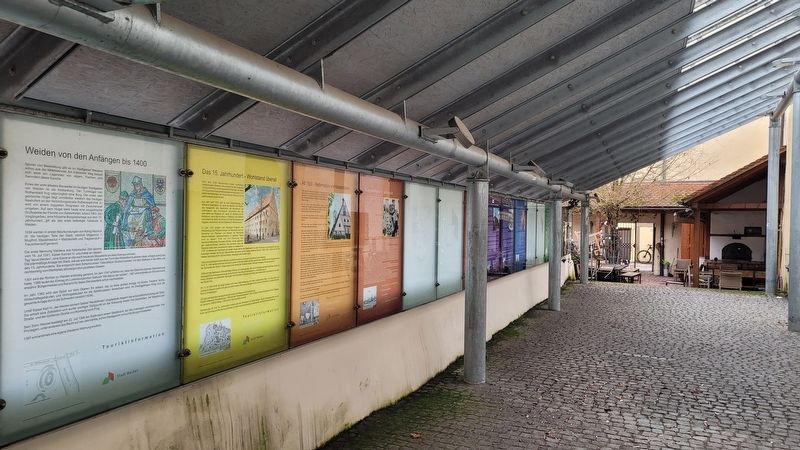
2. The marker is the fourth marker from the left
1635 kehrten die Kaiserlichen zurück und plünderten die ohnehin ausgeblutete Stadt vollends.
Die folgenden Jahre bringen wiederum verschiedene Truppendurchzüge und Einquartierungen in die Stadt, Pfingsten 1648 wurde Weiden wieder von den Schweden besetzt, die Religionszugehörigkeit wechselt erneut. Am 24. Oktober 1648 beendete der Westfälische Friede diesen verheerenden Krieg. Weiden war finanziell am Ende, der Handel, der die Stadt wohlhabend gemacht hatte, war zum Erliegen gekommen. Hatte das Stadtsteueraufkommen 1617 noch über 2.015 Gulden betragen, so waren es 1647 nur noch 375 Gulden, allerdings auch bedingt durch die Reduzierung der Bevölkerung durch Seuchen und Abwanderung aus religiösen Gründen.
Touristinformation
Ein kleiner Stadtführer durch Weiden
Stadt Weiden in der Oberpfalz
©2011 Verantwortlich fur den Inhalt Stadt Weiden i d Oberplatz, Amt für Kulfur, Stadtgeschichte und Tourismus / Hoch- und Tiefbauamt
The location of Weiden in the area between the Empire and Bohemia, at the crossroads of important thoroughfares, had been advantageous in times of peace. However, during the Thirty Years' War, this location made the city a strategic object of supra-regional significance, which would bring endless hardships during the terrible years of 1618 to 1648. Moreover, it brought Weiden the end of its prosperity, which had grown considerably since the 14th century, the destruction of many magnificent buildings, and the death and emigration of almost 50 percent of its population.
Mayor Jakob Schabner became the faithful chronicler of all that the citizens had to endure. The first passage through the city was still received with enthusiasm: Friedrich V of the Palatinate, elected King by the Bohemian estates, passed through Weiden on his way to his coronation in Prague on October 21, 1619. He spent the night with his wife and entourage at Stahl's inn, which, due to this event, carried the name "Churpfälzer Hof" for over 200 years. The council honored Friedrich with a silver-gilt goblet, and Elisabeth received two silver-gilt drinking vessels, all made in Nuremberg.
In the following months, Weiden became increasingly restless, mainly fearing the particularly ruthless mercenary troops of Count Ernst von Mansfeld, who fought for the Palatinate side. Throughout 1621, the people of Weiden tried to keep these soldiers away from the city and push them to the suburbs. The "Mansfeldians" were also responsible for the first deaths among the citizens.
Meanwhile, various troops of different nationalities passed through Weiden and needed to be provided for. One example: on May 19, 1622, 10,000 imperial troops arrived, nearly five times the number of the city's inhabitants. Among the many receipts and lists preserved in the city archives from the Thirty Years' War, there are also the amounts of provisions for "25 banners of Saxon and Walloon infantry along with 500 cavalry," who took quarters in the city in August 1626. The supplies consumed included: about 1,163 liters of wine, 8,667.4 liters of beer, 10,140 pounds of bread, 747 loaves of white bread, 4,760 pounds of beef, 1 calf, 11 sheep and 36 lambs, 44 geese, 18 old hens, 103 young hens, 58 pounds of pike, 41 pounds of carp, 20 pounds of perch, 6 pounds of brook fish, 20 pounds of crayfish, 584 eggs, 44½ pounds of lard, 8 pounds of butter, 81½ pounds of Dutch cheese, 5½ pounds of candles, spices, and confectionery. Additionally, oats, hay, and straw for the horses. It should also be noted that there was a severe grain shortage that year, and bread was scarce.
In 1627, forced re-Catholicization took place. Many citizens were affected. In 1634, the city was conquered by the Swedes, who, alongside great financial sacrifices, also brought the destruction of the flourishing hospital complex outside the Lower Gate. In August, the outbreak of the plague occurred, which claimed the lives of 1,800 people in the city within three months.
In 1635, the Imperial troops returned and completely plundered the already bled-out city.
The following years again saw various troop passages and billeting in the city. In Pentecost 1648, Weiden was once again occupied by the Swedes, and the religious affiliation changed again. On October 24, 1648, the Peace of Westphalia ended this devastating war. Weiden was financially exhausted, and the trade that had made the city wealthy came to a standstill. While the city's tax revenue had amounted to over 2,015 guilders in 1617, by 1647 it had dwindled to only 375 guilders, though this was also due to the reduction in population from plagues and emigration for religious reasons.
Tourist Information
A Small City Guide through Weiden
City of Weiden in the Upper Palatinate
©2011 Responsible for the content City of Weiden in the Upper Palatinate, Department of Culture, Local History and Tourism / Department of Civil and Structural Engineering
Erected by Stadt Weiden.
Topics. This historical marker is listed in these topic lists: Disasters • Settlements & Settlers • Wars, Non-US. A significant historical date for this entry is May 19, 1622.
Location. 49° 40.62′ N, 12° 9.927′ E. Marker is in Weiden in der Oberpfalz, Bayern (Bavaria), in Weiden i.d. OPf.. It is on Hinter der Mauer just north of Unterer Markt. The marker is located in a small alleyway under an open air patio with several other markers. Touch for map. Marker is at or near this postal address: Hinter d Mauer 21, Weiden in der Oberpfalz BY 92637, Germany. Touch for directions.

Regionally, it is in Europe, the European Union, Atlantic Europe, Central Europe, the Schengen Area, Western Europe, and the Western World. Historically, it finds itself in what was once the Holy Roman Empire.
Other nearby markers. At least 8 other markers are within walking distance of this marker: Das 18. Jahrhundert - Goethe in Weiden / The 18th Century - Goethe in Weiden (here, next to this marker); Ab 1900 - Weiden's Weg in die Moderne / From 1900 - Weiden's Path to Modernity (here, next to this marker); Ab 1500 - Reformation und Katastrophen / From 1500 - Reformation and catastrophes (here, next to this marker); Ab 1800 - Weiden wird Industriestandort / From 1800 - Weiden becomes an industrial location (here, next to this marker); Die Kirchengeschichte Weidens / The Church History of Weiden (here, next to this marker); Der History-Point / The History Point (here, next to this marker); Das 15. Jahrhundert - Wohlstand überall / The 15th Century - Prosperity Everywhere (here, next to this marker); Weiden von den Anfängen bis 1400 / Weiden from the beginnings to 1400 (here, next to this marker). Touch for a list and map of all markers in Weiden in der Oberpfalz.
Credits. This page was last revised on March 14, 2025. It was originally submitted on March 13, 2025, by James Hulse of Medina, Texas. This page has been viewed 251 times since then and 20 times this year. Photos: 1, 2. submitted on March 14, 2025, by James Hulse of Medina, Texas.
