South Fork in Rio Grande County, Colorado — The American Mountains (Southwest)
Traveling to South Fork
Photographed by Cosmos Mariner, July 26, 2024
1. Traveling to South Fork Marker
[photo captions]
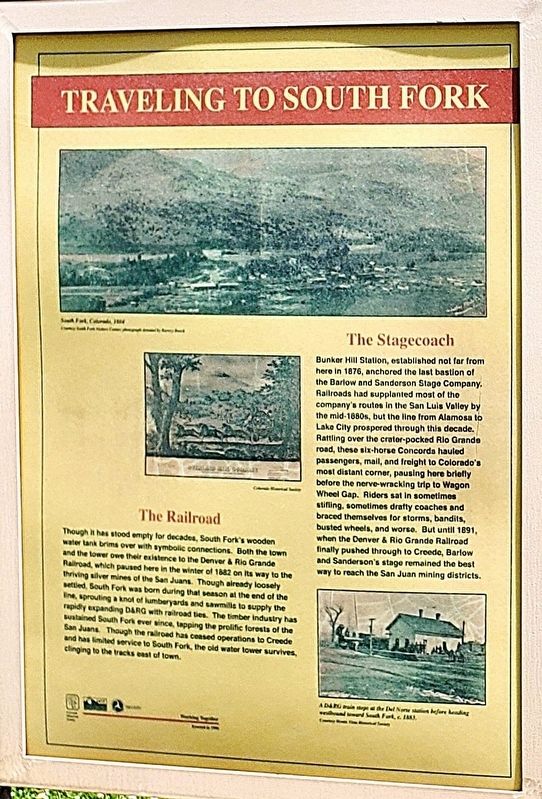
• South Fork, Colorado, 1884
• Overland Mail Company
• A D&RG train stops at the Del Norte station before heading westbound toward South Fork, c. 1883.
Erected 1996 by Colorado Historical Society, Colorado Department of Transportation,
this page online
Topics. This historical marker is listed in these topic lists: Industry & Commerce • Railroads & Streetcars • Roads & Vehicles • Settlements & Settlers. A significant historical year for this entry is 1876.
Location. 37° 40.835′ N, 106° 32.726′ W. Marker is in South Fork, Colorado, in Rio Grande County. It can be reached from U.S. 160 at milepost 191.4, 0.1 miles west of County Road 50, on the right when traveling west. The marker is in the Shaw Creek CDOT Rest Area. Touch for map. Marker is at or near this postal address: 25313 US Highway 160, South Fork CO 81154, United States of America. Touch for directions.

Regionally, this marker is in the Colorado High Rockies, in the San Juan Mountains, and in the San Luis Valley. It is also in the American Mountain West. Globally, it is in North America, the Rocky Mountains, the Western Hemisphere, the Western World, and the Anglosphere. Historically, it finds itself in what was once New Spain and also the Republic of Texas.
Other nearby markers. At least 8 other markers are within 11 miles of this marker, measured as the crow
Photographed by Cosmos Mariner, July 26, 2024
2. Traveling to South Fork Marker
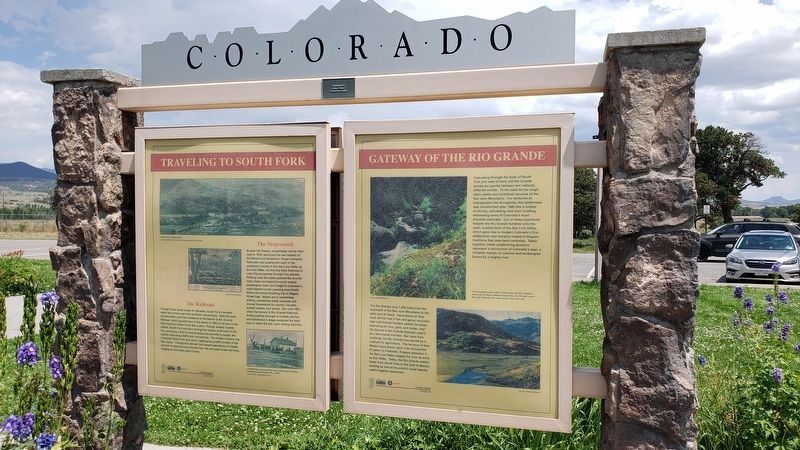
This is the left one of two markers on the southwest side of the interpretive kiosk.
Also see . . .
1. Barlow & Sanderson Company – Staging in the Mountains (Legends of America).
(By Kathy Alexander) Excerpt: Vermont men Jared L. Sanderson and Bradley Barlow, during the Civil War, established the Barlow-Sanderson Overland Mail Company. It operated a stage line between Sedalia and Warrensburg, Missouri. In July 1870, the Company bought out the Denver and Santa Fe Stage Line and renamed it the Southern Overland Mail and Express. Later that year, in December, they moved their headquarters to Denver. The company continued to grow in Colorado, becoming the largest stage line in the area, and in 1874, the headquarters moved again to Granada, Colorado. In 1879, the railroad(Submitted on March 17, 2025, by Cosmos Mariner of Cape Canaveral, Florida.)pushed through Colorado, dramatically cutting into the stage line business. Still, the company hung on for several more years, again relocating its headquarters to Buena Vista. Though business was down, the stage lines continued to operate into the 1880s, though often plagued by bandits.Photographed by Cosmos Mariner, July 26, 20243. Shaw Creek Rest Area Interpretive KioskLooking northeast; the rest area parking lot is in the background.
2. South Fork, Colorado (Wikipedia).
Excerpt: South Fork was founded in 1882, by which date its location was already marked by the presence of a coaching post, dating from the construction of the railroad connection of the Rio Grande Western Railroad line to Creede, which had been built to support the Creede silver mine. Originally the principal economic activities involved forestry and mining, but in recent decades these have been overtaken in the employment statistics by tourism.(Submitted on March 17, 2025, by Cosmos Mariner of Cape Canaveral, Florida.)
Credits. This page was last revised on March 17, 2025. It was originally submitted on March 13, 2025, by Cosmos Mariner of Cape Canaveral, Florida. This page has been viewed 187 times since then and 58 times this year. Photos: 1, 2, 3. submitted on March 17, 2025, by Cosmos Mariner of Cape Canaveral, Florida.
