Weiden in der Oberpfalz in Weiden i.d. OPf., Bavaria, Germany — Central Europe
Der History-Point
⎯⎯⎯
The History Point
Photographed by James Hulse, February 17, 2024
1. Der History-Point / The History Point Marker

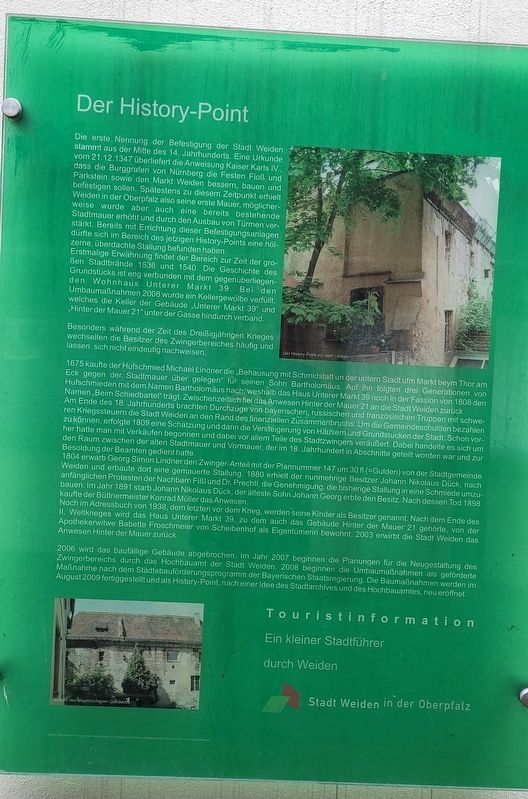
Die erste Nennung der Befestigung der Stadt Weiden stammt aus der Mitte des 14. Jahrhunderts. Eine Urkunde vom 21.12.1347 überliefert die Anweisung Kaiser Karls IV., dass die Burggrafen von Nürnberg die Festen Floß und Parkstein sowie den Markt Weiden bessern, bauen und befestigen sollen. Spätestens zu diesem Zeitpunkt erhielt Weiden in der Oberpfalz also seine erste Mauer, möglicherweise wurde aber auch eine bereits bestehende Stadtmauer erhöht und durch den Ausbau von Türmen verstärkt. Bereits mit Errichtung dieser Befestigungsanlagen dürfte sich im Bereich des jetzigen History-Points eine hölzerne, überdachte Stallung befunden haben.
Erstmalige Erwähnung findet der Bereich zur Zeit der großen Stadtbrände 1536 und 1540. Die Geschichte des Grundstücks ist eng verbunden mit dem gegenüberliegenden Wohnhaus Unterer Markt 39. Bei den Umbaumaßnahmen 2008 wurde ein Kellergewölbe verfüllt, welches die Keller der Gebäude „Unterer Markt 39" und „Hinter der Mauer 21" unter der Gasse hindurch verband.
Besonders während der Zeit des Dreißigjährigen Krieges wechselten die Besitzer des Zwingerbereiches häufig und lassen sich nicht eindeutig nachweisen.
1675 kaufte der Hufschmied Michael Lindner die „Behausung mit Schmidstatt un der untern Stadt ufm Markt beym Thor am Eck gegen der Stadtmauer über gelegen" für seinen Sohn Bartholomäus. Auf ihn folgten drei Generationen von Hufschmieden mit dem Namen Bartholomäus nach, weshalb das Haus Unterer Markt 39 noch in der Fassion von 1808 den Namen „Beim Schiedbartel" trägt. Zwischenzeitlich fiel das Anwesen Hinter der Mauer 21 an die Stadt Weiden zurück. Am Ende des 18. Jahrhunderts brachten Durchzüge von bayerischen, russischen und französischen Truppen mit schweren Kriegssteuern die Stadt Weiden an den Rand des finanziellen Zusammenbruchs. Um die Gemeindeschulden
this page online
1804 erwarb Georg Simon Lindner den Zwinger-Anteil mit der Plannummer 147 um 30 fl (=Gulden) von der Stadtgemeinde Weiden und erbaute dort eine gemauerte Stallung. 1880 erhielt der nunmehrige Besitzer Johann Nikolaus Dück, nach anfänglichen Protesten der Nachbarn Fißl und Dr. Prechtl, die Genehmigung, die bisherige Stallung in eine Schmiede umzubauen. Im Jahr 1891 starb Johann Nikolaus Dück, der älteste Sohn Johann Georg erbte den Besitz. Nach dessen Tod 1898 kaufte der Büttnermeister Konrad Müller das Anwesen.
Noch im Adressbuch von 1938, dem letzten vor dem Krieg, werden seine Kinder als Besitzer genannt. Nach dem Ende des II. Weltkrieges wird das Haus Unterer Markt 39, zu dem auch das Gebäude Hinter der Mauer 21 gehörte, von der Apothekerwitwe
Photographed by James Hulse, February 17, 2024
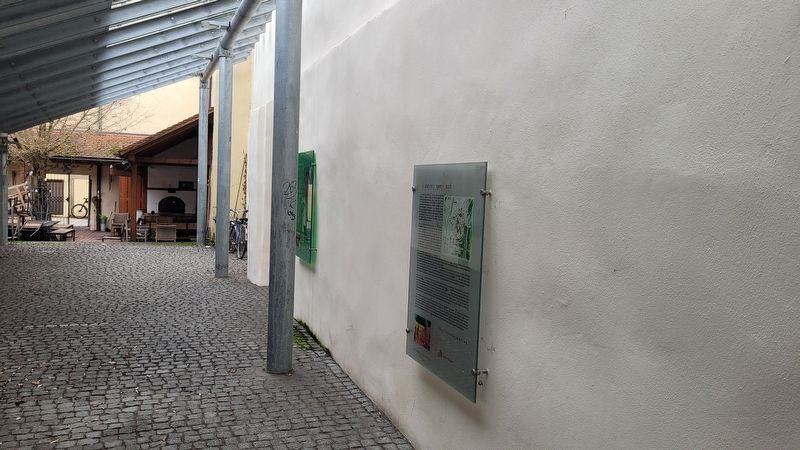
2. The view of the marker along the wall and behind the support pole
2006 wird das baufällige Gebäude abgebrochen. Im Jahr 2007 beginnen die Planungen für die Neugestaltung des Zwingerbereichs durch das Hochbauamt der Stadt Weiden. 2008 beginnen die Umbaumaßnahmen als geförderte Maßnahme nach dem Städtebauförderungsprogramm der Bayerischen Staatsregierung. Die Baumaßnahmen werden im August 2009 fertiggestellt und als History-Point, nach einer Idee des Stadtarchives und des Hochbauamtes, neu eröffnet.
Touristinformation
Ein kleiner Stadtführer durch Weiden
Stadt Weiden in der Oberpfalz
©2011 Verantwortlich fur den Inhalt Stadt Weiden i d Oberplatz, Amt für Kulfur, Stadtgeschichte und Tourismus / Hoch- und Tiefbauamt
The first mention of the fortification of the city of Weiden dates back to the middle of the 14th century. A document from December 21, 1347, records the instruction of Emperor Charles IV that the burgraves of Nuremberg should repair, build, and fortify the castles Floß and Parkstein as well as the market town of Weiden. By this
Photographed by James Hulse, February 17, 2024
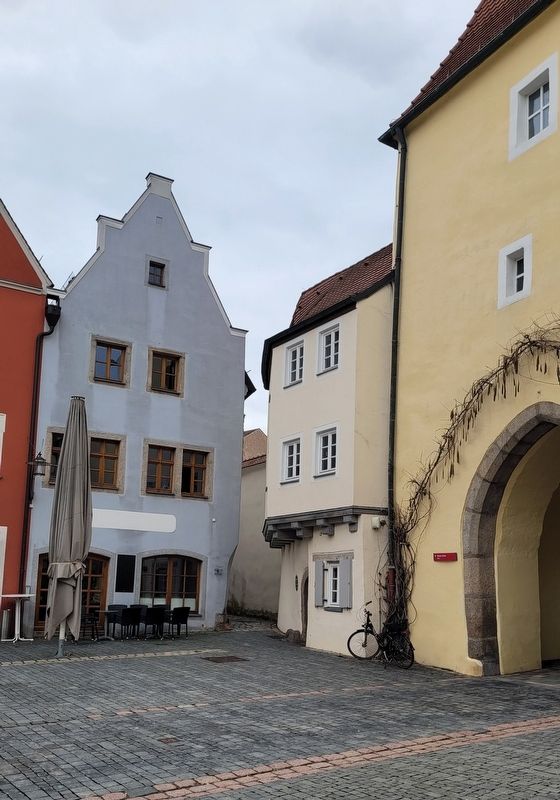
3. Unterer Markt 39 is the light blue building in the middle
The area is first mentioned during the major city fires of 1536 and 1540. The history of the property is closely linked to the adjacent house at Unterer Markt 39. During the renovation work in 2008, a vaulted cellar was filled in, which had connected the cellars of the buildings "Unterer Markt 39" and "Hinter der Mauer 21" under the alley.
Especially during the time of the Thirty Years' War, ownership of the Zwinger area frequently changed and cannot be definitively traced.
In 1675, the blacksmith Michael Lindner bought the "dwelling with the smithy in the lower town by the market at the gate corner opposite the city wall" for his son Bartholomäus. After him, three generations of blacksmiths named Bartholomäus followed, which is why the house Unterer Markt 39 still bears the name "Beim Schiedbartel" in the 1808 edition. In the meantime, the property "Hinter der Mauer 21" reverted to the city of Weiden. At the end of the 18th century, the passage of Bavarian, Russian, and French troops, along with heavy war taxes, brought the city of Weiden to the brink of financial collapse. In order to pay the municipal debts, an appraisal was made in 1809, followed by the auction of houses and properties belonging to the city. Prior to this, sales had already begun, with parts of the city’s Zwinger being sold. This area between the old city wall and the forewall, divided into sections in the 18th century, had been used to pay civil servants.
In 1804, Georg Simon Lindner acquired the Zwinger portion with plan number 147 for 30 florins (gulden) from the city of Weiden and built a masonry stable there. In 1880, the now-owner Johann Nikolaus Dück, after initial protests from neighbors Fißl and Dr. Prechtl, was granted permission to convert the stable into a forge. In 1891, Johann Nikolaus Dück passed away, and his eldest son, Johann Georg, inherited the property. After his death in 1898, the cooper master Konrad Müller purchased the property.
Even in the 1938 address book, the last one before the war, his children are listed as owners. After World War II, the house Unterer Markt 39, which also included the building at Hinter der Mauer 21, was inhabited by the widow of the pharmacist, Babette Froschmeier from Scheibenhof. In 2003, the city of Weiden repurchased the property at Hinter der Mauer.
In 2006, the dilapidated building was demolished. In 2007, planning for the redesign of the Zwinger area began through the city's building office. In 2008, renovation work began as a funded project under the Bavarian State Government's Urban Development Program. The construction was completed in August 2009 and reopened as the History-Point, following an idea from the city archive and the building office.
Tourist Information
A Small City Guide through Weiden
City of Weiden in the Upper Palatinate
©2011 Responsible for the content City of Weiden in the Upper Palatinate, Department of Culture, Local History and Tourism / Department of Civil and Structural Engineering
Erected by Stadt Weiden.
Topics. This historical marker is listed in these topic lists: Forts and Castles • Industry & Commerce • Wars, Non-US. A significant historical month for this entry is August 2009.
Location. 49° 40.619′ N, 12° 9.925′ E. Marker is in Weiden in der Oberpfalz, Bayern (Bavaria), in Weiden i.d. OPf.. It is on Hinter der Mauer just north of Unterer Markt. The marker is located in a small alleyway under an open air patio with several other markers. Touch for map. Marker is at or near this postal address: Hinter der Mauer 21, Weiden in der Oberpfalz BY 92637, Germany. Touch for directions.

Regionally, it is in Europe, the European Union, Atlantic Europe, Central Europe, the Schengen Area, Western Europe, and the Western World. Historically, it finds itself in what was once the Holy Roman Empire.
Other nearby markers. At least 8 other markers are within walking distance of this marker: Das 18. Jahrhundert - Goethe in Weiden / The 18th Century - Goethe in Weiden (here, next to this marker); Krieg und Pest im 17. Jahrhundert / War and Plague in the 17th Century (here, next to this marker); Ab 1500 - Reformation und Katastrophen / From 1500 - Reformation and catastrophes (here, next to this marker); Ab 1900 - Weiden's Weg in die Moderne / From 1900 - Weiden's Path to Modernity (here, next to this marker); Die Kirchengeschichte Weidens / The Church History of Weiden (here, next to this marker); Ab 1800 - Weiden wird Industriestandort / From 1800 - Weiden becomes an industrial location (here, next to this marker); Das 15. Jahrhundert - Wohlstand überall / The 15th Century - Prosperity Everywhere (here, next to this marker); Weiden von den Anfängen bis 1400 / Weiden from the beginnings to 1400 (here, next to this marker). Touch for a list and map of all markers in Weiden in der Oberpfalz.
Credits. This page was last revised on March 14, 2025. It was originally submitted on March 13, 2025, by James Hulse of Medina, Texas. This page has been viewed 133 times since then and 12 times this year. Photos: 1, 2, 3. submitted on March 14, 2025, by James Hulse of Medina, Texas.
