Buckhannon in Upshur County, West Virginia — The American South (Appalachia)
Juglans cinerea (butternut, or white walnut)
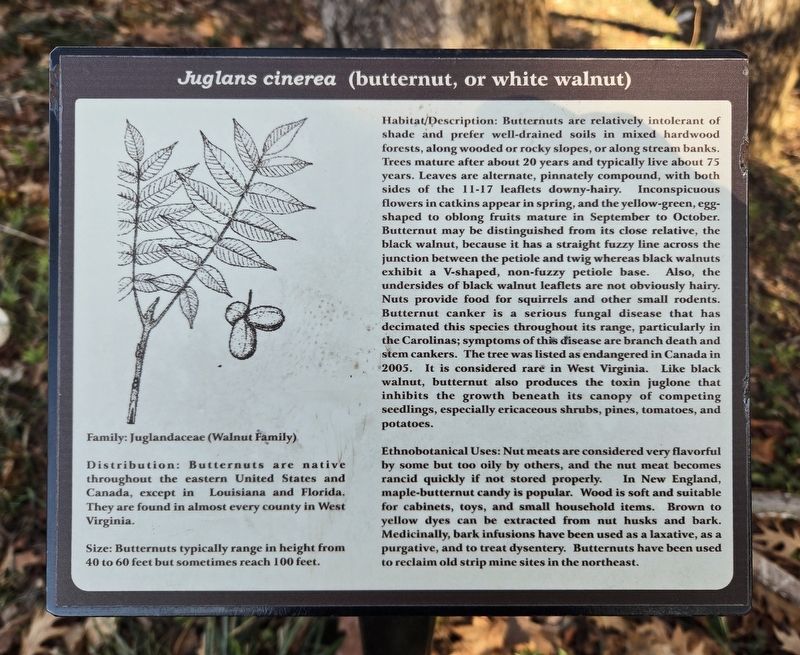
Photographed by Bradley Owen, March 10, 2025
1. Juglans cinerea (butternut, or white walnut) Marker
Family: Juglandaceae (Walnut Family)
Distribution: Butternuts are native throughout the eastern United States and Canada, except in Louisiana and Florida. They are found in almost every county in West Virginia.
Size: Butternuts typically range in height from 40 to 60 feet but sometimes reach 100 feet.
Habitat/Description: Butternuts are relatively intolerant of shade and prefer well-drained soils in mixed hardwood forests, along wooded or rocky slopes, or along stream banks. Trees mature after about 20 years and typically live about 75 years. Leaves are alternate, pinnately compound, with both sides of the 11-17 leaflets downy-hairy. Inconspicuous flowers in catkins appear in spring, and the yellow-green, egg-shaped to oblong fruits mature in September to October. Butternut may be distinguished from its close relative, the black walnut, because it has a straight fuzzy line across the junction between the petiole and twig whereas black walnuts exhibit a V-shaped, non-fuzzy petiole base. Also, the undersides of black walnut leaflets are not obviously hairy. Nuts provide food for squirrels and other small rodents.
this page online
Ethnobotanical Uses: Nut meats are considered very flavorful by some but too oily by others, and the nut meat becomes rancid quickly if not stored properly. In New England, maple-butternut candy is popular. Wood is soft and suitable for cabinets, toys, and small household items. Brown to yellow dyes can be extracted from nut husks and bark. Medicinally, bark infusions have been used as a laxative, as a purgative, and to treat dysentery. Butternuts have been used to reclaim old strip mine sites in the northeast.
Erected 2017 by West Virginia Wesleyan College Department of Biology.
Topics. This historical marker is listed in these topic lists: Environment
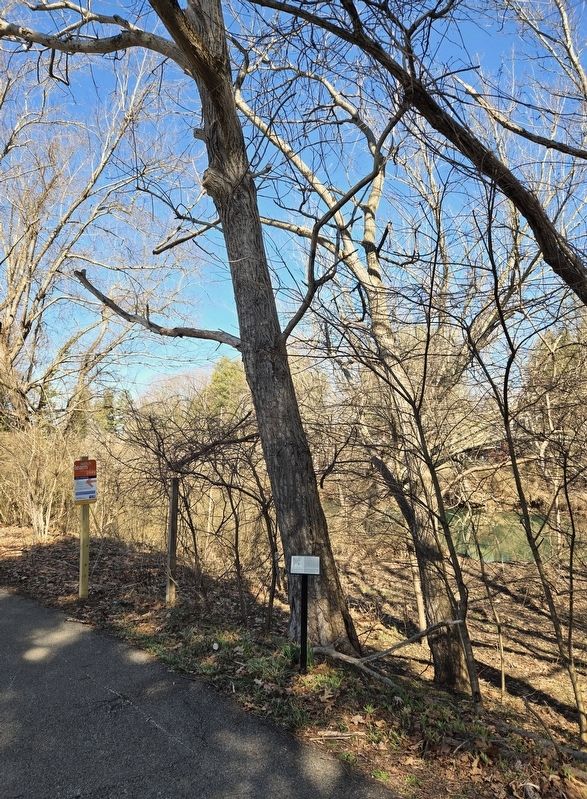
Photographed by Bradley Owen, March 10, 2025
2. Juglans cinerea (butternut, or white walnut) Marker
Location. 38° 59.57′ N, 80° 12.772′ W. Marker is in Buckhannon, West Virginia, in Upshur County. It can be reached from the intersection of Walktrail Lane and Wood Street, on the left when traveling east. Marker is located on the Buckhannon River Walk Trail most easily accessed from the Buckhannon Dog Park parking lot. Touch for map. Marker is at or near this postal address: 54 Walktrail Lane, Buckhannon WV 26201, United States of America. Touch for directions.

Regionally, this marker is in North Central West Virginia. It is also in the American South, specifically in the Upper South, in Appalachia, and specifically in Northern Appalachia. Globally, it is in North America, the Western Hemisphere, the Western World, and the Anglosphere. Historically, it finds itself in what was once the territory of the Mississippian Culture.
Other nearby markers. At least 8 other markers are within walking distance of this marker: Juglans nigra (black walnut) (here, next to this marker); Parthenocissus quinquefolia (Virginia creeper) (within shouting distance of this marker); West Virginia Wesleyan College (within shouting distance of this marker); Two Buddies & An Angel (within shouting distance of this marker); Bob Wallace Bridge (about 400 feet away, measured in a direct line); Celastrus orbiculatus (Oriental bittersweet) (about 400 feet away); Castanea dentata x mollissima (Dunstan chestnut) (about 500 feet away); The Bicentennial Sycamore (about 600 feet away). Touch for a list and map of all markers in Buckhannon.
Credits. This page was last revised on March 14, 2025. It was originally submitted on March 14, 2025, by Bradley Owen of Morgantown, West Virginia. This page has been viewed 120 times since then and 25 times this year. Photos: 1, 2. submitted on March 14, 2025, by Bradley Owen of Morgantown, West Virginia.
