Jordan Park in St. Petersburg in Pinellas County, Florida — The American South (South Atlantic)
Campbell Park
Faith, Family, and Education • 9th Avenue South Corridor
| — | St. Petersburg African-American Heritage Trail | — |
Photographed by Brandon D Cross
1. Campbell Park Marker
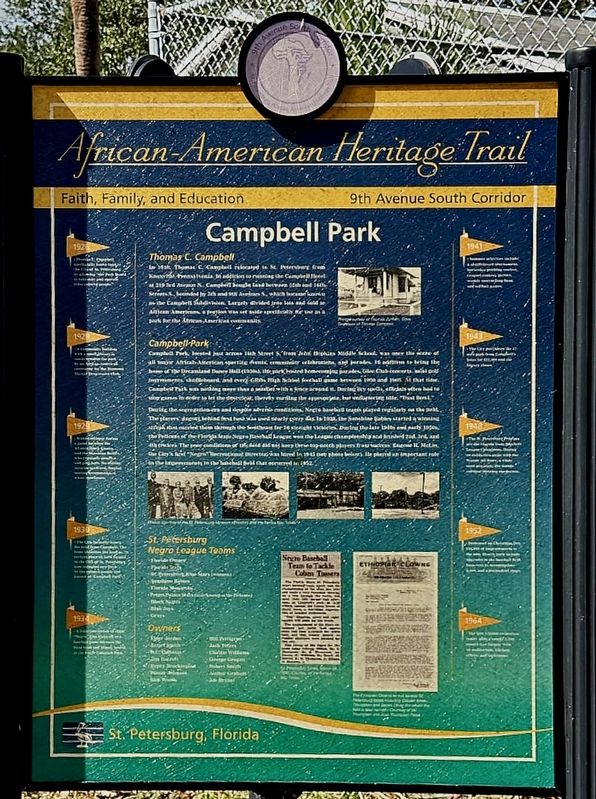
Thomas C. Campbell
In 1918, Thomas C. Campbell relocated to St. Petersburg from Knoxville, Pennsylvania. In addition to running the Campbell Hotel at 219 3rd Avenue N., Campbell bought land between 12th and 16th Streets S. bounded by 5th and 9th Avenues S., which became known as the Campbell Subdivision. Largely divided into lots and sold to African Americans, a portion was set aside specifically for use as a park for the African-American community.
Campbell Park
Campbell Park, located just across 16th Street S. from John Hopkins Middle School, was once the scene of all major African-American sporting events, community celebrations, and parades. In addition to being the home of ile Dreamland Dance Hall (1930s), the park hosted homecoming parades, Glee Club concerts, mini-golf tournaments shuffleboard, and even Gibbs High School football game between 1930 and 1966. At that time Campbell Park was nothing more than a sandlot with a fence around it. During dry spells, officials often had to stop games in order to let the dust clear, thereby earning the appropriate, but unflattering title, "Dust Bowl."
During
this page online
St. Petersburg Negro League Teams
Florida Gators • Florida State • St. Petersburg Blue Stars (women) • Sunshine Babies • Florida Monarchs • Peter’s Palace Stars (later known as the Pelicans) • Black Saints • Blue Jays • Grays
Owners
Elder Jordan • James Smith • R.C. Calhoun • Jim Barrett • Henry Brockington • Buster Johnson. • Sam Woods • Bill Pettigrew • Jack Peters • Charlie Williams • George Grogan
Photographed by Brandon D Cross
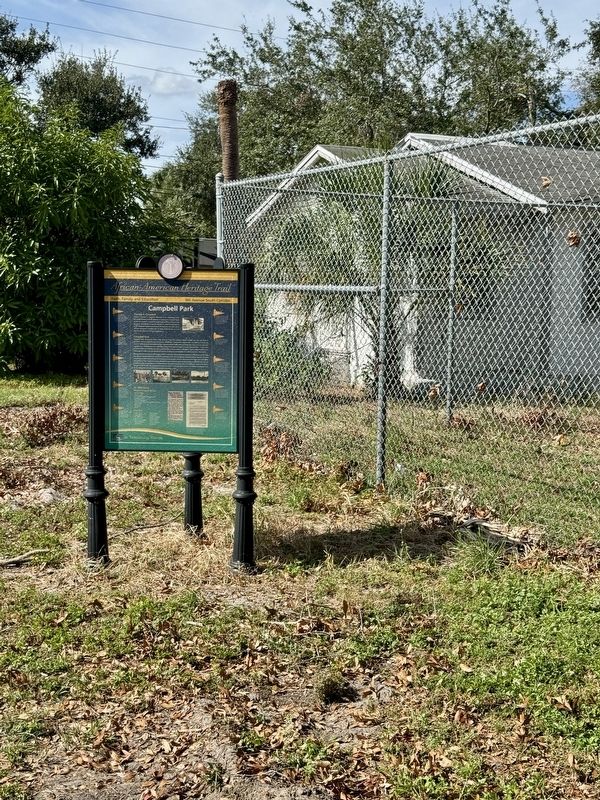
2. Campbell Park Marker
1926
Thomas C. Campbell unofficially leaves land to the City of St. Petersburg by allowing “ the Park Board to take over and operate it for colored people.”
1928
A community building with a small library is constructed in the park by an African-American contractor for the Diamond Mutual Progressive Club.
1929
Stands collapse during a game between the Atlanta Black Giants and the Sunshine Babies who regularly practiced and played here. No serious injuries. Special seating accommodations for white spectators.
1930
The city formally leases the land from Campbell. The lease identifies the land as a certain piece of land located in the City of St. Petersburg and to be used by the colored people and known as Campbell Park.
1934
A 3-day competition of “Negro” teams kicks off at the field between the local team and Miami hoisted at Campbell Park.
1941
Summer activities include a shuffleboard tournament, horseshoe pitching contest, croquet contest, picnics, weekly storytelling hour and softball games.
1943
The City purchases the 17 acre for $22,500 and the library closes.
1948
The St. Petersburg Pelicans are the Florida State Baseball League Champions. During an exhibition game with the Winter All-Stars, a white semi-pro team, the stands collapsed injuring one person.
1954
Dedicated on Christmas Day $10,000 of improvements to the now 10-park acre park actual upgrades to the baseball field bleachers to accommodate 2,000 and a permanent stage.
1964
The new $53.000 recreation center adds a nearly 5,000 square foot facility with an auditorium, kitchen, offices, and bathrooms.
St. Petersburg Negro League Teams
Florida Gators • Florida Stars • St. Petersburg Blu Stars (women) • Sunshine Babies • Florida Monarchs • Peter’s Palace Stars (later known as the Pelicans) • Black Saints • Blue Jays • Grays
Owners
Elder Jordan • James Smith • R.C. Calhoun • Jim Barrett • Henry Brockington • Buster Johnson • Sam Woods
(captions)
Photo courtesy of Thomas Zurfieh, Great Grandson of Thomas Campbell
Photos courtesy of the St. Petersburg Museum of History and the Tampa Bay Times.
St. Petersburg Times, March 29, 1931. Courtesy of the Tampa Bay Times
The Ethiopian Clowns recruit several St. Petersburg locals including Copper Knee Thompson and James Oliver (for whom the field is later named). Courtesy of Vel Thompson and Joan Thompson Reed.
Erected by National Park Service, Florida Department of State, the City of St. Petersburg and the Dr. Carter G. Woodson African American History Museum.
Topics. This historical marker is listed in these topic lists: African Americans • Civil Rights • Entertainment • Sports. A significant historical year for this entry is 1926.
Location. 27° 45.535′ N, 82° 39.778′ W. Marker is in St. Petersburg, Florida, in Pinellas County. It is in Jordan Park. It is at the intersection of 9th Avenue South and Queen Street South, on the right when traveling west on 9th Avenue South. Touch for map. Marker is at or near this postal address: 701 16th St S, Saint Petersburg FL 33712, United States of America. Touch for directions.

Regionally, this marker is on Florida’s Gulf Coast and on Tampa Bay. It is also in the American South and on the Gulf Coast. Globally, it is in the North Atlantic Region, North America, a Gulf of Mexico state, the Western Hemisphere, the Western World, and the Anglosphere. Historically, it finds itself in what was once New Spain, the territory of the Mississippian Culture, one of the Confederate States of America, and the Antebellum South.
Other nearby markers. At least 8 other markers are within walking distance of this marker: Faces and Stories (here, next to this marker); 22nd Street South Corridor (here, next to this marker); Royal Theater (within shouting distance of this marker); a different marker also named 22nd Street South Corridor (about 500 feet away, measured in a direct line); Building 22nd Street S. (about 500 feet away); A Community of Caring (about 700 feet away); Civic Associations (approx. 0.2 miles away); The Beginning (approx. 0.2 miles away). Touch for a list and map of all markers in St. Petersburg.
Also see . . .
1. Campbell Park walking tour offers a look at African-American history in St. Pete. (Submitted on March 15, 2025, by Brandon D Cross of Flagler Beach, Florida.)
2. The Heritage Trail. (Submitted on March 15, 2025, by Brandon D Cross of Flagler Beach, Florida.)
Credits. This page was last revised on March 31, 2025. It was originally submitted on March 15, 2025, by Brandon D Cross of Flagler Beach, Florida. This page has been viewed 204 times since then and 54 times this year. Photos: 1, 2. submitted on March 15, 2025, by Brandon D Cross of Flagler Beach, Florida. • J. J. Prats was the editor who published this page.
