Old Lyme in Lower Connecticut River Valley Region, Connecticut — The American Northeast (New England)
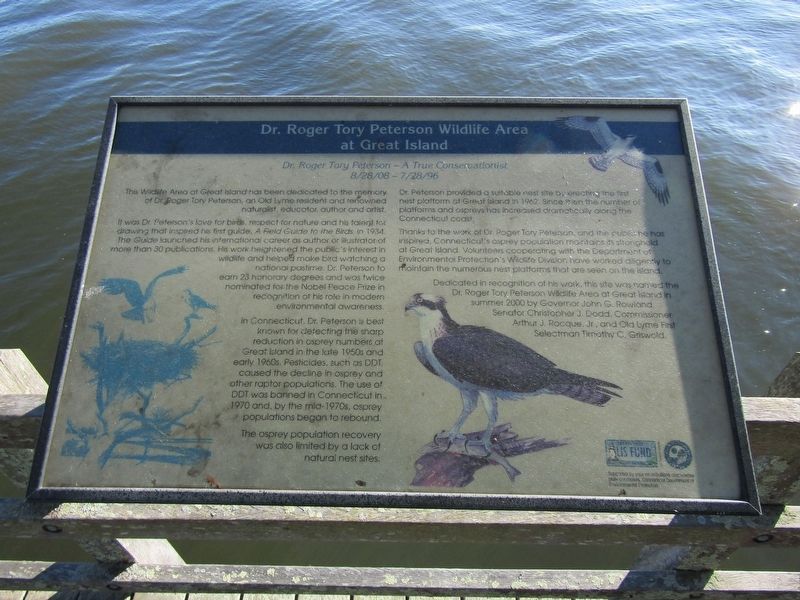
Dr. Roger Tory Peterson Wildlife Area at Great Island
Photographed by Conrad Ward, October 19, 2024
1. Dr. Roger Tory Peterson Wildlife Area Marker
8/28/08 - 7/28/96
This Wildlife Area at Great Island has been dedicated to the memory of Dr. Roger Tory Peterson, an Old Lyme resident and renowned naturalist, educator, author and artist.
It was Dr. Peterson's love for birds, respect for nature and his talent for drawing that inspired his first guide, A Field Guide to the Birds in 1934. The Guide launched his international career as author or illustrator of more than 30 publications. His work heightened the public's interest in wildlife and helped make bird watching a national pastime. Dr. Peterson to earn 23 honorary degrees and was twice nominated for the Nobel Peace Prize in recognition of his role in modern environmental awareness.
In Connecticut, Dr. Peterson is best known for detecting the sharp reduction in osprey numbers at Great Island in the late 1950s and early 1960s. Pesticides, such as DDT, caused the decline in osprey and other raptor populations. The use of DDT was banned in Connecticut in 1970 and, by the mid-1970s, osprey populations began to rebound.
The osprey population recovery was also
this page online
Dr. Peterson provided a suitable nest site by erecting the first nest platform at Great Island in 1962. Since then the number of platforms and ospreys has increased dramatically along the Connecticut coast.
Thanks to the work of Dr. Roger Tory Peterson, and the public he has inspired, Connecticut's osprey population maintains its stronghold at Great Island. Volunteers cooperating with the Department of Environmental Protection's Wildlife Division have worked diligently to maintain the numerous nest platforms that are seen on the island.
Dedicated in recognition of his work, this site was named the Dr. Roger Tory Peterson Wildlife Area at Great Island in summer 2000 by Governor John G. Rowland, Senator Christopher J. Dodd, Commissioner Arthur J. Rocque, Jr., and Old Lyme First Selectman Timothy C. Griswold.
Erected by Connecticut Department of Environmental Protection.
Topics. This historical marker is listed in these topic lists: Animals • Environment. A significant historical year for this entry is 1934.
Location. 41° 18.557′ N, 72° 20.703′ W. Marker is in Old Lyme in Lower
Photographed by Conrad Ward, October 19, 2024
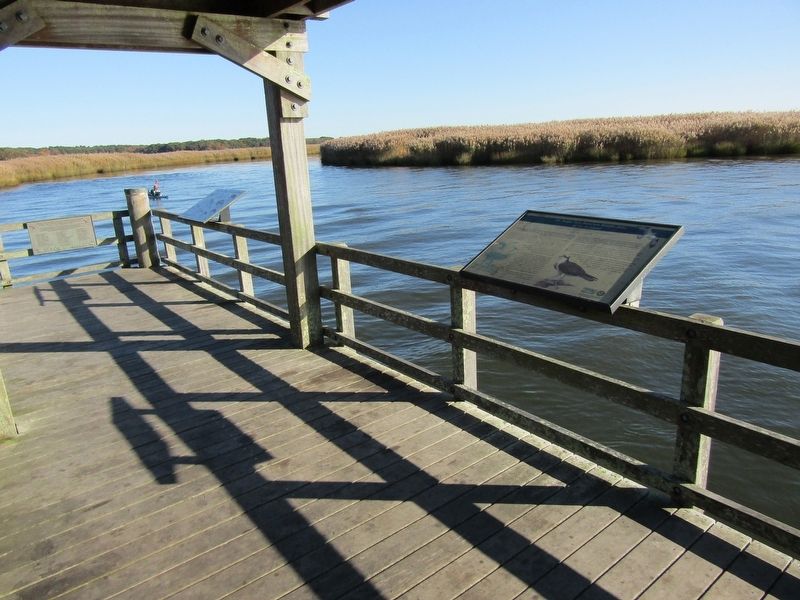
2. Dr. Roger Tory Peterson Wildlife Area Marker

Regionally, this marker is on the Connecticut Shoreline, in Greater New London, in Mystic and the Eastern Shore, and in the Thames River Valley. It is also in the American Northeast, in New England, and on the Eastern Seaboard. Globally, it is in the North Atlantic Region, North America, the Western Hemisphere, the Western World, and the Anglosphere. Historically, it finds itself in what was once New London County and also one of the original Thirteen Colonies.
Other nearby markers. At least 8 other markers are within walking distance of this marker: Osprey (a few steps from this marker); Anadromous Fish (a few steps from this marker); British Raid 1814 (approx. 0.2 miles away); Connecticut River (approx. 0.3 miles away); Votes For Women (approx. ¾ mile away); Basil (approx. ¾ mile away); Margaret Crosley Lewia (approx. ¾ mile away); Cato (approx. ¾ mile away). Touch for a list and map of all markers in Old Lyme.
Also see . . . Roger Tory Peterson (Wikipedia). (Submitted on March 17, 2025.)
Credits. This page was last revised on May 19, 2026. It was originally submitted on March 17, 2025, by Conrad Ward of Guilford, Connecticut. This page has been viewed 140 times since then and 19 times this year. Photos: 1, 2. submitted on March 17, 2025, by Conrad Ward of Guilford, Connecticut. • Michael Herrick was the editor who published this page.
