Near Cushing in Rusk County, Texas — The American South (West South Central)
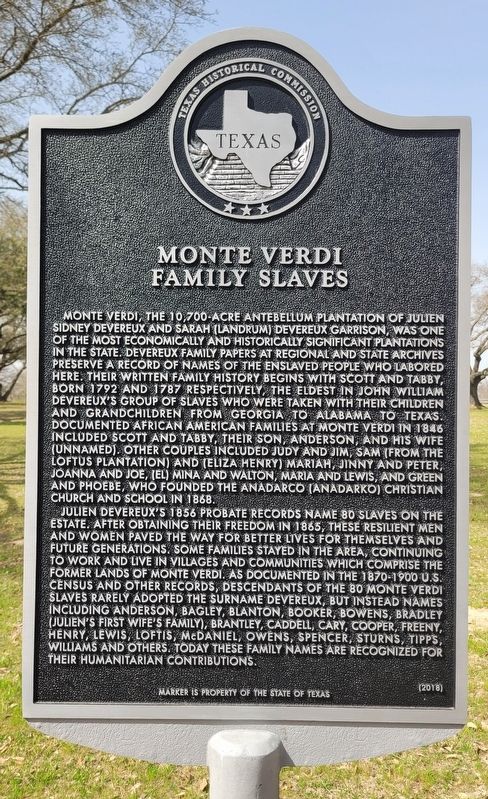
Monte Verdi Family Slaves
Photographed by James Hulse, March 15, 2025
1. Monte Verdi Family Slaves Marker
Julien Devereux's 1856 probate records name 80 slaves on the estate. After obtaining their freedom in 1865, these resilient men and women paved the way for better lives for themselves and future generations. Some families stayed in the area, continuing to work and live in villages and communities which comprise the former lands of Monte Verdi. As documented in the 1870-1900 U.S. Census and other records, descendants of the 80 Monte Verdi slaves rarely adopted the surname Devereux, but instead names including Anderson, Bagley, Blanton, Booker, Bowens, Bradley (Julien's first wife's family), Brantley, Caddell, Cary, Cooper, Freeny, Henry, Lewis, Loftis, Medaniel, Owens, Spencer, Sturns, Tipps, Williams and others. Today these family names are recognized for their humanitarian contributions.
Erected 2018 by Texas Historical Commission. (Marker Number 20165.)
Topics.
this page online
Location. 31° 54.074′ N, 94° 52.185′ W. Marker is near Cushing, Texas, in Rusk County. It is on County Road 4233 0.7 miles west of Highway 2753, on the right when traveling west. The marker is located along the road. Touch for map. Marker is at or near this postal address: 11988 Co Rd 4233, Cushing TX 75760, United States of America. Touch for directions.

Regionally, this marker is in the American South, specifically in the Deep South, and in the Piney Woods. Globally, it is in North America, a Gulf of Mexico state, the Western Hemisphere, the Western World, and the Anglosphere. Historically, it finds itself in what was once New Spain, the Republic of Texas, one of the Confederate States of America, and the Antebellum South.
Other nearby markers. At least 8 other markers are within 7 miles of this marker, measured as the crow flies: Glenfawn Cemetery (approx. ¾ mile away); Lyles-Sanders Cemetery (approx. 5.4 miles away); Sulphur Springs Missionary Baptist Church
Photographed by James Hulse, March 15, 2025
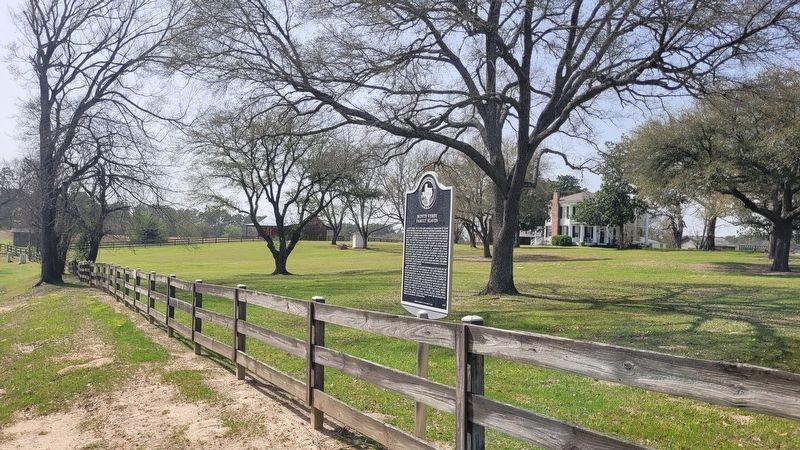
2. The view of the Monte Verdi Family Slaves Marker along the road
Photographed by James Hulse, March 15, 2025
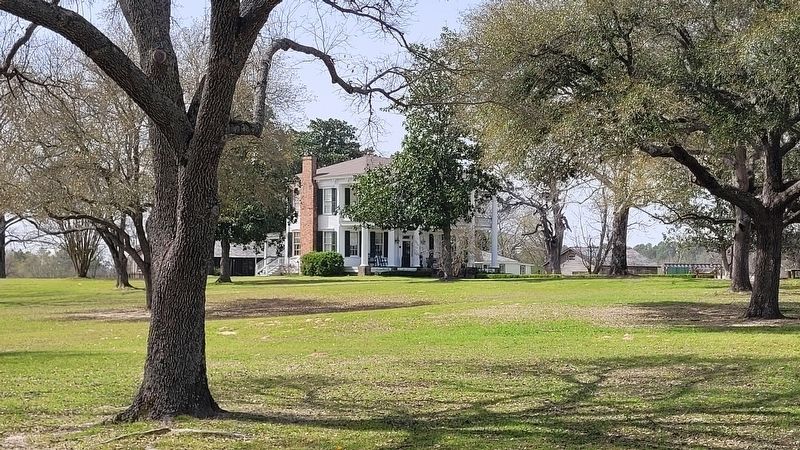
3. The Monte Verdi Plantation
Credits. This page was last revised on March 20, 2025. It was originally submitted on March 19, 2025, by James Hulse of Medina, Texas. This page has been viewed 928 times since then and 277 times this year. Photos: 1, 2. submitted on March 19, 2025, by James Hulse of Medina, Texas. 3. submitted on March 20, 2025, by James Hulse of Medina, Texas.
