Champlain in Clinton County, New York — The American Northeast (Mid-Atlantic)
The Shipwrights of Champlain
⎯⎯⎯
La construction navale á Champlain
Photographed by Cosmos Mariner, May 19, 2024
1. The Shipwrights of Champlain Marker

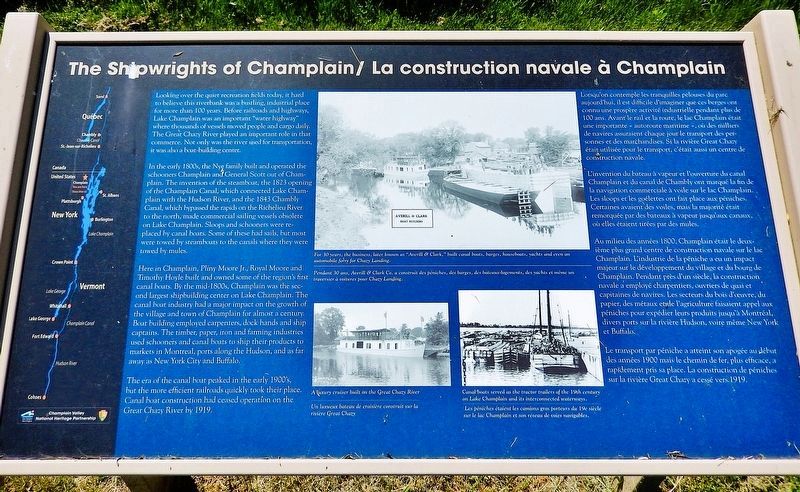
In the early 1800s, the Nye family built and operated the schooners Champlain and General Scott out of Champlain. The invention of the steamboat, the 1823 opening of the Champlain Canal, which connected Lake Champlain with the Hudson River, and the 1843 Chambly Canal which bypassed the rapids on the Richelieu River to the north, made commercial sailing vessels obsolete on Lake Champlain. Sloops and schooners were replaced by canal boats. Some of these had sails, but most were towed by steamboats to the canals where they were towed by mules.
Here in Champlain, Pliny Moore Jr., Royal Moore and Timothy Hoyle built and owned some of the region's first canal boats. By the mid-1800s, Champlain
this page online
The era of the canal boat peaked in the early 1900's, but the more efficient railroads quickly took their place. Canal boat construction had ceased operation on the Great Chazy River by 1919.
L'invention du bateau à vapeur et
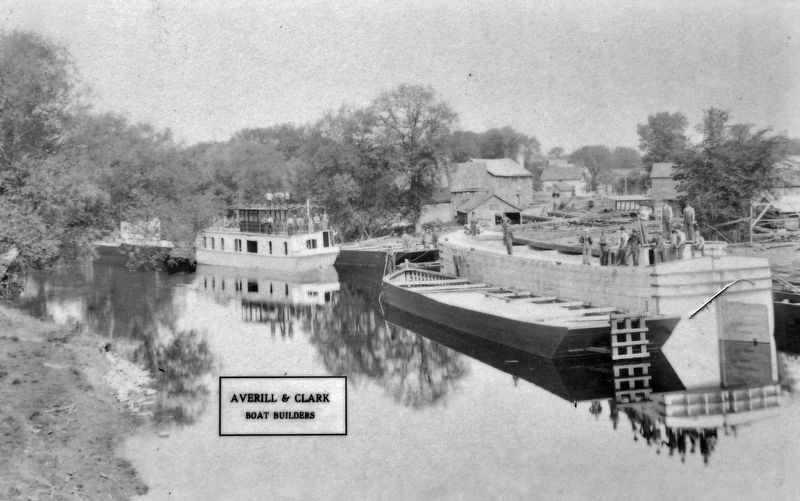
2. Marker detail: Averill & Clark, Boat Builders
For 30 years, the business, later known as “Averill & Clark,” built canal boats, barges, houseboats, yachts and even an automobile ferry for Chazy Landing. • • • Pendant 30 ans, Averill & Clark Co. a construit des péniches, des barges, des bateaux-logements, des yachts et même un traversier a voitures Pour Chazy Landing.
Au milieu des années 1800, Champlain était le deuxième plus grand centre de construction navale sur le lac Champlain. L'industrie de la péniche a eu un impact majeur sur le développement du village et du bourg de Champlain. Pendant près d'un siècle, la construction navale a employé charpentiers, ouvriers de quai et capitaines de navires. Les secteurs du bois d'œuvre, du papier, des métaux et de l'agriculture faisaient appel aux péniches pour expédier leurs produits jusqu'à Montréal, divers ports sur la rivière Hudson, voire même New York et Buffalo.
Le transport par péniche a atteint son apogée au début des années 1900 mais le chemin de fer, plus efficace, a rapidement pris sa place. La construction de péniches sur la rivière Great Chazy a cessé vers 1919.
Erected by Champlain Valley National Heritage
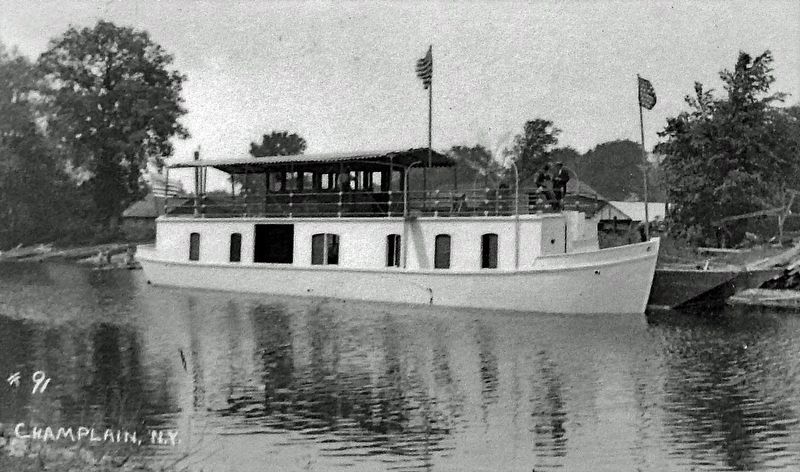
3. Marker detail: Luxury Cruiser
A luxury cruiser built on the Great Chazy River • • • Un luxueux bateau de croisière construit sur la rivière Great Chazy
Topics. This historical marker is listed in these topic lists: Industry & Commerce • Waterways & Vessels. A significant historical year for this entry is 1823.
Location. 44° 59.088′ N, 73° 26.571′ W. Marker is in Champlain, New York, in Clinton County. It is on River Street 0.2 miles east of Elm Street, on the right when traveling east. The marker is located in Bill Earl Park, overlooking the Great Chazy River. Touch for map. Marker is in this post office area: Champlain NY 12919, United States of America. Touch for directions.

Regionally, this marker is in Upstate New York, in the Adirondacks & North Country, and in the Champlain Valley. It is also in the American Northeast and in the Mid-Atlantic. Globally, it is in North America, the Great North Woods, the Western Hemisphere, the Western World, and the Anglosphere. Historically, it finds itself in what was once the Viceroyalty of New France, New Netherland, and one of the original Thirteen Colonies.
Other nearby markers. At least 8 other markers are within 4 miles of this marker, measured as the crow flies: Bill Earl Park (within shouting distance

4. Marker detail: Canal Boats
Canal boats served as the tractor trailers of the 19th century on Lake Champlain and its interconnected waterways. • • • Les péniches étaient les camions gros porteurs du 19e siècle sur le Lac Champlain et son réseau de voies navigables.
Also see . . . Champlain Canal (Wikipedia).
Excerpt: The Champlain Canal is a 60-mile canal in New York that connects the Hudson River to the south end of Lake Champlain. It was simultaneously constructed with the Erie Canal for use by commercial vessels, fully opening in 1823. Today, it is mostly used by recreational boaters as part of the New York State Canal System and Lakes to Locks Passage.(Submitted on March 19, 2025, by Cosmos Mariner of Cape Canaveral, Florida.)

Photographed by Cosmos Mariner, May 19, 2024
5. The Shipwrights of Champlain Marker
Looking south; the Great Chazy River is in the background.
Credits. This page was last revised on April 5, 2025. It was originally submitted on March 19, 2025, by Cosmos Mariner of Cape Canaveral, Florida. This page has been viewed 187 times since then and 46 times this year. Photos: 1, 2, 3, 4, 5. submitted on March 19, 2025, by Cosmos Mariner of Cape Canaveral, Florida.
