Monnickendam in Waterland, North Holland, Netherlands — Northwestern Europe
Joodse Begrafplaats
⎯⎯⎯
Jewish Cemetery
Photographed by Andrew Ruppenstein, March 19, 2025
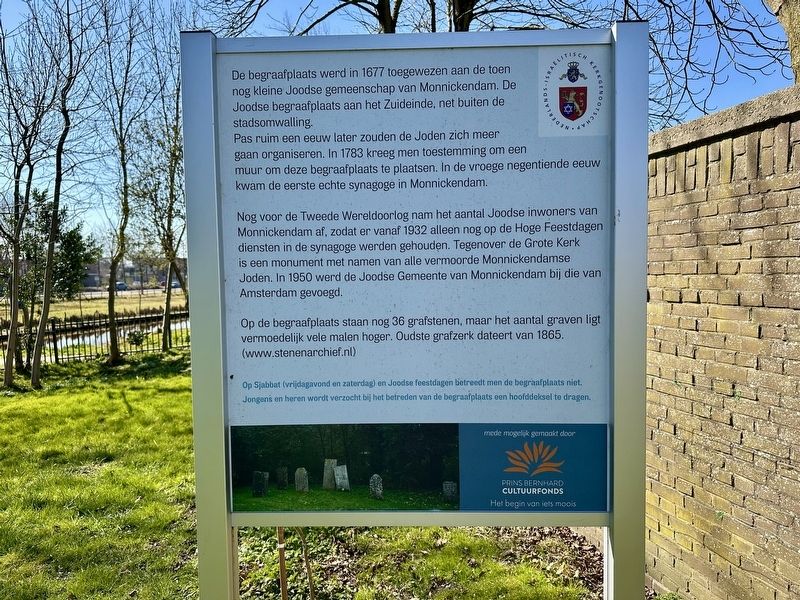
1. Joodse Begrafplaats / Jewish Cemetery Marker

Pas ruim een eeuw later zouden de Joden zich meer gaan organiseren. In 1783 kreeg men toestemming om een muur om deze begraafplaats te plaatsen. In de vroege negentiende eeuw kwam de eerste echte synagoge in Monnickendam.
Nog voor de Tweede Wereldoorlog nam het aantal Joodse inwoners van Monnickendam af, zodat er vanaf 1932 alleen nog op de Hoge Feestdagen diensten in de synagoge werden gehouden. Tegenover de Grote Kerk is een monument met namen van alle vermoorde Monnickendamse Joden. In 1950 werd de Joodse Gemeente van Monnickendam bij die van Amsterdam gevoegd.
Op de begraafplaats staan nog 36 grafstenen, maar het aantal graven ligt vermoedelijk vele malen hoger. Oudste grafzerk dateert van 1865.
(www.stenenarchief.nl)
Op Sjabbat (vrijdagavond en zaterdag) en Joodse feestdagen betreedt men de begraafplaats niet. Jongens en heren wordt verzocht bij het betreden van de begraafplaats een hoofddeksel te dragen.
The cemetery was assigned to the then small Jewish community of Monnickendam in 1677. The Jewish cemetery
this page online
It was not until more than a century later that the Jews would start to organize themselves more. In 1783, permission was granted to place a wall around this cemetery. In the early nineteenth century, the first real synagogue came to Monnickendam.
Even before the Second World War, the number of Jewish residents of Monnickendam decreased, so that from 1932 onwards services were only held in the synagogue on the High Holidays. Opposite the Grote Kerk is a monument with the names of all the murdered Monnickendam Jews. In 1950, the Jewish Community of Monnickendam was merged with that of Amsterdam.
There are still 36 gravestones in the cemetery, but the number of graves is probably many times higher. The oldest gravestone dates from 1865.
(www.stenenarchief.nl)
On Shabbat (Friday evening and Saturday) and Jewish holidays, the cemetery is not entered. Boys and men are requested to wear a head covering when entering the cemetery.
Topics. This historical marker is listed in these topic lists: Cemeteries & Burial Sites • Religion & Religious Structures. A significant historical year for this entry is 1677.
Location. 52° 27.438′ N, 5° 2.325′ E. Marker is in Monnickendam, Noord-Holland (North Holland),
Photographed by Andrew Ruppenstein, March 19, 2025
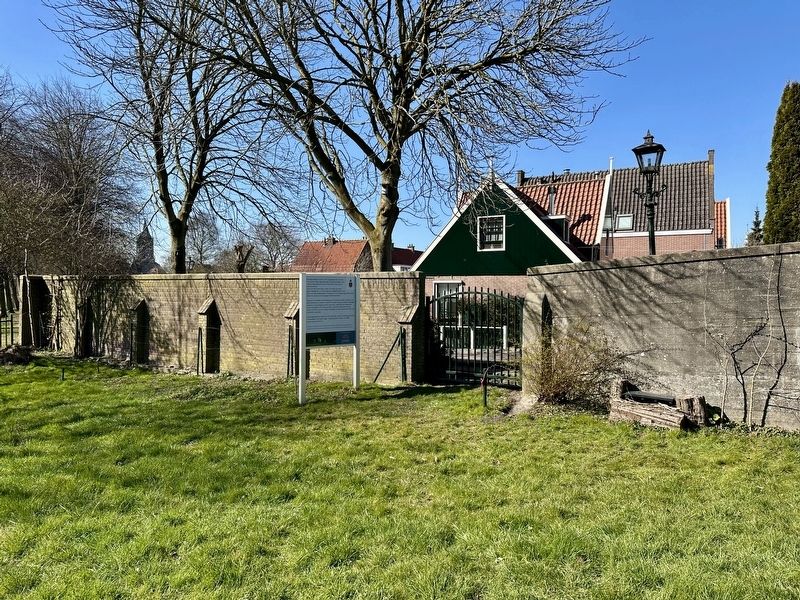
2. Joodse Begrafplaats / Jewish Cemetery Marker - wide view
The marker is located within the cemetery and is not really visible from the street.

Regionally, it is in Europe, the European Union, Atlantic Europe, the Benelux Low Countries, the Schengen Area, Western Europe, and the Western World. Historically, it finds itself in what was once the Holy Roman Empire.
Other nearby markers. At least 8 other markers are within walking distance of this marker: Doopsgezinde Vermaning / Mennonite Meeting House (about 180 meters away, measured in a direct line); Voormalig Hervormd Burger Weeshuis / Former Protestant Orphanage (about 210 meters away); Weezenland 17 (about 210 meters away); Andries Witmond (approx. 0.3 kilometers away); Philip Benjamin Witmond (approx. 0.3 kilometers away); Speeltoren / Bell Tower (approx. 0.3 kilometers away); Het Kerkhof / The Church Cemetery (approx. 0.3 kilometers away); “De Vergulde Eenhoorn” / “The Gilded Unicorn” (approx. 0.3 kilometers away). Touch for a list and map of all markers in Monnickendam.
Also see . . . Joodse begraafplaats (Monnickendam) (Wikipedia, in Dutch). Excerpt (in translation):
The Jewish cemetery of Monnickendam is located on the Zuideinde, just outside(Submitted on March 20, 2025.)the city walls. This is typical for a Jewish cemetery, because the Jews themselves consider these to be unclean. That is why a Jewish cemetery was always built outside the city.Photographed by Andrew Ruppenstein, March 19, 20253. Joodse Begrafplaats / Jewish Cemetery
The cemetery was assigned in 1677 to the then few (probably Sephardic) Jewish inhabitants of Monnickendam. It was not until a century later that the Jews would start to organize themselves more. In the early nineteenth century, the first real synagogue was built. Even before the Second World War, the number of Jewish inhabitants of Monnickendam decreased, but services were still held on important Jewish holidays. After the war, the municipality was incorporated into Amsterdam.
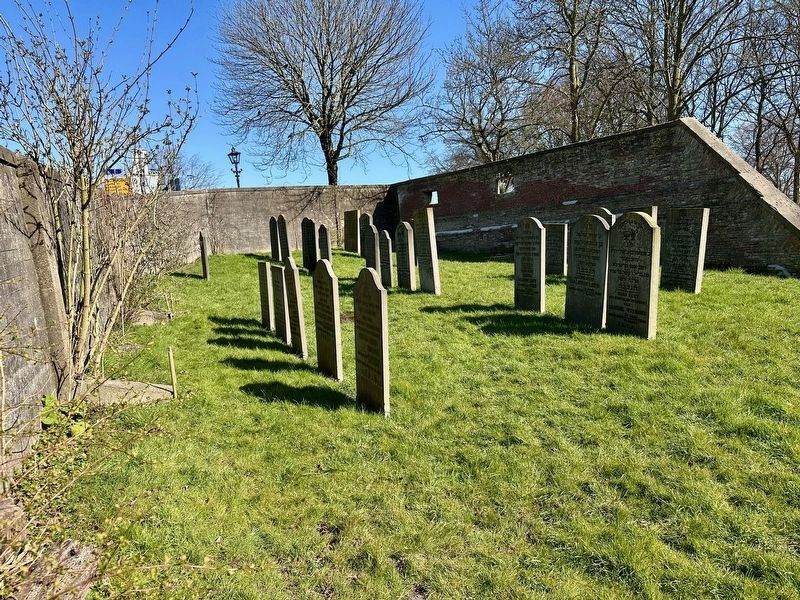
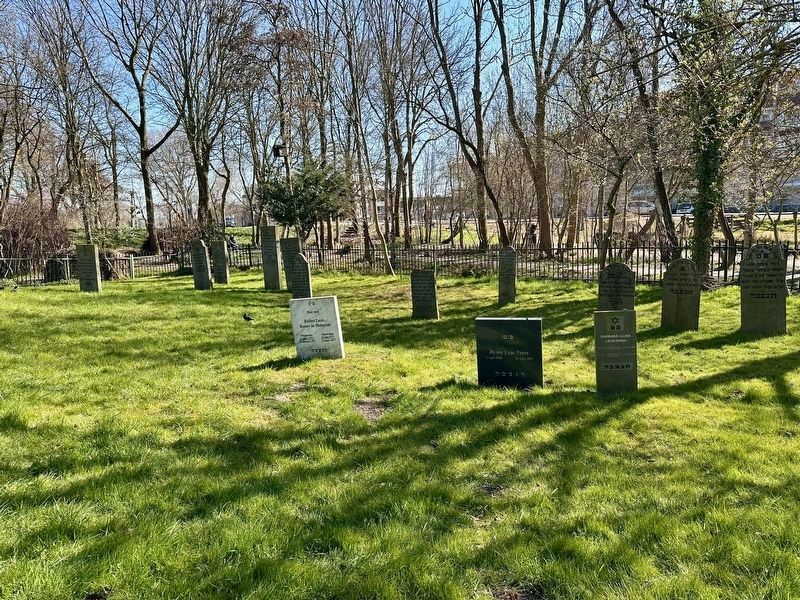
There are still 36 gravestones in the cemetery, but the number of people buried is probably many times higher. The texts on the stones have been blackened out and are therefore easy to read. The local government manages the cemetery.
Photographed by Andrew Ruppenstein, March 19, 2025
4. Joodse Begrafplaats / Jewish Cemetery
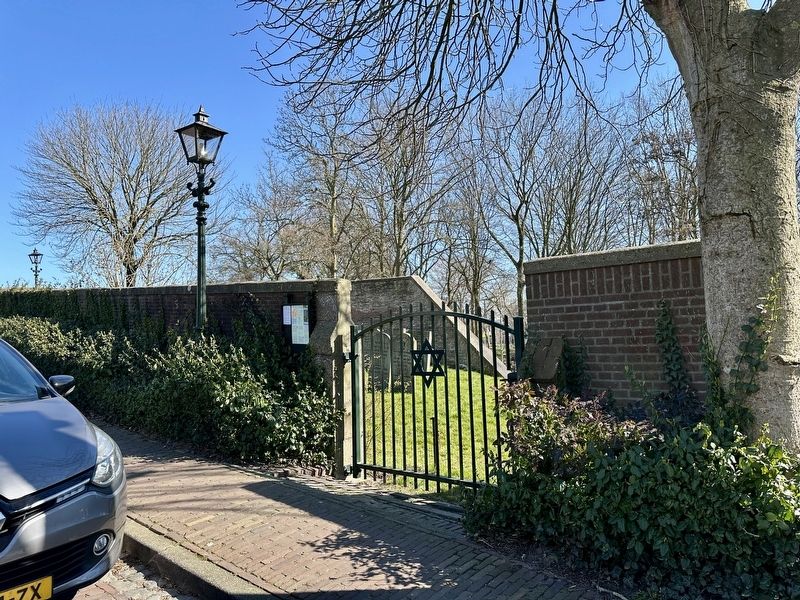
Photographed by Andrew Ruppenstein, March 19, 2025
5. Cemetery entrance
Credits. This page was last revised on March 20, 2025. It was originally submitted on March 20, 2025, by Andrew Ruppenstein of Lamorinda, California. This page has been viewed 85 times since then and 11 times this year. Photos: 1, 2, 3, 4, 5. submitted on March 20, 2025, by Andrew Ruppenstein of Lamorinda, California.
