Gloucester Point in Gloucester County, Virginia — The American South (Mid-Atlantic)
On to Richmond!
McClellan Invades the Virginia Tidewater
Photographed by Bernard Fisher, May 2, 2009
1. On to Richmond! Marker
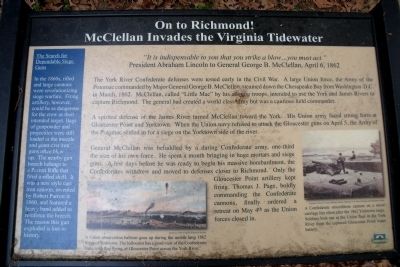
“It is indispensable to you that you strike a blow...you must act.”
President Abraham Lincoln to General George B. McClellan, April 6, 1862
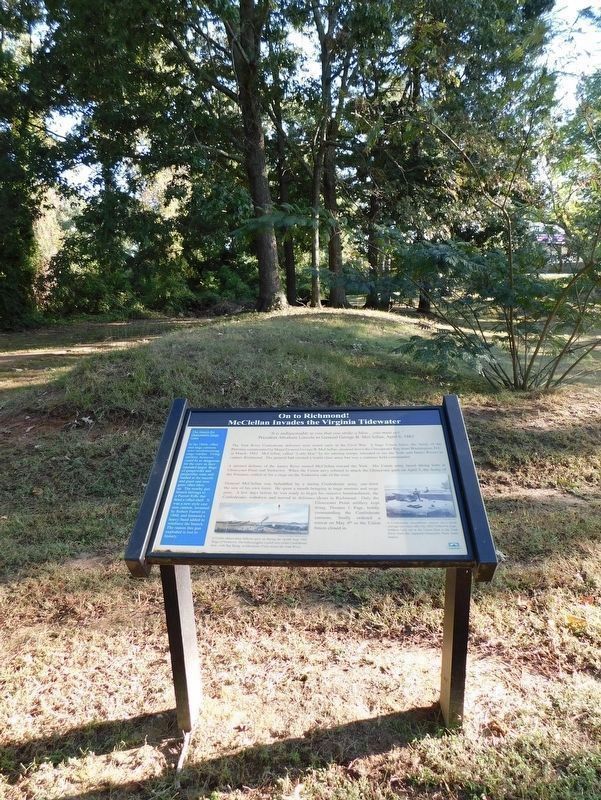
The York River Confederate defenses were tested early in the Civil War. A large Union force, the Army of the Potomac, commanded by Major General George B. McClellan, steamed down the Chesapeake Bay from Washington D.C. in March, 1862. McClellan, called “Little Mac” by his adoring troops, intended to use the York and James Rivers to capture Richmond. The general had created a world class army but was a cautious field commander.
A spirited defense of the James River turned McClellan toward the York. His Union army faced strong forts at Gloucester Point and Yorktown. When the Union navy refused to attack the Gloucester guns on April 5, the Army of the Potomac settled in for a siege on the Yorktown side of the river.
General McClellan was befuddled by a daring Confederate army, one-third the size of his own force. He spent a month bringing in huge mortars and siege guns. A few days before he was ready to begin his massive bombardment, the Confederates withdrew and moved to defenses
this page online
(sidebar)
The Search for Dependable Siege Guns
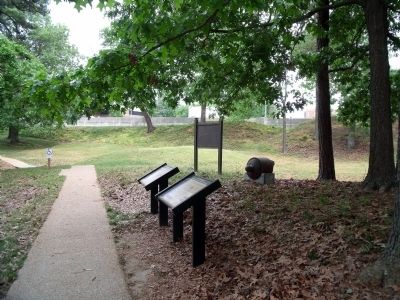
In the 1860s, rifled and large cannons were revolutionizing siege warfare. Firing artillery, however, could be as dangerous for the crew as their intended target. Bags of gunpowder and projectiles were still loaded at the muzzle and giant cast iron guns often blew up. The nearby gun breech belongs to a Parrott Rifle that fired a rifled shell. It was a new style cast iron cannon, invented by Robert Parrott in 1860, and featured a heavy band added to reinforce the breech. The reason this gun exploded is lost to history.
(captions)
A Union observation balloon goes up during the month long 1862 Siege of Yorktown. The balloonist has a good view of the Confederate forts, with flag flying, at Gloucester Point across the York River. Courtesy of the Virginia Historical Society
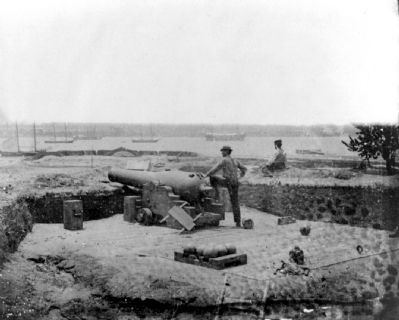
A Confederate smoothbore cannon on a naval carriage lies silent after the 1862 Yorktown siege. Soldiers look out at the Union fleet in the York River from the captured Gloucester Point water battery. Courtesy of the U.S. Army Military History Institute, U.S. Army Heritage and Education Center
Erected by Chesapeake
Photographed by Bernard Fisher, May 2, 2009
2. Tyndall’s Point Park Walkway.
Topics. This historical marker is listed in this topic list: War, US Civil. A significant historical month for this entry is March 1862.
Location. 37° 14.98′ N, 76° 30.149′ W. Marker is in Gloucester Point, Virginia, in Gloucester County. It can be reached from Vernon Street near Riverview Street. The marker is on the Tyndall’s Point Park Walkway. Touch for map. Marker is at or near this postal address: 1376 Vernon Street, Gloucester Point VA 23062, United States of America. Touch for directions.

Regionally, this marker is on the Middle Peninsula and in the Hampton Roads Metropolitan Area. It is also in the American South, specifically in the Upper South, in the Tidewater, in the Chesapeake Bay Region, and on the Eastern Seaboard. Globally, it is in the North Atlantic Region, North America, the Western Hemisphere, the Western World, and the Anglosphere. Historically, it finds itself in what was once the territory of the Mississippian Culture, one of the original Thirteen Colonies, one of the Confederate States of America, and the Antebellum South.
Other nearby markers. At least 8 other markers are within
Photographed by Bradley Owen, October 18, 2021
3. On to Richmond! Marker
Marker is shown at its new location.
Photographed by George N. Barnard, June 1862
4. Confederate fortifications at Gloucester Point, Va., opposite Yorktown, Va.
Library of Congress [LC-USZ62-76208]
Photographed by Bernard Fisher, May 2, 2009
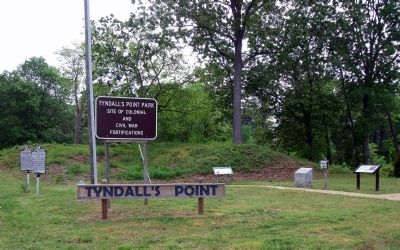
5. Tyndall’s Point Park Entrance.
Credits. This page was last revised on March 21, 2025. It was originally submitted on May 8, 2009, by Bernard Fisher of Richmond, Virginia. This page has been viewed 1,214 times since then and 29 times this year. Last updated on March 20, 2025, by Evan Dwyer of Richmond, Virginia. Photos: 1, 2. submitted on May 8, 2009, by Bernard Fisher of Richmond, Virginia. 3. submitted on November 26, 2021, by Bradley Owen of Morgantown, West Virginia. 4, 5. submitted on May 8, 2009, by Bernard Fisher of Richmond, Virginia.
