Gloucester Point in Gloucester County, Virginia — The American South (Mid-Atlantic)
A Vital British Outpost at Gloucester Point
Photographed by Bernard Fisher, May 2, 2009
1. A Vital British Outpost at Gloucester Point Marker
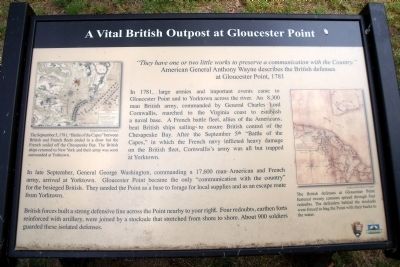
In 1781, large armies and important events came to Gloucester Point and to Yorktown across the river. An 8,300 man British army, commanded by General Charles Lord Cornwallis, marched to the Virginia coast to establish a naval base. A French battle fleet, allies of the Americans, beat British ships sailing to ensure British control of the Chesapeake Bay. After the September 5th “Battle of the Capes,” in which the French navy inflicted heavy damage on the British fleet, Cornwallis’s army was all but trapped at Yorktown.
In late September, General George Washington, commanding a 17,600 man American and French army, arrived at Yorktown. Gloucester Point became the only “communication with the country” for the besieged British. They needed the Point as a base to forage for local supplies and as an escape route from Yorktown.
British forces built a strong defensive line across the Point nearby to your right. Four redoubts, earthen forts reinforced with
this page online
Erected by National Park Service, Chesapeake Bay Gateways Network.
Topics. This historical marker is listed in these topic lists: Forts and Castles • War, US Revolutionary. A significant historical month for this entry is September 1781.
Location. 37° 14.99′ N, 76° 30.136′ W. Marker is in Gloucester Point, Virginia, in Gloucester County. It can be reached from Vernon Street near Riverview Street. The marker is on the Tyndall’s Point Park Walkway. Touch for map. Marker is at or near this postal address: 1376 Vernon Street, Gloucester Point VA 23062, United States of America. Touch for directions.

Regionally, this marker is on the Middle Peninsula and in the Hampton Roads Metropolitan Area. It is also in the American South, specifically in the Upper South, in the Tidewater, in the Chesapeake Bay Region, and on the Eastern Seaboard. Globally, it is in the North Atlantic Region, North America, the Western Hemisphere, the Western World, and the Anglosphere. Historically, it finds itself in what was once
Photographed by Bernard Fisher, May 2, 2009
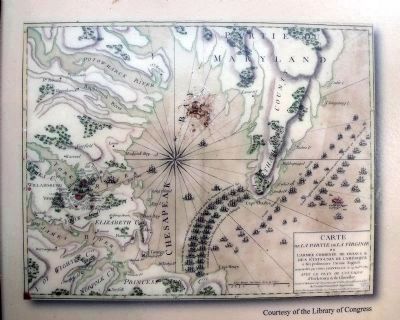
2. Map of Chesapeake Bay.
The September 5, 1781, “Battle of the Capes” between British and French fleets ended in a draw but the French sealed off the Chesapeake Bay. The British ships returned to New York and their army was soon surrounded at Yorktown. Courtesy of the Library of Congress
Other nearby markers. At least 8 other markers are within walking distance of this marker: The British Safety Valve (here, next to this marker); Parts of a Parrott Rifle (here, next to this marker); On to Richmond! (within shouting distance of this marker); Natives, Explorers, Tobacco and Buccaneers (within shouting distance of this marker); Classic Camp Life (within shouting distance of this marker); Still Defending Virginia’s Shores (within shouting distance of this marker); Gloucester Point (within shouting distance of this marker); Attacking with “Decisive Vigor” (within shouting distance of this marker). Touch for a list and map of all markers in Gloucester Point.
Photographed by Bernard Fisher, May 2, 2009
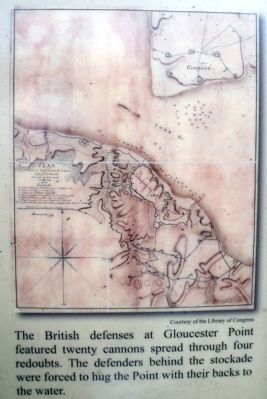
3. British Defenses at Gloucester Point.
The British defenses at Gloucester Point featured twenty cannons spread though four redoubts. The defenses behind the stockade were forced to hug the Point with their backs to the water. Courtesy of the Library of Congress
Photographed by Bernard Fisher, May 2, 2009
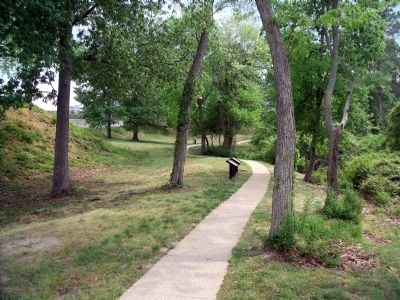
4. The Tyndall’s Point Park Walkway.
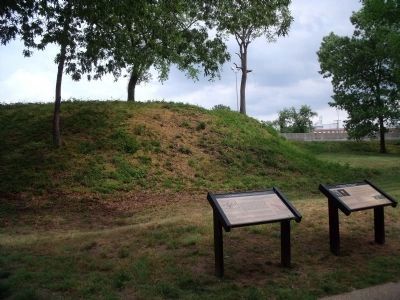
Photographed by Bernard Fisher, May 2, 2009
5. Markers and earthworks at Gloucester Point.
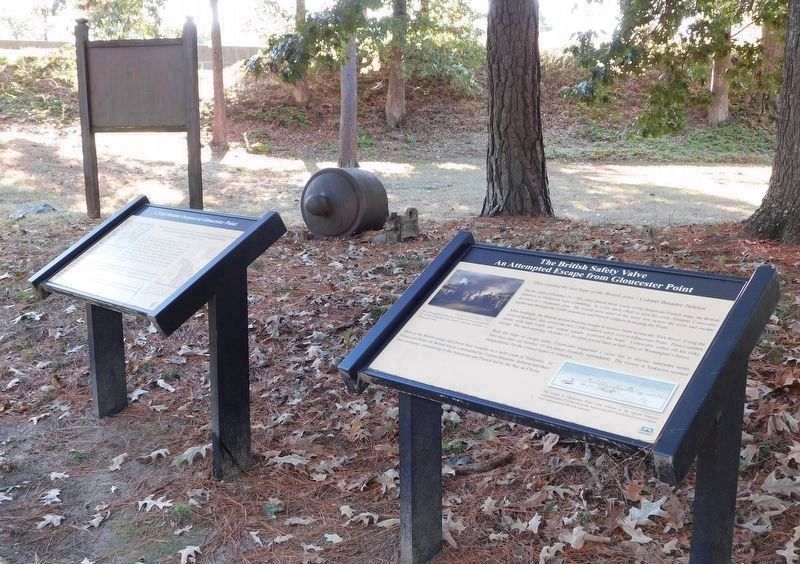
Photographed by Bradley Owen, October 18, 2021
6. A Vital British Outpost at Gloucester Point Marker
Seen on the left, the marker has been relocated to near the “Parts of a Parrott Rifle” marker.
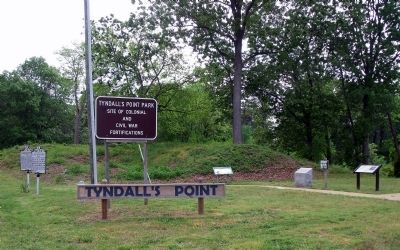
Photographed by Bernard Fisher, May 2, 2009
7. Tyndall’s Point Park Entrance.
Credits. This page was last revised on March 21, 2025. It was originally submitted on May 7, 2009, by Bernard Fisher of Richmond, Virginia. This page has been viewed 1,540 times since then and 43 times this year. Last updated on March 20, 2025, by Evan Dwyer of Richmond, Virginia. Photos: 1, 2, 3, 4, 5. submitted on May 7, 2009, by Bernard Fisher of Richmond, Virginia. 6. submitted on November 4, 2021, by Bradley Owen of Morgantown, West Virginia. 7. submitted on May 7, 2009, by Bernard Fisher of Richmond, Virginia.
