Gloucester Point in Gloucester County, Virginia — The American South (Mid-Atlantic)
Classic Camp Life
The Union Army Occupies Gloucester Point
Photographed by Bernard Fisher, May 2, 2009
1. Classic Camp Life Marker
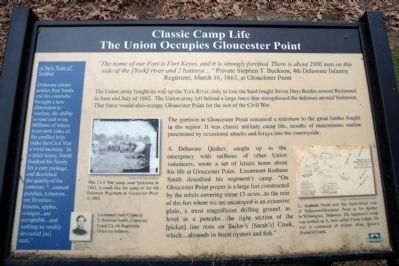
“The name of our Fort is Fort Keyes, and it is strongly fortified. There is about 2000 men on this side of the [York] river and 2 batterys…” Private Stephen T. Buckson, 4th Delaware infantry Regiment, March 16, 1863, at Gloucester Point
The Union army fought its way up the York River, only to lose the hard fought Seven Days Battles around Richmond in June and July of 1862. The Union army left behind a large force that strengthened the defenses around Yorktown. That force would also occupy Gloucester Point for the rest of the Civil War.
The garrison at Gloucester Point remained a sideshow to the great battles fought in the region. It was classic military camp life, months of monotonous routine punctuated by occasional attacks and forays into the countryside.
A Delaware Quaker, caught up in the emergency with millions of other Union volunteers, wrote a set of letters home about his life at Gloucester Point. Lieutenant Rodman Smith described his regiment’s camp. “On Gloucester Point proper is a large fort constructed by the rebels covering some 15 acres…to the rear of the fort where we are encamped is an extensive
this page online
(sidebar)
A New Type of Soldier
Delaware citizen soldier Rod Smith and his comrades brought a new dimension to warfare, the ability to read and write. Millions of letters from both sides of the conflict help make the Civil War a vivid memory. In a letter home, Smith thanked his family for a care package, and described the quality of the contents: "…canned peaches, tomatoes...are favorites…lemons, apples, oranges…are acceptable…and nothing so readily devoured [as] nuts."
Erected by Chesapeake Bay Gateways Network.
Topics. This historical marker is listed in this topic list: War, US Civil. A significant historical date for this entry is March 16, 1863.
Location. 37° 14.998′ N, 76° 30.113′ W. Marker is in Gloucester Point, Virginia, in Gloucester County. It can be reached from Vernon Street near Riverview Street. The marker is on the Tyndall’s Point Park Walkway. Touch for map. Marker is at or near this postal address: 1376 Vernon Street, Gloucester Point VA
Photographed by Bernard Fisher, May 2, 2009
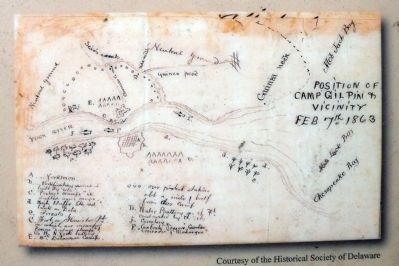
2. Position of Camp Gilpin & Vicinity, Feb 7, 1863.
Lt. Rodman Smith sent this hand-drawn map of Yorktown/Gloucester Point to his mother in Wilmington, Delaware. His regiment’s camp was marked with an E, then called Camp Gilpin. He was in command of pickets along Sailor’s [Sarah’s] Creek. Courtesy of the Historical Society of Delaware

Regionally, this marker is on the Middle Peninsula and in the Hampton Roads Metropolitan Area. It is also in the American South, specifically in the Upper South, in the Tidewater, in the Chesapeake Bay Region, and on the Eastern Seaboard. Globally, it is in the North Atlantic Region, North America, the Western Hemisphere, the Western World, and the Anglosphere. Historically, it finds itself in what was once the territory of the Mississippian Culture, one of the original Thirteen Colonies, one of the Confederate States of America, and the Antebellum South.
Other nearby markers. At least 8 other markers are within walking distance of this marker: Parts of a Parrott Rifle (within shouting distance of this marker); A Vital British Outpost at Gloucester Point (within shouting distance of this marker); The British Safety Valve (within shouting distance of this marker); Attacking with “Decisive Vigor” (within shouting distance of this marker); Where North Meets South (within shouting distance of this marker); Gloucester Point (within shouting distance of this marker);
Photographed by Bernard Fisher, May 2, 2009
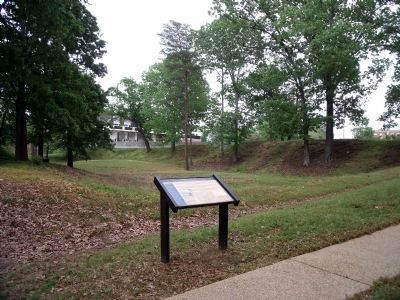
3. Tyndall’s Point Park Walkway.
More about this marker. On the upper left is a photo of a Union camp with the caption, “This Civil War camp, near Yorktown in 1862, is much like the camp of the 4th Delaware Regiment at Gloucester Point in 1863.” Courtesy of the Library of Congress
On the lower left is a photo of “Lieutenant (later Captain) S. Rodman Smith, Company I (and C), 4th Regiment, Delaware Infantry.” Courtesy of the Historical Society of Delaware
On the lower right is a map with the caption, “Lt. Rodman Smith sent this hand-drawn map of Yorktown/Gloucester Point to his mother in Wilmington, Delaware. His regiment’s camp was marked with an E, then called Camp Gilpin. He was in command of pickets along Sailor’s [Sarah’s] Creek.” Courtesy of the Historical Society of Delaware
Photographed by Bernard Fisher, May 2, 2009
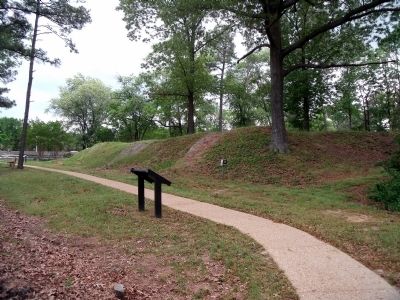
4. Marker & earthworks along Tyndall’s Point Park Walkway.
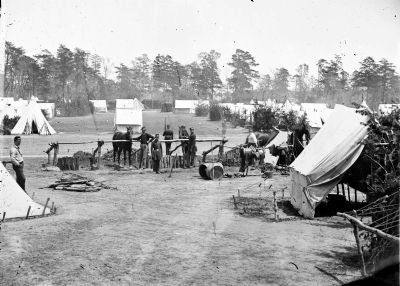
Photographed by James. F. Gibson, May 3, 1862
5. Yorktown, Va., vicinity. Headquarters of Gen. George B. McClellan, Camp Winfield Scott.
Library of Congress [LC-B811- 367A]
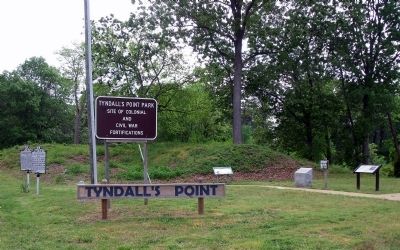
Photographed by Bernard Fisher, May 2, 2009
6. Tyndall’s Point Park Entrance.
Credits. This page was last revised on March 21, 2025. It was originally submitted on May 8, 2009, by Bernard Fisher of Richmond, Virginia. This page has been viewed 1,899 times since then and 53 times this year. Last updated on March 20, 2025, by Evan Dwyer of Richmond, Virginia. Photos: 1, 2, 3, 4, 5, 6. submitted on May 8, 2009, by Bernard Fisher of Richmond, Virginia.
