Near Henderson in Rusk County, Texas — The American South (West South Central)
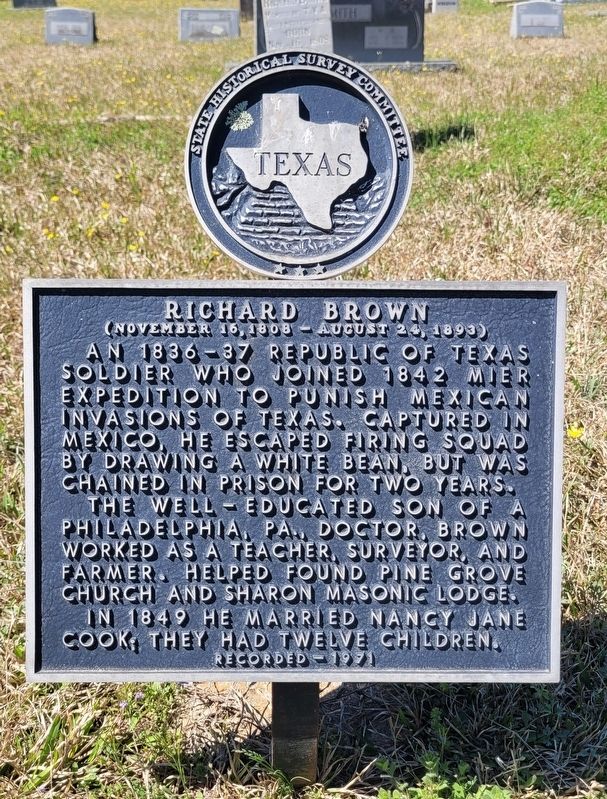
Richard Brown
(November 16, 1808 – August 24, 1893)
Photographed by James Hulse, March 16, 2025
1. Richard Brown Marker
Erected 1971 by State Historical Survey Committee. (Marker Number 10971.)
Topics. This historical marker is listed in these topic lists: War, Texas Independence • Wars, Non-US. A significant historical year for this entry is 1842.
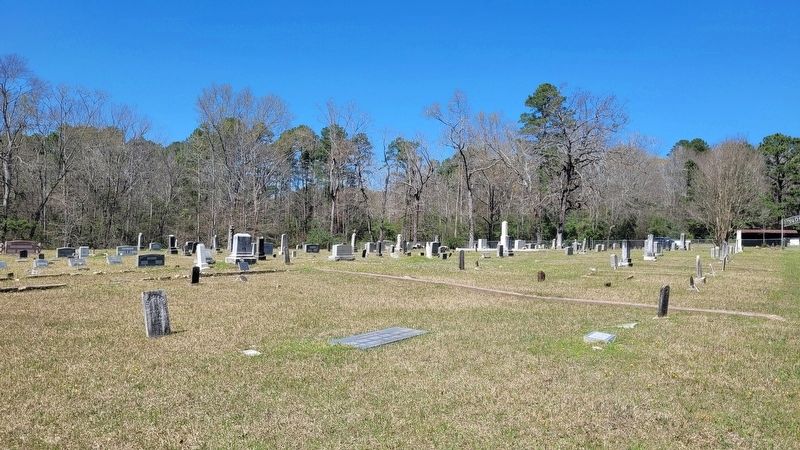
Location. 32° 6.088′ N, 94° 39.214′ W. Marker is near Henderson, Texas, in Rusk County. It can be reached from County Road 364 0.6 miles south of Farm to Market Road 2867, on the left when traveling south. The marker is located in the center section of the Pine Grove Cemetery. Touch for map. Marker is at or near this postal address: 3641 County Rd 364 S, Henderson TX 75654, United States of America. Touch for directions.

Regionally,
this page online
Other nearby markers. At least 8 other markers are within 4 miles of this marker, measured as the crow flies: Pine Grove Cumberland Presbyterian Church (within shouting distance of this marker); Pine Hill Methodist Cemetery (approx. 2½ miles away); Welch Cemetery (approx. 2.9 miles away); Bridges Cemetery (approx. 2.9 miles away); Buckner Cemetery (approx. 3 miles away); The Patrick Community (approx. 3.2 miles away); Blossom Hill United Methodist Church (approx. 3.6 miles away); Brachfield (approx. 3.9 miles away). Touch for a list and map of all markers in Henderson.
Also see . . .
1. Brown, Richard (1808–1893). Texas State Historical Association (TSHA)
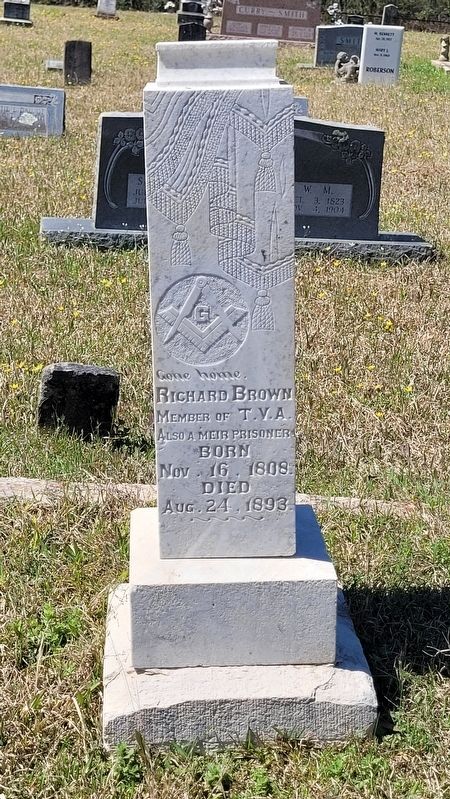
Upon hearing of the war in Texas, Brown sold his small farm, his cotton gin, and his two slaves(Submitted on March 22, 2025, by James Hulse of Medina, Texas.)and moved west. At New Orleans he joined the Texas army on October 19, 1836, by enlisting in Capt. David Sample's Company E of the First Regiment of Texas Infantry. The unit arrived in Texas on November 10. According to his enlistment papers Brown was then twenty-six years old and had light skin, blue eyes, and brown hair. He served through January 1, 1837. For his service he received a bounty warrant for 1,280 acres of land that he sold to N. H. Watrous.Photographed by James Hulse, March 16, 20252. Richard Brown Gravestone
2. Black Bean Episode. Texas State Historical Association (TSHA)
The Black Bean Episode, an aftermath of the Mier Expedition, resulted from an attempted escape of the captured Texans as they were being marched from Mier to Mexico City. After an escape at Salado, Tamaulipas, on February 11, 1843, some 176 of the men were recaptured within about a week. A decree that all who participated in the break were to be executed was modified to an order to kill every tenth man. Col. Domingo Huerta was to be in charge of the decimation. The victims were chosen by lottery, each man drawing a bean from an earthen jar containing 176 beans, seventeen black beans being the tokens signifying death. Commissioned officers were ordered to draw first; then the enlisted men were called as their names appeared on the muster rolls.(Submitted on March 22, 2025, by James Hulse of Medina, Texas.)
Photographed by James Hulse, March 16, 2025
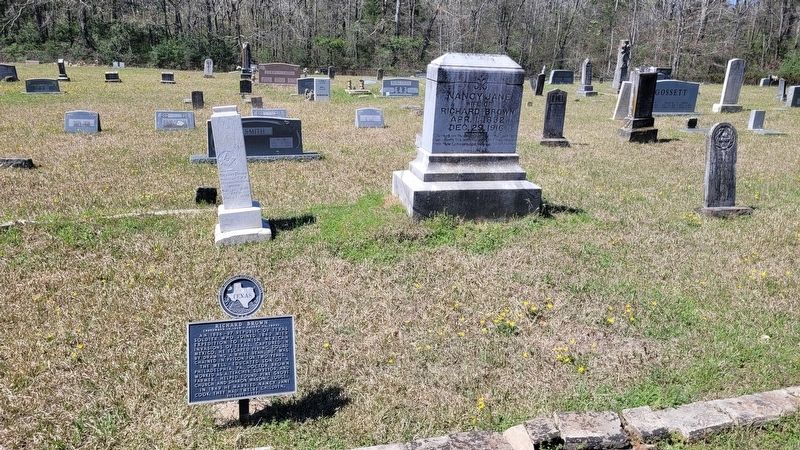
3. Richard Brown Gravestone and Marker with his wife, Nancy Jane Brown
Photographed by James Hulse, March 16, 2025
4. The wide view of the Richard Brown Marker in the Pine Grove Cemetery
Credits. This page was last revised on March 22, 2025. It was originally submitted on March 22, 2025, by James Hulse of Medina, Texas. This page has been viewed 184 times since then and 37 times this year. Photos: 1, 2, 3, 4. submitted on March 22, 2025, by James Hulse of Medina, Texas.
