Des Plaines in Cook County, Illinois — The American Midwest (Great Lakes)
Illinois Remembers POW/MIA
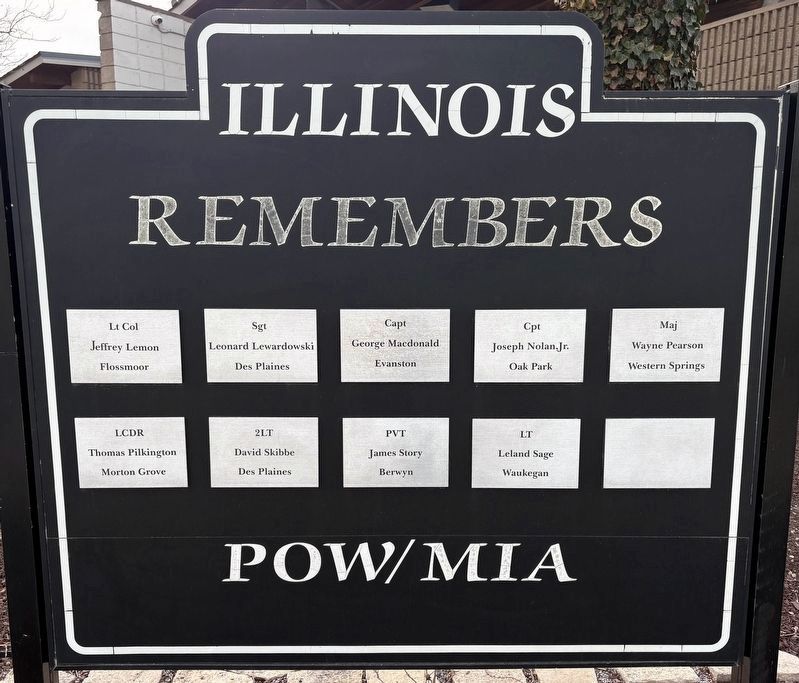
Photographed by Sean P. Flynn, March 21, 2025
1. Illinois Remembers POW/MIA Marker
Lt Col Jeffrey Lemon, Flossmoor • LCDR Thomas Pilkington, Morton Grove • Sgt Leonard Lewardowski, Des Plaines • David Skibbe, Des Plaines • Capt George Macdonald, Evanston • PVT James Story, Berwyn • Cpt Joseph Nolan Jr., Oak Park • LT Leland Sage, Waukegan • Maj Wayne Pearson, Western Springs
[Memorial to right of sign:]
We will never forget.
Topics. This memorial is listed in these topic lists: Parks & Recreational Areas • Patriots & Patriotism • War, Vietnam.
Location. 42° 0.789′ N, 87° 53.684′ W. Memorial is in Des Plaines, Illinois, in Cook County. It is on Lee Street. The memorial is in Lake Park, to the left of the bandshell that is just east of the lake. Touch for map. Memorial is at or near this postal address: 2200 Lee St, Des Plaines IL 60018, United States of America. Touch for directions.

Regionally, this memorial is in Greater Chicago. It is also in the American Midwest. Globally, it is in North America, on the Great Lakes, in the Western Hemisphere, in the Western World, and in the Anglosphere. Historically, it finds itself in what was once the Viceroyalty of New France, the territory of the Mississippian Culture, and the Northwest Territory.
Other nearby markers. At least 8 other markers are within walking distance of this marker: Iraq War, 2003-2011 (here, next to this marker); Gulf War, 1990-1991 (here, next to this marker); War in Afghanistan, 2001-2021 (here,
this page online
More about this memorial. This POW/MIA memorial is found amid a series of war memorials inside Des Plaines's Lake Park.
Roughly 10 other Illinois Remembers signs dedicated to MIA/POW soldiers can be found around the state, including at least four with an identical style to this one.
Regarding Illinois Remembers POW/MIA. The nine men named on this memorial are Chicago-area soldiers who were declared missing in action during the Vietnam War.
Jeffrey Lemon grew up in Flossmoor, a southern suburb of Chicago, and attended Mendel Catholic High School on Chicago’s far south side. He graduated in 1965 from Villanova University with a degree in civil engineering. A member of the U.S. Air Force’s 421s Tactical Fighter Squadron during the Vietnam War, the 27-year-old Lemon was piloting a Phantom II Fighter (F-4D) with one other crewmate on April 25, 1971, escorting a gunship on a night reconnaissance and strike mission over Laos. About two hours in, Lemon’s plane lost radio contact. Neither the plane nor the remains of Lemon and his crewmate were ever found. Lemon was promoted to lieutenant colonel after he went missing.
Thomas Pilkington, a Morton Grove native, remains officially missing in action after the F-4B Phantom II plane he was flying in for the U.S. Navy on September 19, 1966, went missing over North Vietnam. According to the government's POW/MIA
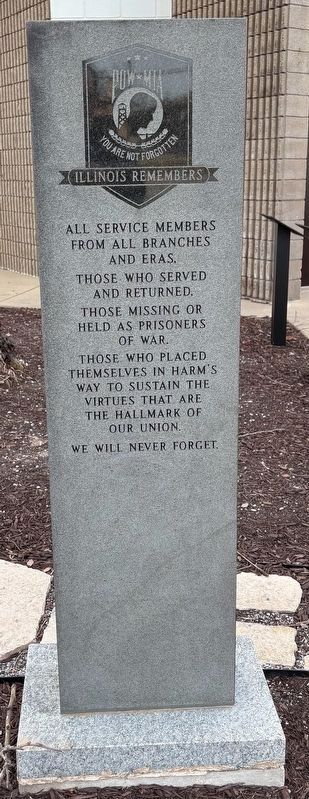
Photographed by Sean P. Flynn, March 21, 2025
2. Illinois Remembers POW/MIA Memorial
Leonard Lewandowski — his last name on the memorial appears to have a typo — was born in Des Plaines and graduated from Maine West High School in 1964 before joining the Marines and serving in Vietnam. On October 19, 1966, Lewandowski was one of three Marines who were given permission to take a swim in the Cua Viet River during R&R. About three hours later, the three men could no longer be seen, and despite several hours of extensive search, they were never found. No evidence was ever recovered to indicate how they died, perhaps by capture or by being swept away by the river current, and their remains were never recovered.
David Skibbe attended Mt. Prospect High School in the northwest suburbs of Chicago. In 1969 he graduated with a degree in agricultural, consumer and environmental sciences from the University of Illinois, where he was also president of his fraternity and a battalion commander in the Naval ROTC. According to a 2012 article about his military service, his father had been an assistant postmaster in Des Plaines. Skibbe joined the Marines after college and was sent to Vietnam in the fall of 1969. On March 2, 1970, Skibbe was part of a reconnaissance team operating in An Hoa when he was wounded in battle. With no landing zone for the rescue helicopter, Skibbe was hoisted up on a jungle penetrator, which snapped while he was near the helicopter, sending Skibbe crashing to the ground. When helicopters returned to try to find Skibbe, his commander, Capt. LeRoy McVey, also fell. Because of the environmental conditions and the enemy presence, further attempts to find Skibbe and McVey were halted. Although the two soldiers are presumed to have died from their falls, the body of neither man was found in any subsequent searches, and they both remain MIA.
Capt George Macdonald grew up in Evanston, a northern suburb of Chicago, and attended Nichols Junior High and Evanston Township High School. On
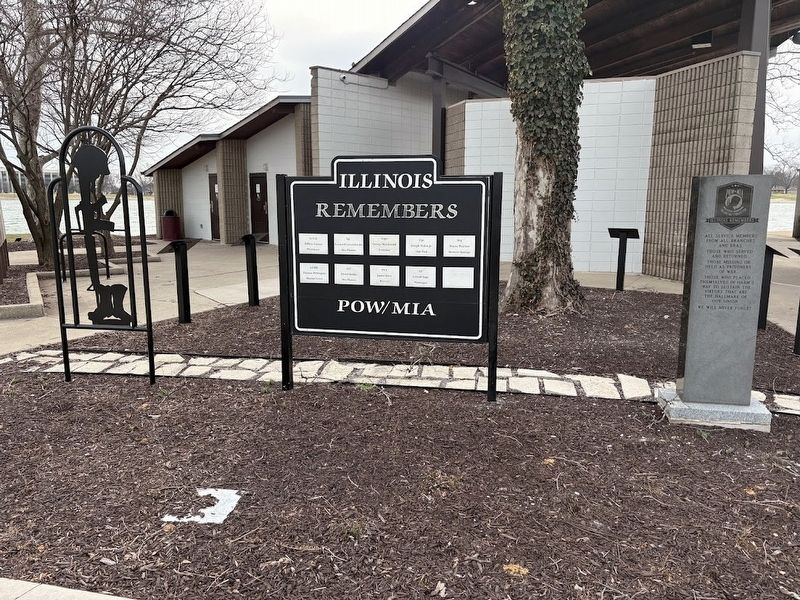
Photographed by Sean P. Flynn, March 21, 2025
3. Illinois Remembers POW/MIA Marker
On June 13, 1969, James Clellan Story, a 21-year-old private from suburban Berwyn, was driving a M54 truck carrying artillery projectiles to Pleiku Air Base in South Vietnam when the convoy he was in was ambushed by enemy forces. After being hit by a rocket or mortar fire, Story’s truck completely disintegrated. While presumed dead, his remains were never found.
Joseph Nolan Jr. was born in Oak Park, an inner western suburb of Chicago, and graduated from Oak Park and River Forest High School. In Vietnam, Nolan piloted a UH-1H helicopter for A Company, 101st Aviation Group. On May 16, 1971, Captain Nolan and three crew mates carried troops to a landing zone in the Thua Thien Province. Upon leaving the landing zone, Nolan reported that he was taking
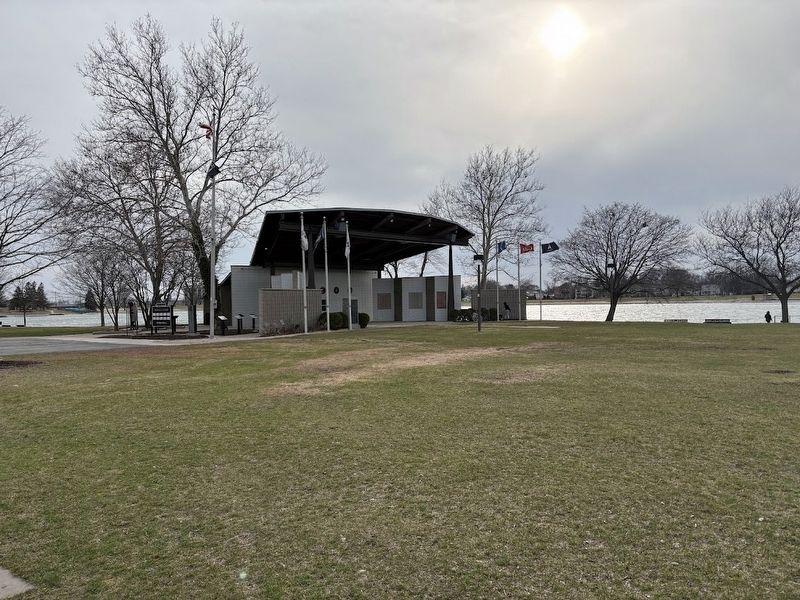
Photographed by Sean P. Flynn, March 21, 2025
4. Lake Park Memorial Bandshell
The POW/MIA memorial is on the left side of this photo. Several veterans memorials are located at this site.
Born in Chicago on Christmas Day 1943, Leland Sage grew up in Waukegan, where graduated from Waukegan High School. He was a 1966 graduate of the U.S. Naval Academy. In Vietnam, Sage was assigned to fly a Skyhawk from the U.S.S. Bon Homme Richard. On June 23, 1969, Lieutenant Sage was sent on a night combat mission into Laos. After reaching his target, his plane was seen to crash into the ground and explode. Aerial search efforts yielded no signs of Lt. Sage, and no communication was ever established with him. Ground search efforts never happened because of enemy presence in the area, and his remains were never found.
Wayne Pearson grew up in the suburb of Western Springs, attended Lyons Township High School, and graduated from the University of Illinois in 1961 with a degree in commerce and business administration. During college, Pearson married his high school sweetheart Julie, with whom he had two children, who were 9 and 7 when he went missing. On February 22, 1969, the 29-year-old Pearson was the aircraft commander on an F-4D Phantom II on a strike mission over Laos. The plane was shot down by anti-aircraft fire near Phou Teung and crashed into a hard-to-reach area. While his crewmate was able to eject before the plane crashed and was eventually rescued, Pearson appears to have not ejected and was presumed to have died. However, because of the terrain and the presence of enemy troops, the area could not be searched, and Pearson was officially listed as MIA. In the meantime, he was promoted from captain to major. In 1992, a joint U.S./Laos investigation visited the crash site and found human remains, later identified to be Pearson's. He was buried at Arlington National Cemetery.
Related markers. Click here for a list of markers that are related to this marker. Other Illinois Remembers POW/MIA memorials in the same style
Credits. This page was last revised on June 14, 2025. It was originally submitted on March 22, 2025, by Sean P. Flynn of Oak Park, Illinois. This page has been viewed 240 times since then and 43 times this year. Photos: 1, 2, 3, 4. submitted on March 22, 2025, by Sean P. Flynn of Oak Park, Illinois.
