Florence in Lauderdale County, Alabama — The American South (East South Central)
The Singing River Sculpture
In Florence, Alabama
Photographed by Sandra Hughes Tidwell, July 17, 2024
1. The Singing River Sculpture Marker
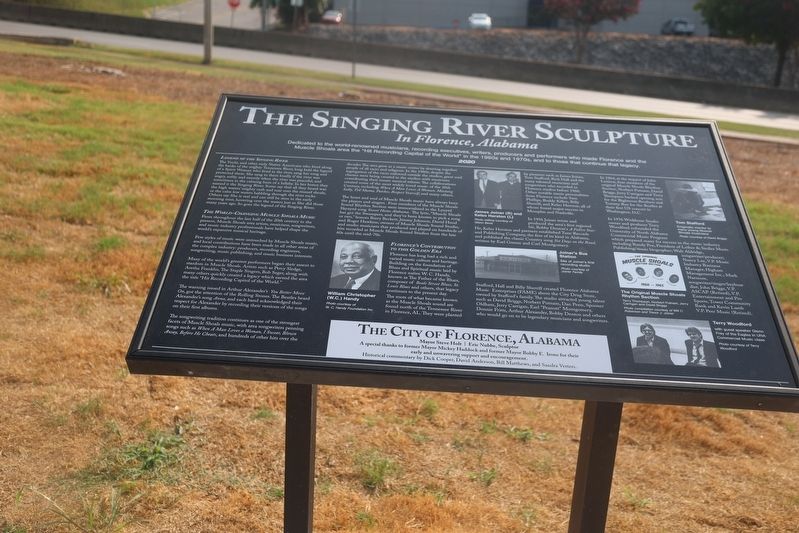
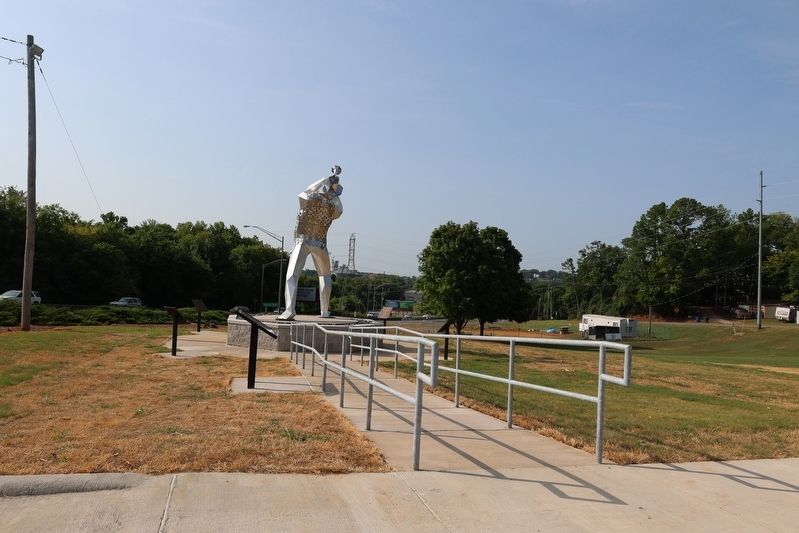
Dedicated to the world-renowned musicians, recording executives, writers, producers, and performers who made Florence and the Muscle Shoals area the “Hit Recording Capital of the World” in the 1960s and 1970s, and to those that continue that legacy.
Legend of the Singing River
The Yuchi, and other early Native Americans who lived along the banks of the mighty Tennessee River, long held the legend of a Spirit Woman who lived in the river, sang her song, and protected them. She sang to them loudly if the river was angry, softly and sweetly when the river was peaceful, and sometimes in the calming hum of a lullaby. In her honor, they named it the Singing River. Some say that all they heard was the high waters’ mighty rush and roar over the mussel shoals, or the calm low waters babbling through the river rocks. Others say She is real and over the waters just as She did those many years ago. So goes the legend of the Singing River.
The World-Changing Muscle Shoals Music
From throughout the last half of the 20th century to the present, Muscle Shoals area artists, musicians songwriters, and music industry professionals
this page online
Few styles of music were untouched by Muscle Shoals music, and local contributions have been made in all the areas of the complex industry: producers, recording engineers, songwriting, music publishing, and music business interest.
Many of the world’s greatest performers began their assent to stardom in Muscle Shoals. Artists such as Percy Sledge, Aretha Franklin, The Staple Singers, and Bob Seger, along with many others quickly created a legacy that earned the area the title “Hit Recording Capitol of the World.”
The warning issued in Arthur Alexander’s You Better Move On got the attention of the Rolling Stones. The Beatles heard Alexander’s song Anna, and each band acknowledged their respect for Alexander by recording their version of the songs on their first albums.
The songwriting tradition continues as one of the strongest facets of Muscle Shoals music, with area songwriters penning songs such as When A Man Loves a Woman, I Swear, Blown Away, Before He Cheats, and hundreds of other hits over the decades. The area grew a music center by drawing together people

Photographed by Sandra Hughes Tidwell, July 17, 2024
2. The Singing River Sculpture Marker
The heart and soul of Muscle Shoals music have always been the players and singers. Four members of the Muscle Shoals Sound Rhythm Section were immortalized in the Lynyrd Skynyrd song Sweet Home Alabama. The lyric, “Muscle Shoals has got the Swampers, and they’ve been known to pick a song or two “ honors Barry Beckett, Jimmy Johnson, David Hood, and Roger Hawkins, owner of Muscle Shoals Sound Studio, and studio musicians that produced and played on hundreds of hit recorded at Muscle Shoals Sound Studios from the late 60s until the mid-70s.
Florence’s Contribution to this Golden Era
Florence has long had a rich and varied music culture and heritage. Building on the foundation of Blues and Spiritual music laid by Florence native W.C.
Photographed by Sandra Hughes Tidwell, July 17, 2024
3. The Singing River Sculpture Marker
In 1956 Joiner wrote and produced the area’s first regional hit, Bobby Denton’s A Fallen Star. He, Kelso Herston, and partners established “Tune Records and Publishing Company, the first of its kind in Alabama, and published the classic Country song Six Days on the Road, written by Earl Greene and Carl Montgomery.
Stafford, Hall, and Billy Sherrill created Florence Alabama Music Enterprises (FAME) above the City Drug Store, owned by Stafford’s family. The studio attracted young talents such as David Briggs, Norbert Putnam, Dan Penn,
Photographed by Sandra Hughes Tidwell, July 17, 2024
4. City of Florence Singing River Sculpture
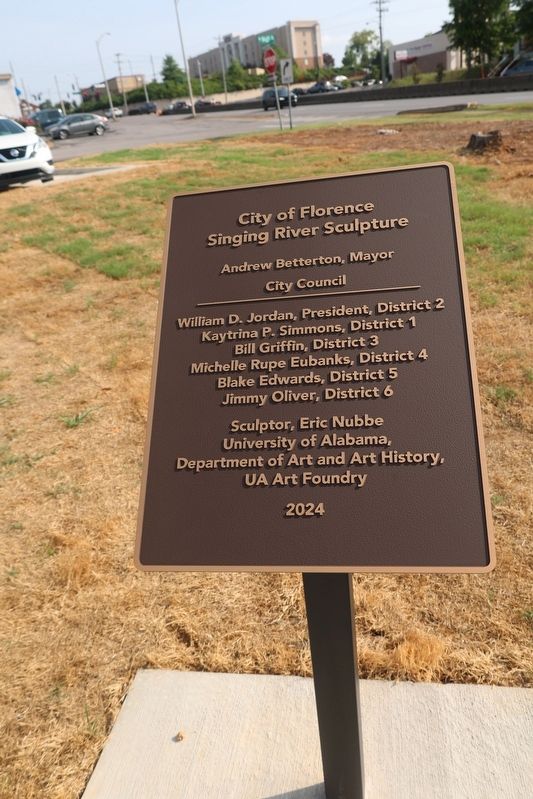
Andrew Betterton, Mayor
----City Council------
William D. Jordan, President, District 2,
Katrina P. Simmons, District 1,
Bill Griffin, District 3,
Michelle Rupe Eubanks, District 4,
Blake Edwards, District 5,
Jimmy Oliver, District 6,
----- Sculpture, Eric Nubbe----
University of Alabama,
Department of Art and Art History,
UA Art Foundry
2024
In 1964, at the request of John Lennon, four members of the original Muscle Shoals Rhythm Section, Norbert Putnam, David Briggs, Jerry Carrigan, and Terry Thompson backed opening acts for the Righteous Brothers and Tommy Roe for the Beatles at their first US concert in Washington D.C.
In 1976 Wishbone Studio owner and producer Terry Woodford cofounded the University of North Alabama Commercial Music Program which prepared many for success in the music industry including Randy Poe, President of Leiber & Stoller Music Publishing/music biographer; Walt Aldridge songwriter/producer, Nancy Lee, V.P. Music Industry Business, Manager Higham Management Ince.; Mark Narmore, Songwriter/singer/keyboardist; John Briggs, V.P. ASCAP (Retired), V.P. Entertainment and Pro Sports, Tower Community Band, and Kevin Lamb V.P. Peer Music (Retired).
Photo Captions
William Christopher (W.C.) Handy
Photo courtesy of W.C. Handy Foundation Inc.
James Joiner (R) and Kelson Herston (L)
Photo editing courtesy of Glenn Bevis
Joiner’s Bus Station
Site of Joiner’s first recording studio
Photo courtesy of Joiner Family
Tom Stanford
Enigmatic mentor to many young Muscle Shoals musicians
Photo courtesy of David Briggs
The Original Muscle Shoals Rhythm Section
Terry Thompson, Norbert Putnam, Jerry Carrigan, and David Briggs
Photo compilation courtesy of Will C. Roberson and Trevor J. Joiner
Terry Woodford
With guest speaker Glenn Frey of the Eagles in UNA Commercial Music class
Photo courtesy of Terry Woodford.
The City of Florence, Alabama • Mayor Steve Holt - Eric Nubbe, Sculpture • A special thanks to former Mayor Mickey Haddock and former Mayor Bobby E. Irons for their early and unwavering support and encouragement. Historical commentary by Dick Cooper, David Anderson, Bill Matthews, and Sandra Vetters.
Erected 2020
Photographed by Sandra Hughes Tidwell, July 17, 2024
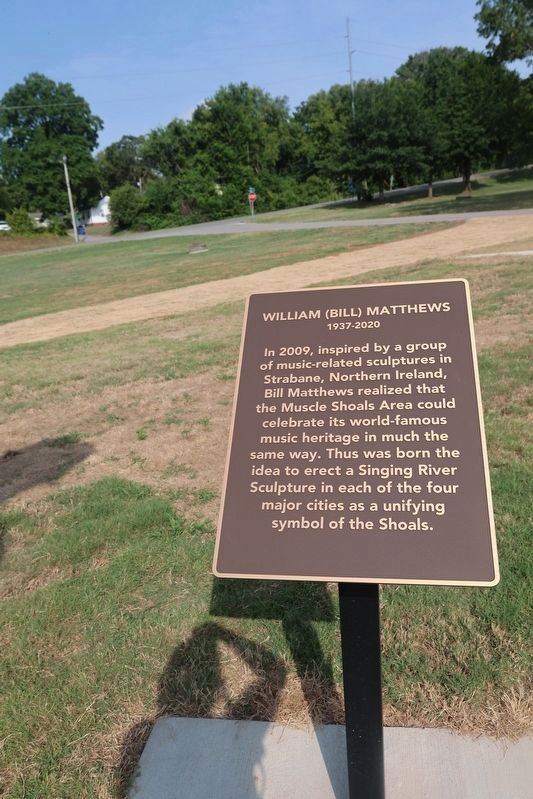
5. William (Bill) Matthews 1937-2020
----In 2009,----
inspired by a group of music-related sculptures in Strabane, Northern Ireland, Bill Matthews realized that the Muscle Shoals Area could celebrate its world-famous music heritage in much the same way.
---Thus---
was born the idea to erect a Singing River Sculpture in each of the four major cities as a unifying symbol of the Shoals.
Topics. This historical marker is listed in these topic lists: African Americans • Arts, Letters, Music • Entertainment • Indigenous Peoples and Communities. A significant historical year for this entry is 1960.
Location. 34° 47.665′ N, 87° 40.382′ W. Marker is in Florence, Alabama, in Lauderdale County. It is at the intersection of South Court Street (U.S. 72) and West Bluff on South Court Street. Touch for map. Marker is at or near this postal address: South Court St, Florence AL 35630, United States of America. Touch for directions.

Regionally, this marker is in North Alabama and in the Shoals. It is also in the American South, specifically in the Deep South, in Appalachia, and specifically in Southern Appalachia. Globally, it is in North America, a Gulf of Mexico state, the Western Hemisphere, the Western World, and the Anglosphere. Historically, it finds itself in what was once the territory of the Mississippian Culture, one of the Confederate States of America, and the Antebellum South.
Other nearby markers. At least 8 other markers are within walking distance of this marker: Constellium (here, next to this marker); Church Spring Church and School (about 400 feet away, measured in a direct line); Church Spring and School (about 500 feet away); John McKinley Associate Justice, U.S. Supreme Court (about 700 feet away); The Rolling Stones in the Shoals in 1969 (approx. 0.2 miles away); The American Legion (approx. ¼ mile away); Florence Little League Baseball (1951) (approx. ¼ mile away); Lauderdale County (approx. 0.3 miles away). Touch for a list and map of all markers in Florence.
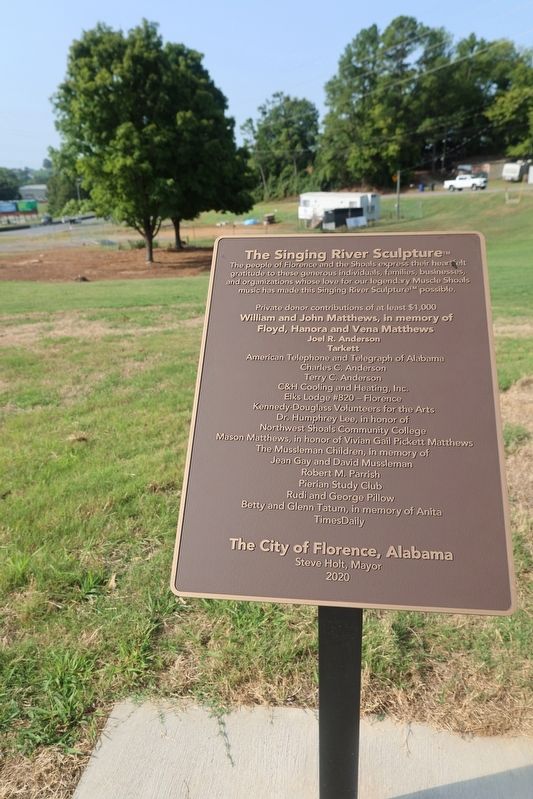
Photographed by Sandra Hughes Tidwell, July 17, 2024
6. The Singing River Sculpture
The people of Florence and the shoals expressed their heartfelt gratitude to these generous individuals, families, businesses, and organizations whose love for our legendary Muscle Shoals music has made this Singing River Sculpture possible.
----Private donor contributions of at least $1,000---
William and John Matthews, in memory of
Floyd, Hanora, and Vena Matthews,
Joel R. Anderson,
Tarkett,
American Telephone and Telegraph of Alabama,
Charles C. Anderson,
Terry C. Anderson,
C&H Cooling and Heating, Inc.,
Elks Lodge #820-Florence,
Kennedy-Douglas Volunteers for the Arts,
Dr. Humphrey Lee, in honor of
Northwest-Shoals Community College,
Mason Matthews, in honor of Vivian Gail Pickett Matthews,
The Musselman Children, in memory
of Jean Gay and David Mussleman,
Robert M. Parrish,
Pierian Study Club,
Rudi and George Pillow,
Betty and Glenn Tatum, in memory of Anita,
Times Daily,
The City of Florence, Alabama,
Steve Holt, Mayor 2020
Credits. This page was last revised on June 27, 2025. It was originally submitted on July 17, 2024, by Sandra Hughes Tidwell of Killen, Alabama, USA. This page has been viewed 778 times since then and 71 times this year. Last updated on March 22, 2025, by Carl Gordon Moore Jr. of North East, Maryland. Photos: 1, 2, 3, 4, 5, 6. submitted on July 17, 2024, by Sandra Hughes Tidwell of Killen, Alabama, USA. • James Hulse was the editor who published this page.
