Okeechobee in Okeechobee County, Florida — The American South (South Atlantic)
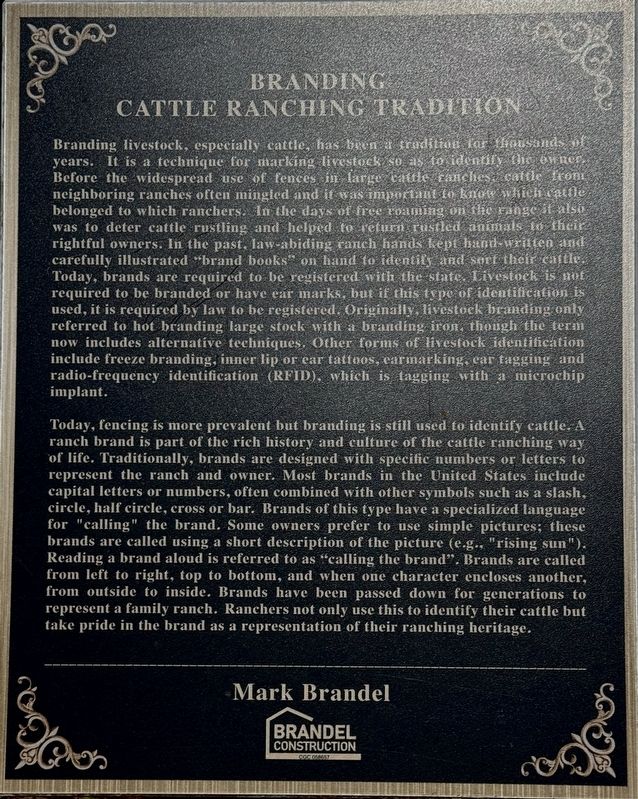
Branding Cattle Ranching Tradition
| — | Cattleman’s Square | — |
Photographed by Brandon D Cross
1. Branding Cattle Ranching Tradition Marker
this page online
Today, fencing is more prevalent but branding is still used to identify cattle. A ranch brand is part of the rich history and culture of the cattle ranching way of life. Traditionally, brands are designed with specific numbers or letters to represent the ranch and owner. Most brands in the United States include capital letters or numbers, often combined with other symbols such as a slash, circle, half circle, cross or bar. Brands of this type have a specialized language for "calling" the brand. Some owners prefer to use simple pictures; these brands are called using a short description of the picture (eg., "rising sun"). Reading a brand aloud is referred to as "calling the brand". Brands are called from left to right, top to bottom, and when one character encloses another, from outside to inside. Brands have been passed down for generations to represent a family ranch. Ranchers not only use this to identify their cattle but take pride in the brand as a representation of their ranching heritage.
Erected 2022 by Mark Brandel.
Topics. This historical marker is listed in these topic lists: Agriculture
Photographed by Brandon D Cross
2. Branding Cattle Ranching Tradition Marker
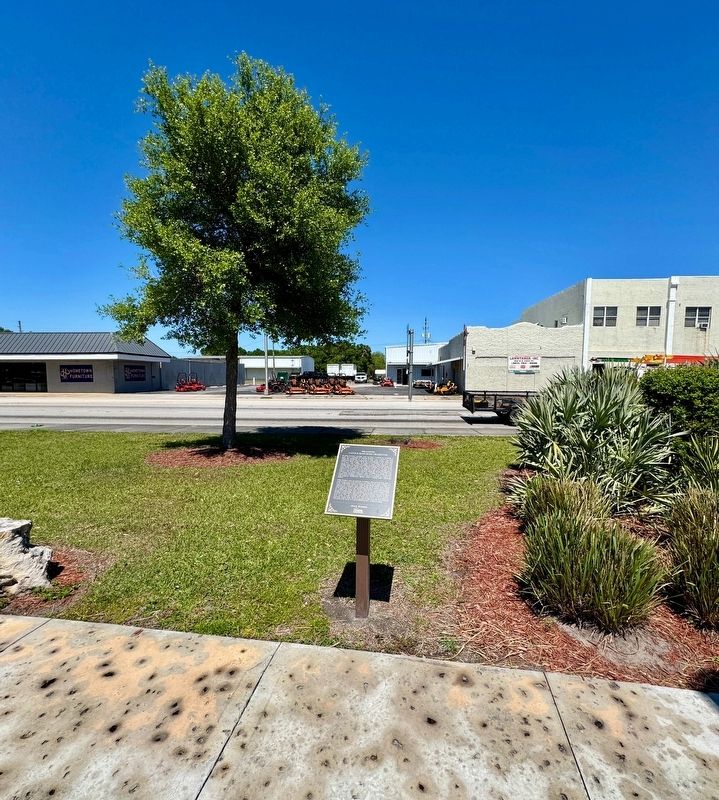
Location. 27° 14.618′ N, 80° 50.095′ W. Marker is in Okeechobee, Florida, in Okeechobee County. It can be reached from the intersection of SW Park Street and SW 6th Avenue, on the right when traveling east. The marker is located within Cattleman’s Square. Touch for map. Marker is at or near this postal address: 517 SW Park Street, Okeechobee FL 34972, United States of America. Touch for directions.

Regionally, this marker is in Central Florida. It is also in the American South. Globally, it is in the North Atlantic Region, North America, a Gulf of Mexico state, the Western Hemisphere, the Western World, and the Anglosphere. Historically, it finds itself in what was once New Spain, the territory of the Mississippian Culture, one of the Confederate States of America, and the Antebellum South.
Other nearby markers. At least 8 other markers are within walking distance of this marker: Florida Cattle Ranchers Committed to Conservation (a few steps from this marker); Rollins Ranch (a few steps from this marker); Historic Role of Seminole Cattle Ranching
Photographed by Brandon D Cross
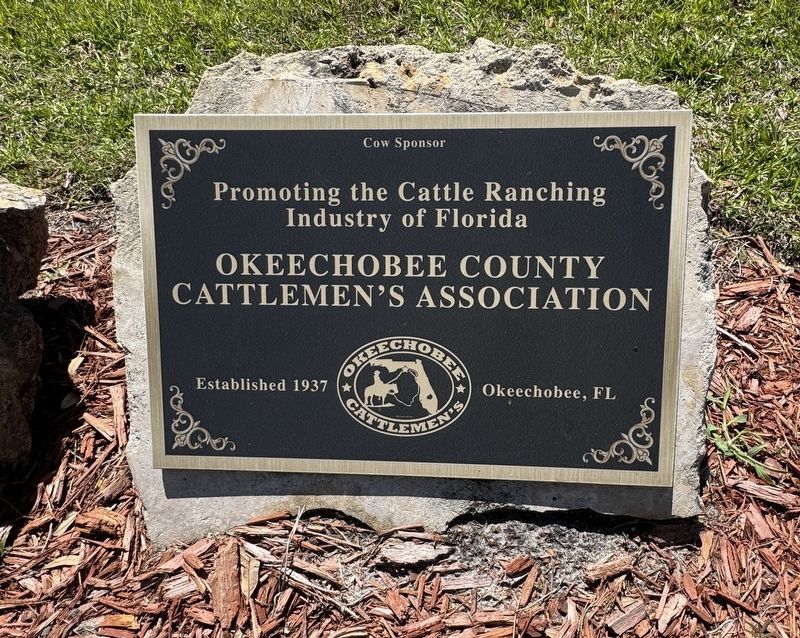
3. Okeechobee County Cattlemen’s Association
Industry of Florida
Established 1937 Okeechobee, FL
Also see . . .
1. Cattleman’s Square. (Submitted on March 23, 2025, by Brandon D Cross of Flagler Beach, Florida.)
2. Celebrating Cattle Ranching History through Arts. (Submitted on March 23, 2025, by Brandon D Cross of Flagler Beach, Florida.)
3. Cattle drive ends at Cattleman’s Square Park. (Submitted on March 23, 2025, by Brandon D Cross of Flagler Beach, Florida.)
Credits. This page was last revised on March 31, 2025. It was originally submitted on March 23, 2025, by Brandon D Cross of Flagler Beach, Florida. This page has been viewed 225 times since then and 52 times this year. Photos: 1, 2, 3. submitted on March 23, 2025, by Brandon D Cross of Flagler Beach, Florida. • Andrew Ruppenstein was the editor who published this page.
