Winchester, Virginia — The American South (Mid-Atlantic)
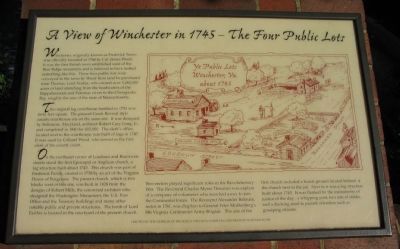
A View of Winchester in 1745 - The Four Public Lots
Photographed by Craig Swain, October 5, 2008
1. A View of Winchester in 1745 - The Four Public Lots Marker
The original log courthouse finished in 1751 was forty feet square. The present Greek Revival style county courthouse sits on the same site. It was designed by Baltimore, Maryland, architect Robert Cary Long, Jr., and completed in 1840 for $12,000. The clerk's office located next to the courthouse, was built of logs in 1747. It was used by Colonel Wood, who served as the first clerk of the county court.
On the northeast corner of Loudoun and Boscawen streets stood the first Episcopal or Anglican church, a log structure built about 1745. This church was part of Frederick Parish, created in 1738 by an act of the Virginia
this page online
Two rectors played significant roles in the Revolutionary War. The Reverend Charles Mynn Thurston was captain of a company of volunteers who marched away to join the Continental forces. The Reverend Alexander Balmain, rector in 1781, was chaplain to General Peter Muhlenburg's 8th Virginia Continental Army Brigade. The site of the first church included a burial ground located behind the church next to the jail. Next to it was a log structure built about 1745 It was flanked by the instruments of justice of the day: a whipping post, two sets of stocks, and a dunking stool to punish offenders such as gossiping citizens.
Erected by the Members of Frederick Episcopal Parhish in cooperation with F&M Bank.
Topics. This historical marker is listed in these topic lists:
Photographed by Craig Swain, October 5, 2008
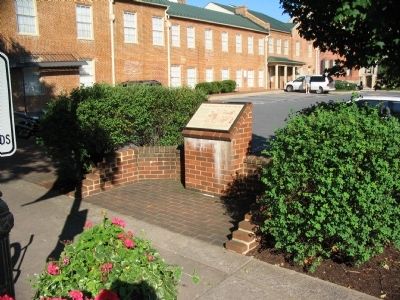
2. Public Lots Marker
Location. 39° 11.05′ N, 78° 9.93′ W. Marker is in Winchester, Virginia. It is at the intersection of North Loudoun Street and East Boscawan Street, on the right when traveling north on North Loudoun Street. Loudoun Street is closed to vehicle traffic near the marker. Touch for map. Marker is in this post office area: Winchester VA 22601, United States of America. Touch for directions.

Regionally, this marker is in Virginia’s Shenandoah Valley. It is also in the American South, specifically in the Upper South, and in the Mid-Atlantic. Globally, it is in North America, the Western Hemisphere, the Western World, and the Anglosphere. Historically, it finds itself in what was once the territory of the Mississippian Culture, one of the original Thirteen Colonies, one of the Confederate States of America, and the Antebellum South.
Other nearby markers. At least 8 other markers are within walking distance of this marker: The Wilbur M. Feltner Building (here, next to this marker); History of the Courthouse
Photographed by Craig Swain, October 5, 2008
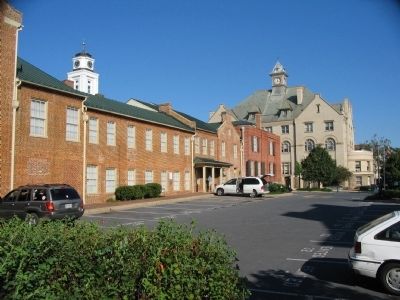
3. Area of the Public Lots Today
Another marker is no longer nearby. Frederick County Courthouse (was within shouting distance of this marker but has been replaced with another marker now near it).
Photographed by Allen C. Browne, October 18, 2015
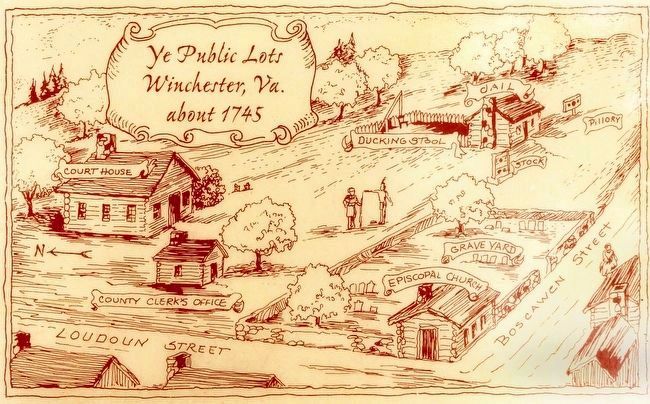
4. Ye Public Lots
Winchester Va.
about 1745
Winchester Va.
about 1745
Credits. This page was last revised on April 17, 2020. It was originally submitted on January 24, 2010, by Craig Swain of Leesburg, Virginia. This page has been viewed 2,193 times since then and 33 times this year. Photos: 1, 2, 3. submitted on January 24, 2010, by Craig Swain of Leesburg, Virginia. 4. submitted on January 26, 2016, by Allen C. Browne of Silver Spring, Maryland.
