Monrovia in Los Angeles County, California — The American West (Pacific Coastal)
The Significance of Coast Live Oaks
At Monrovia High School & Beyond
Photographed by Craig Baker, March 24, 2025
1. Coast Live Oaks Marker
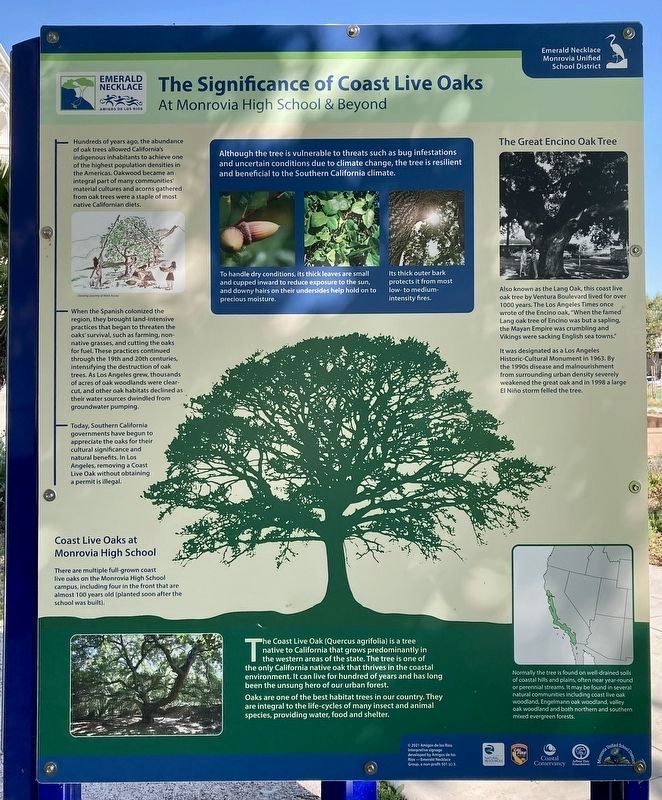
Hundreds of years ago, the abundance of oak trees allowed California's indigenous inhabitants to achieve one of the highest population densities in the Americas. Oakwood became an integral part of many communities’ material cultures and acorns gathered from oak trees were a staple of most native Californian diets.
When the Spanish colonized the region, they brought land-intensive practices that began to threaten the oaks survival, such as farming, non- native grasses, and cutting the oaks for fuel. These practices continued through the 19th and 20th centuries, intensifying the destruction of oak trees. As Los Angeles grew, thousands of acres of oak woodlands were clear cut, and other oak habitats declined as their water sources dwindled from groundwater pumping.
Today, Southern California governments have begun to appreciate the oaks for their cultural significance and natural benefits. In Los Angeles, removing a Coast Live Oak without obtaining a permit is illegal.
Coast Live Oaks at Monrovia High School
There are multiple full-grown coast live oaks on the
this page online
The Great Encino Oak Tree
Also known as the Lang Oak, this coast live oak tree by Ventura Boulevard lived for over 1000 years. The Los Angeles Times once wrote of the Encino oak, "When the famed Lang oak tree of Encino was but a sapling the Mayan Empire was crumbling and Vikings were sacking English sea towns."
It was designated as a Los Angeles Historic Cultural Monument in 1963. By the 1990s disease and malnourishment from surrounding urban density severely weakened the great oak and in 1998 a large El Niño storm felled the tree.
Coast Live Oaks
Although the tree is vulnerable to threats such as bug infestations and uncertain conditions due to climate change, the tree is resilient and beneficial to the Southern California climate.
To handle dry conditions, its thick leaves are small and cupped inward to reduce exposure to the sun, and downy hairs on their undersides help hold on to precious moisture.
Its thick outer bark protects it from
Photographed by Craig Baker, March 24, 2025
2. Monrovia Land Acknowledgement
The Coast Live Oak (Quercus agrifolia) is a tree native to California that grows predominantly in the western areas of the state. The tree is one of the only California native oak that thrives in the coastal environment. It can live for hundred of years and has long been the unsung hero of our urban forest.
Oaks are one of the best habitat trees in our country. They are integral to the life-cycles of many insect and animal species, providing water, food and shelter.
Normally the tree is found on well-drained soils of coastal hills and plains, often near year-round or perennial streams. It may be found in several natural communities including coast live oak woodland, Engelmann oak woodland, valley oak woodland and both northern and southern mixed evergreen forests.
Monrovia Land Acknowledgement
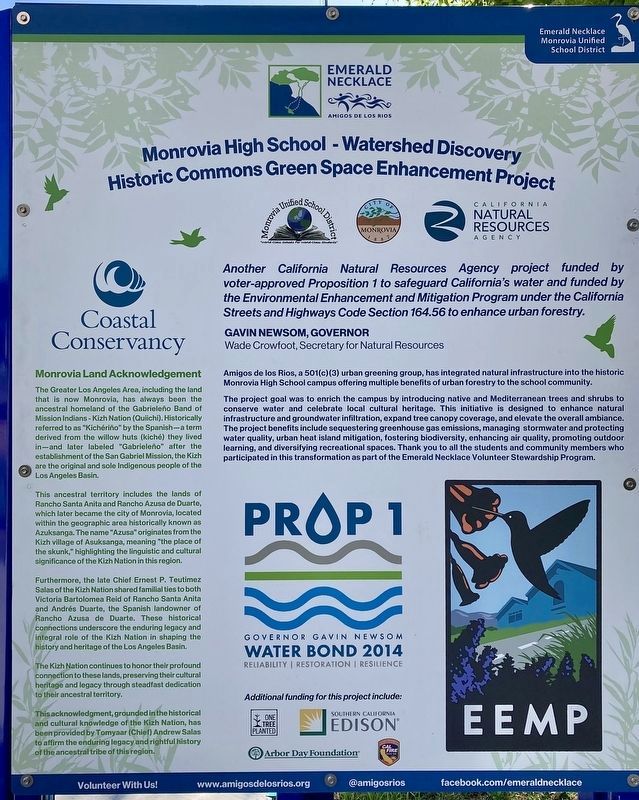
The Greater Los Angeles Area, including the land that is now Monrovia, has always been the ancestral homeland of the Gabrieleño Band of Mission Indians-Kizh Nation (Quiichi). Historically referred to as "Kichériño" by the Spanish - a term derived from
Photographed by Craig Baker, March 24, 2025
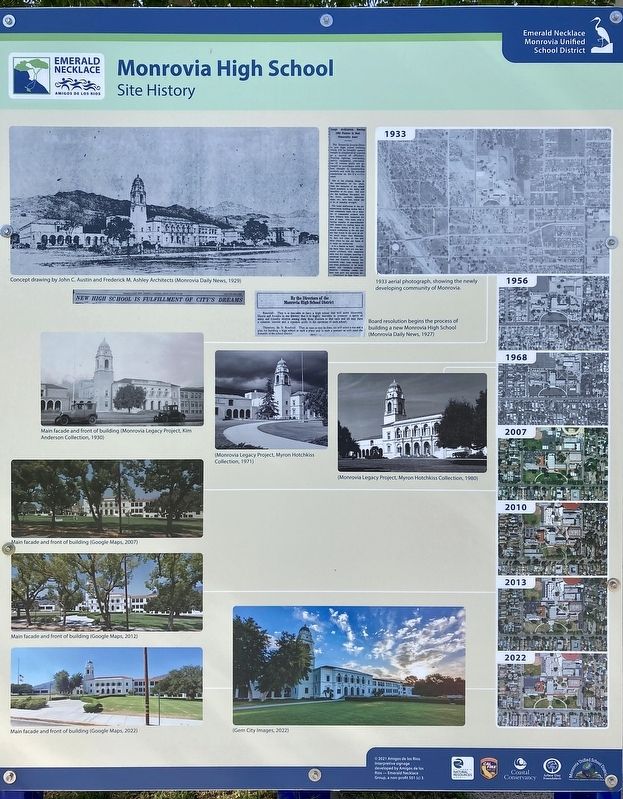
3. Monrovia High School History
This ancestral territory includes the lands of Rancho Santa Anita and Rancho Azusa de Duarte, which later became the city of Monrovia, located within the geographic area historically known as Azuksanga. The name "Azusa" originates from the Kizh village of Asuksanga, meaning "the place of the skunk," highlighting the linguistic and cultural significance of the Kizh Nation in this region.
Furthermore, the late Chief Ernest P. Teutimez Salas of the Kizh Nation shared familial ties to both Victoria Bartolomea Reid of Rancho Santa Anita and Andrés Duarte, the Spanish landowner of Rancho Azusa de Duarte. These historical connections underscore the enduring legacy and integral role of the Kizh Nation in shaping the history and heritage of the Los Angeles Basin.
The Kizh Nation continues to honor their profound connection to these lands, preserving their cultural heritage and legacy through steadfast dedication to
Photographed by Craig Baker, March 24, 2025
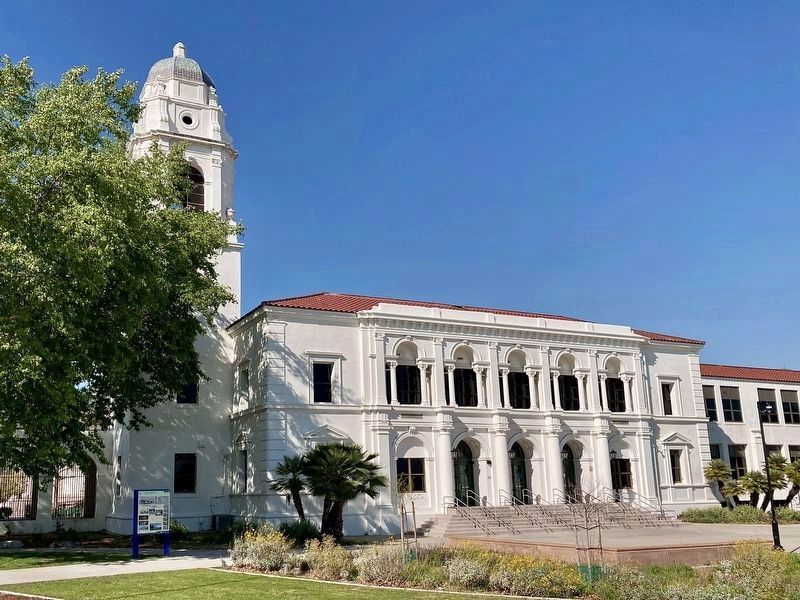
4. Monrovia High School and Marker
The marker is near the tower.
This acknowledgment, grounded in the historical and cultural knowledge of the Kizh Nation, has been provided by Tomyaar (Chief) Andrew Salas to affirm the enduring legacy and rightful history of the ancestral tribe of this region.
Amigos de los Rios, a 501(c)(3) urban greening group, has integrated natural infrastructure into the historic Monrovia High School campus offering multiple benefits of urban forestry to the school community.
The project goal was to enrich the campus by introducing native and Mediterranean trees and shrubs to conserve water and celebrate local cultural heritage. This initiative is designed to enhance natural infrastructure and groundwater infiltration, expand tree canopy coverage, and elevate the overall ambiance. The project benefits include sequestering greenhouse gas emissions, managing stormwater and protecting water quality, urban heat island mitigation, fostering biodiversity, enhancing air quality, promoting outdoor learning, and diversifying recreational spaces. Thank you to all the students and community members who participated in this transformation
Photographed by Craig Baker, March 24, 2025
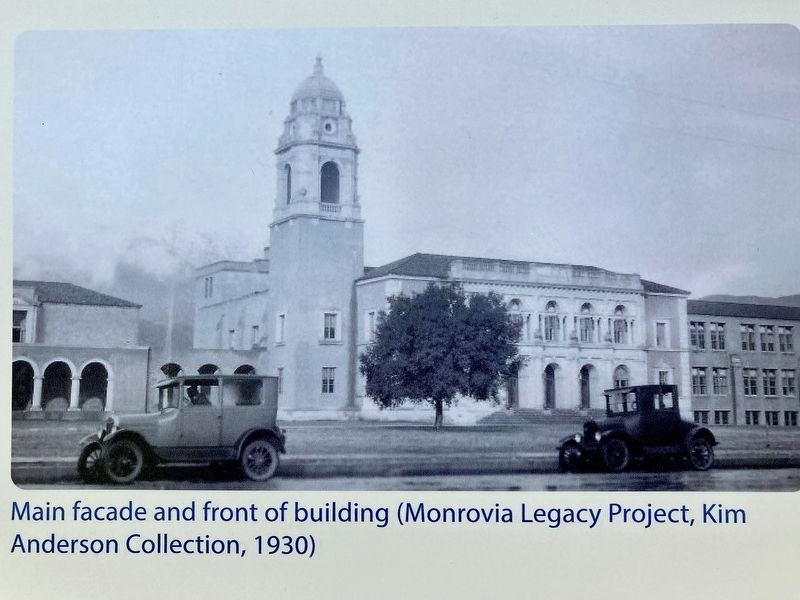
5. Monrovia High School - 1930
Erected 2021 by Amigos de los Rios.
Topics. This historical marker is listed in these topic lists: Education • Indigenous Peoples and Communities • Natural Resources.
Location. 34° 8.773′ N, 118° 1.05′ W. Marker is in Monrovia, California, in Los Angeles County. It is at the intersection of Colorado Boulevard and Madison Avenue, on the left when traveling east on Colorado Boulevard. Touch for map. Marker is at or near this postal address: 845 W Colorado Blvd, Monrovia CA 91016, United States of America. Touch for directions.

Regionally, this marker is in Greater Los Angeles and in the Transverse Ranges. It is also on the American Pacific Coast. Globally, it is in North America, on the Ring of Fire, on the Pacific Rim, in the Western Hemisphere, in the Western World, and in the Anglosphere. Historically, it finds itself in what was once New Spain and also Mexico’s Alta California.
Other nearby markers. At least 8 other markers are within walking distance of this marker: The Derby Restaurant
Photographed by Craig Baker, March 24, 2025
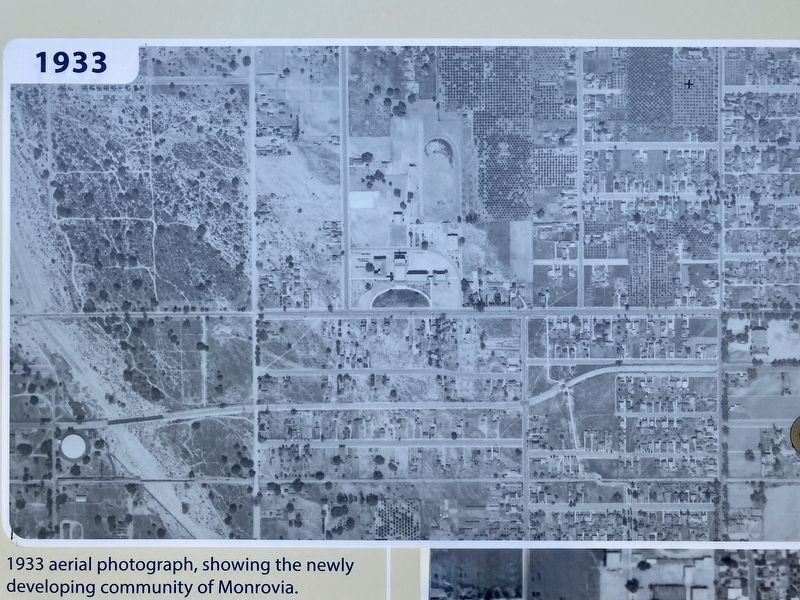
6. Monrovia Neighborhood - 1933
The high school is at the center of this photo.
Related marker. Click here for another marker that is related to this marker. - The Great Encino Oak Tree.
Credits. This page was last revised on March 27, 2025. It was originally submitted on March 25, 2025, by Craig Baker of Sylmar, California. This page has been viewed 379 times since then and 89 times this year. Photos: 1, 2, 3, 4, 5, 6. submitted on March 25, 2025, by Craig Baker of Sylmar, California.
