Buckhannon in Upshur County, West Virginia — The American South (Appalachia)
Welcome to the Buckhannon Nature Park and Learning Trail
⎯⎯⎯
Our Floodplain Forest
Photographed by Bradley Owen, March 10, 2025
1. Welcome to the Buckhannon Nature Park and Learning Trail / Our Floodplain Forest Marker
(Panel 1):
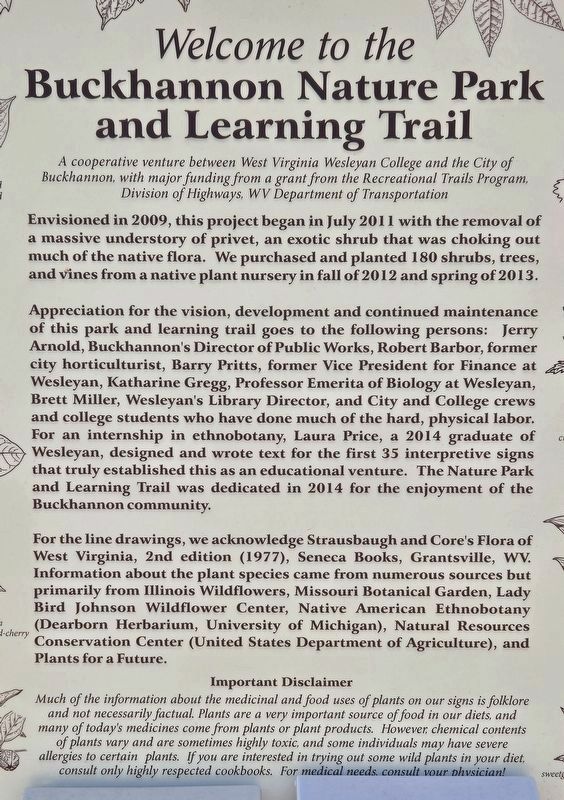
Envisioned in 2009, this project began in July 2011 with the removal of a massive understory of privet, an exotic shrub that was choking out much of the native flora. We purchased and planted 180 shrubs, trees, and vines from a native plant nursery in fall of 2012 and spring of 2013.
Appreciation for the vision, development and continued maintenance of this park and learning trail goes to the following persons: Jerry Arnold, Buckhannon's Director of Public Works, Robert Barbor, former city horticulturist, Barry Pritts, former Vice President for Finance at Wesleyan, Katharine Gregg, Professor Emerita of Biology at Wesleyan, Brett Miller, Wesleyan's Library Director, and City and College crews and college students who have done much of the hard, physical labor. For an internship in ethnobotany, Laura Price, a 2014 graduate of Wesleyan, designed and wrote text for the first 35 interpretive signs that truly established this as an educational venture. The Nature Park and Learning Trail was dedicated in 2014 for the enjoyment of the Buckhannon community.
For the line drawings, we acknowledge Strausbaugh and
this page online
(Panel 2):
You are about to enter a small remnant of a Central Appalachian silver maple floodplain forest. Look up: in the canopy

Photographed by Bradley Owen, March 10, 2025
2. Welcome to the Buckhannon Nature Park and Learning Trail / Our Floodplain Forest Marker
Along the edges of the park you'll see a number of non-native trees like white mulberry, Norway maple, and tree-of-heaven. Removal of a thick tangle of exotic, invasive privet was a first step in restoring this floodplain forest. Much appreciated volunteers regularly help remove others, like multiflora rose, Japanese stilt grass, Japanese knotweed, sweet autumn clematis, and garlic mustard. We also remove many tree saplings to allow the flowering herbs to flourish.
Floodplain forests like this one depend on periodic
Photographed by Bradley Owen, March 10, 2025
3. Welcome to the Buckhannon Nature Park and Learning Trail / Our Floodplain Forest Marker
Walk quietly and listen. If you're lucky, you'll spot songbirds, hawks, squirrels, groundhogs, maybe a garter snake, even beaver, or their tell-tale marks! Butterflies, moths and their caterpillars are here for you to discover, along with many kinds of colorful fungi.
Erected 2021 by West Virginia Wesleyan College Department of Biology, the City of Buckhannon, the Recreational Trails Program, and Division of Highways, WV Department of Transportation.
Topics. This historical marker is listed in these topic lists: Education • Horticulture & Forestry • Parks & Recreational Areas. A significant historical month for this entry is July 2011.
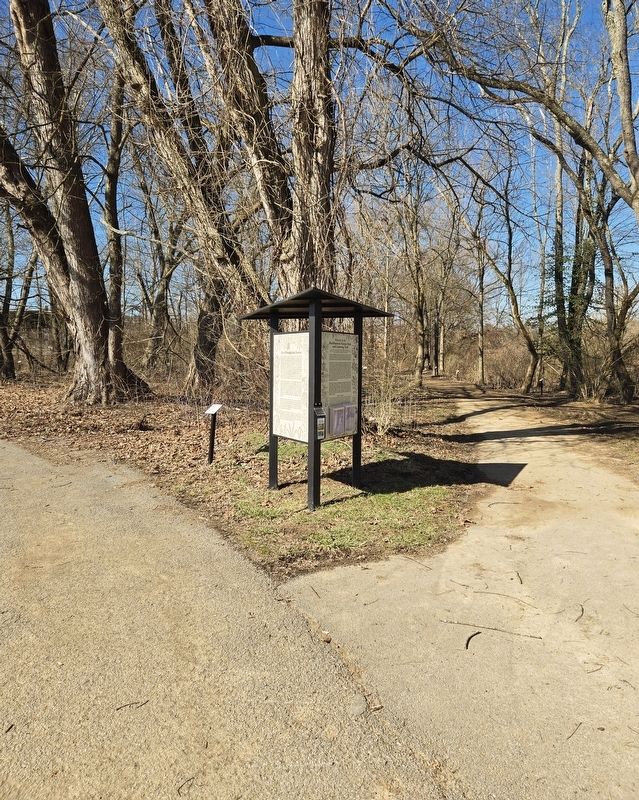
Location. 38° 59.613′ N, 80° 12.983′ W. Marker is in Buckhannon, West Virginia, in Upshur County. It can be reached from Camden Avenue north of Walktrail Lane, on the left when traveling north. Marker is located on the Buckhannon River Walk Trail west of the Camden Avenue parking area. Touch for map. Marker is at or near this postal address: 8 Camden Avenue, Buckhannon WV 26201, United States of America. Touch for directions.

Regionally, this marker is in North Central West Virginia. It is also in the American South, specifically in the Upper South, in Appalachia, and specifically in Northern Appalachia. Globally, it is in North America, the Western Hemisphere, the Western World, and the Anglosphere. Historically, it finds itself in what was once the territory of the Mississippian Culture.
Other nearby markers. At least 8 other markers are within walking distance of this marker: Toxicodendron radicans (poison ivy) (here, next to this marker); Morus alba (white mulberry) (a few steps from this marker); Acer saccharinum (silver maple) (within shouting distance of this marker); Clethra acuminata (sweet pepperbush) (within shouting distance of this marker); Lindera benzoin (spicebush) (within shouting distance of this marker); Eupatorium fistulosum (Joe-pye weed) (within shouting distance of this marker); Acer negundo (boxelder) (within shouting distance of this marker); Microstegium vimineum (Japanese stiltgrass) (within shouting distance of this marker). Touch for a list and map of all markers in Buckhannon.
Credits. This page was last revised on March 25, 2025. It was originally submitted on March 25, 2025, by Bradley Owen of Morgantown, West Virginia. This page has been viewed 111 times since then and 17 times this year. Photos: 1, 2, 3. submitted on March 25, 2025, by Bradley Owen of Morgantown, West Virginia.
