
Montgomery in Montgomery County, Alabama — The American South (East South Central)
The Alabama Appellate Courts
Photographed by Craig Doda, March 1, 2025
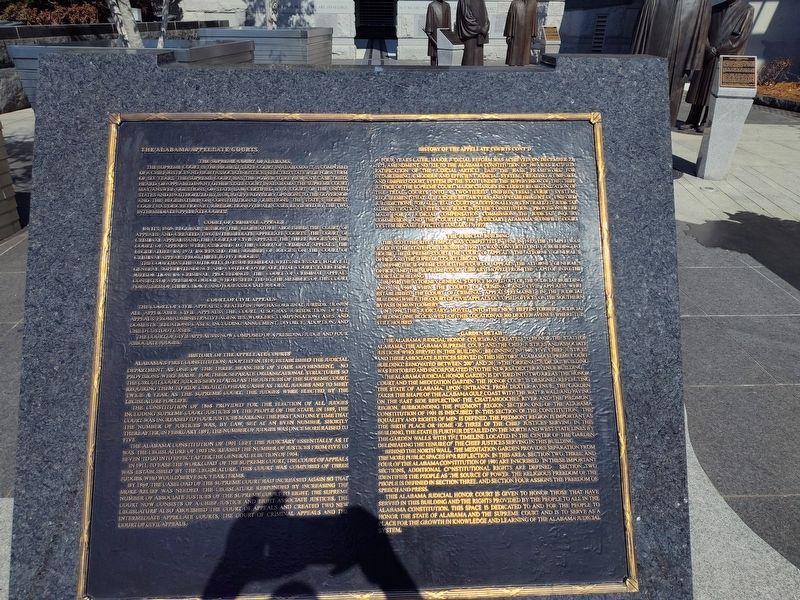
1. The Alabama Appellate Courts Marker
The supreme court is the highest state court in Alabama. It is composed of a chief justice and eight associate justices elected statewide for a term of six years. The Supreme Court has the power to review any case tried, heard, or appealed in any other state court in Alabama. The Supreme Court may answer questions of state law certified by a court of the United States and is authorized by law to give advisory opinions to the governor and the legislature on constitutional questions. The state's highest court has discretionary jurisdiction overall cases reviewed by the two intermediate appellate courts.
Court of Criminal Appeals
In its 1969 regular session, the legislature abolished the court of appeals and created two intermediate appellate courts: The Court of Criminal Appeals and the Court of Civil Appeals. The three judges on the court of appeals were assigned to The Court of Criminal Appeals. The legislature in 1971 increased the number of judges on the Court of Criminal Appeals from three to five judges.
The court has the authority to issue remedial writs necessary to give
this page online
Court of Civil Appeals
The Court of Civil Appeals, created in 1969, has original jurisdiction in all applicable civil appeals. The court also has jurisdiction of all appeals, from administrative agencies, workers' compensation cases, and domestic relations cases, including annulment, divorce, adoption, and child custody cases.
The Court of Civil Appeals is now composed of a presiding judge and four associate judges.
History of the Appellate Courts
Alabama's first constitution, adopted in 1819, established the judicial department as one of the three branches of state government. No provisions were made for their separate organizational structures so the circuit court judges served also as the justices of the Supreme Court, requiring them to ride circuit to hear cases as trial judges and to meet twice a year as the Supreme Court. The judges were elected by the legislature
Photographed by Craig Doda, March 1, 2025
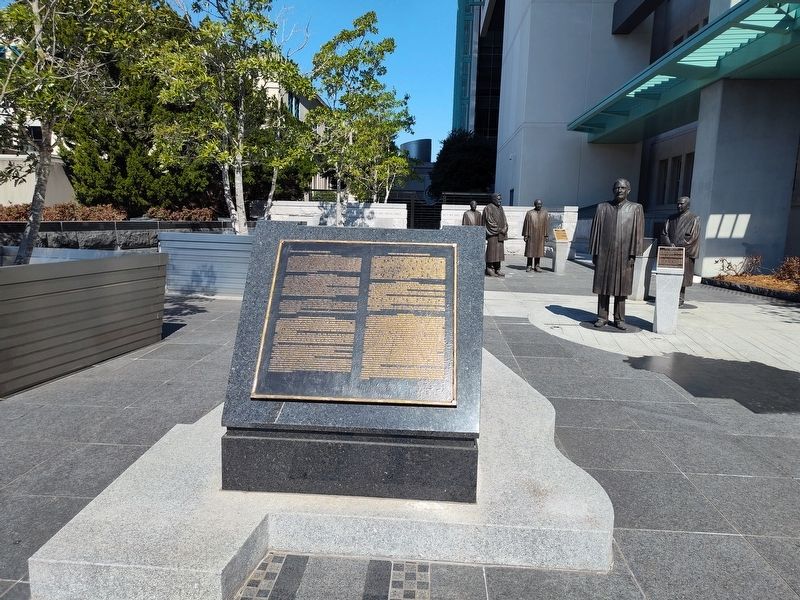
2. The Alabama Appellate Courts Marker
The constitution of 1868 provided for the election of all judges including Supreme Court justices by the people of the state. In 1889, the court was increased to four justices marking the first and only time that the number of justices was, by law, set at an even number. Shortly thereafter, in February 1891, the number of judges was once more raised to five.
The Alabama Constitution of 1901 left the judiciary essentially as it was. The legislature of 1903 increased the number of justices from five to seven to go into effect after the general election of 1904.
In 1911, to ease the workload of the Supreme Court, the court of appeals was established by the legislature. This court was composed of three judges, who would serve six-year terms.
By 1969, the caseload of the Supreme Court had increased again so that more relief was needed. The legislature responded by increasing the number of associate justices of the Supreme Court to eight. The Supreme Court now consists of a chief justice and eight associate justices. The legislature also abolished the court of appeals and created two new intermediate appellate courts, the Court
Photographed by Craig Doda, March 1, 2025
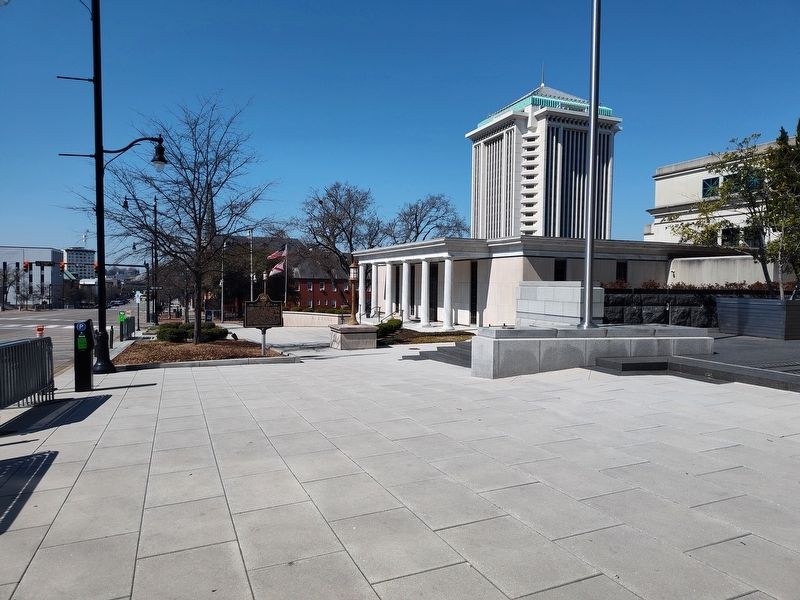
3. The Alabama Appellate Courts Marker
History of the Appellate Courts Continued
Four years later, major judicial reform was achieved on December 27, 1973, Amendment No. 328 to the Alabama Constitution of 1901 was ratified. Ratification of the judicial article laid the basic framework for establishing a modern and efficient judicial system, creating a uniform and unified court system in the state under the supervision of the chief justice of the supreme court. Major changes included: reorganization of the trial courts into a two tiered unified trial court system; requirement that all judges be lawyers and establishment of uniform jurisdictions for all trial courts additionally a centralized judicial administration system was built into the constitution. Provisions were made for a judicial compensation commission, the judicial inquiry commission, and the court of the judiciary. Alabama's unified court system became effective January 17, 1977.
The Judicial Building
The Scottish Rite Temple was completed in 1926. In 1932, the temple was sold to the state for $126,500. In 1938, it was converted into a building to house the Supreme Court, the Court of Appeals, the Attorney General's Office and the Supreme Court Library.
In 1940, the Supreme Court, the Court of Appeals the Attorney General's Office, and the Supreme Court Library moved from the capitol into the judicial building.
In 1958, the Attorney General's Office moved out of the judicial building and in 1969 when the courts of criminal and civil appeals were established, the Court of Criminal Appeals remained in the judicial building while the Court of Civil Appeals occupied offices on the southern bypass in Montgomery.
In 1994, the judiciary moved into the new Heflin Torbert Judicial Building one block west of this location at 300 Dexter Avenue where it is still housed.
Garden Detail
The Alabama Judicial Honor Court was created to honor the State of Alabama, the Alabama Supreme Court and the Chief Justices and Associate Justices who served in this building. Beginning in 1940, five chief justices and their associate justices served in this historic Alabama Supreme Court Building. Renovated between 2007 and 2011, the original judicial building was restored and incorporated into the new RSA Dexter Avenue Building.
The Alabama Judicial Honor Garden is divided into two areas: the honor court and the meditation garden. The honor court is designed reflecting the state of Alabama, upon entrance from Dexter Avenue, the garden takes the shape of the Alabama Gulf Coast with the water wall and paving on the east side reflecting the Chattahoochee River and the Piedmont Region. Surrounding the Piedmont Region, section one of the Alabama Constitution of 1901 is inscribed in this section of the constitution, the equality and rights of men is defined. The Piedmont Region is important as the birth place or home of three of the chief justices serving in this building. The state is further detailed on the north and west state lines by the garden walls with the timeline located in the center of the garden delineating the tenure of the chief justices serving in this building.
Behind the north wall, the meditation garden provides separation from the more public spaces for reflection. In this area, section two, three, and four of the Alabama Constitution of 1901 are inscribed. In these important sections, additional constitutional rights are defined. Section two identifies the people as the source of power. The religious freedom of the people is defined in section three, and section four assigns the freedom of speech and press.
This Alabama Judicial Honor Court is given to honor those that have served in this building and the rights provided by the people to all in the Alabama Constitution, this space is dedicated to and for the people to honor the state of Alabama and the Supreme Court and is to serve as a place for the growth in knowledge and learning of the Alabama Judicial System.
Topics. This historical marker is listed in this topic list: Government & Politics. A significant historical date for this entry is January 17, 1977.
Location. 32° 22.673′ N, 86° 18.193′ W. Marker is in Montgomery, Alabama, in Montgomery County. It is at the intersection of Dexter Avenue and North Hull Street, in the median on Dexter Avenue. Touch for map. Marker is at or near this postal address: 445 Dexter Ave, Montgomery AL 36104, United States of America. Touch for directions.

Regionally, this marker is in Alabama’s Tri-Counties River Region. It is also in the American South, specifically in the Deep South, and in the Black Belt. Globally, it is in North America, a Gulf of Mexico state, the Western Hemisphere, the Western World, and the Anglosphere. Historically, it finds itself in what was once the territory of the Mississippian Culture, one of the Confederate States of America, and the Antebellum South.
Other nearby markers. At least 8 other markers are within walking distance of this marker: Lucien Dunbibben Gardner (here, next to this marker); Clement Clay "Bo" Torbert, Jr. (here, next to this marker); James Edwin Livingston (here, next to this marker); Events During the Terms of Chief Justices (a few steps from this marker); The Alabama Judicial System and the Chief Justices of the Supreme Court. (a few steps from this marker); Howell Thomas Heflin (a few steps from this marker); Associate Justices (a few steps from this marker); Ernest C. “Sonny” Hornsby (a few steps from this marker). Touch for a list and map of all markers in Montgomery.
Credits. This page was last revised on April 13, 2025. It was originally submitted on March 26, 2025, by Craig Doda of Napoleon, Ohio. This page has been viewed 156 times since then and 23 times this year. Photos: 1, 2, 3. submitted on March 26, 2025, by Craig Doda of Napoleon, Ohio. • James Hulse was the editor who published this page.
