Meatpacking District in Manhattan in New York County, New York — The American Northeast (Mid-Atlantic)
Improving Our River Habitat
Photographed by Larry Gertner, September 8, 2024
1. Improving Our River Habitat wayside
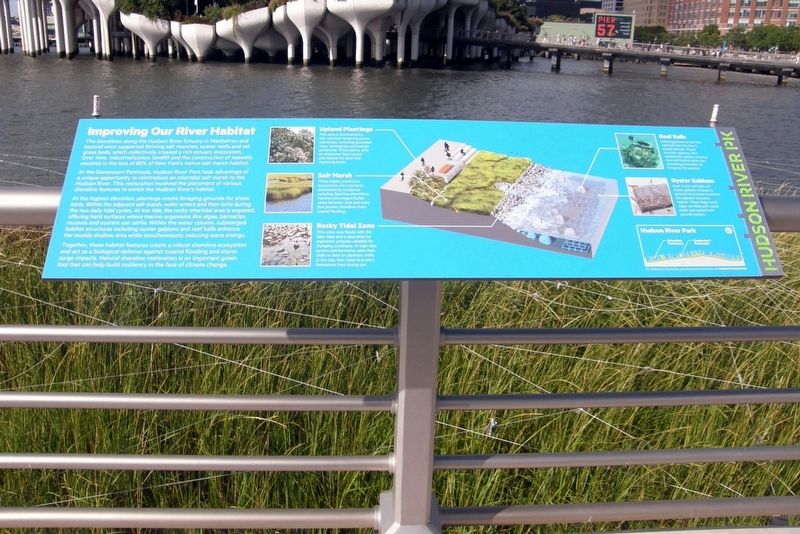
The shoreline along the Hudson River Estuary in Manhattan and beyond once supported thriving salt marshes, oyster reefs and eel grass beds, which collectively created a rich estuary ecosystem. Over time, industrialization, landfill and the construction of seawalls resulted in the loss of 85% on New York’s native salt marsh habitats.
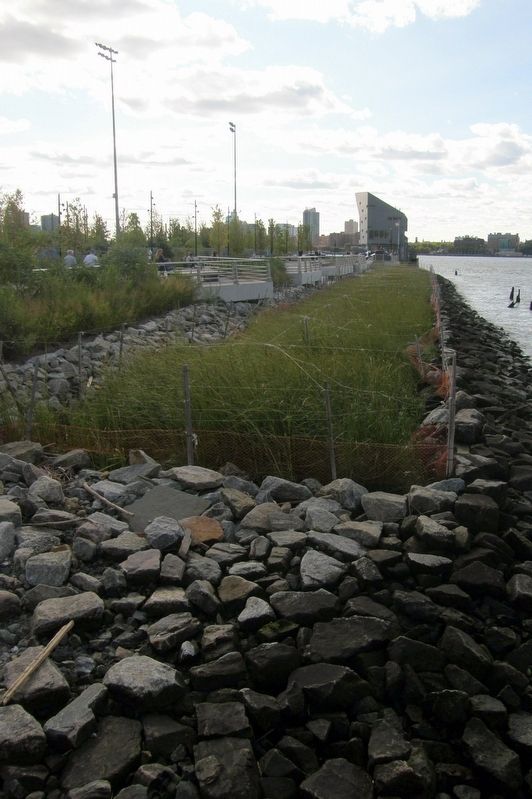
At the Gansevoort Peninsula, Hudson River Park took advantage of a unique opportunity to reintroduce an intertidal salt marsh to the Hudson River. This restoration involved the placement of various shoreline features to enrich the Hudson River’s habitat.
At the highest elevation, plantings create foraging grounds for shore birds. Within the adjacent salt marsh, water enters and then exits during the two daily tidal cycles. At low tide, the rocky intertidal area is exposed, offering hard surfaces where marine organisms like algae, barnacles, mussels and oysters can settle. Within the water columns, submerged habitat structures include oyster gabions and reef balls enhance the muddy shallow area while simultaneously reducing wave energy.
Together, these habitat features create a robust shoreline
this page online
Upland Plantings
This area is dominated by salt-resistant flowering plants and shrubs, including groundsel trees, switchgrass and seaside goldenrod. These plants offer an important food source and habitat for local and migrating birds.
Salt Marsh
These highly productive ecosystems are commonly dominated by cordgrass including Spartina alterniflora. Marshes are integral buffer zones between land and water that protect shorelines from coastal flooding.
Rocky Tidal Zone
This rocky area floods with the daily tides and is populated by organisms uniquely adapted for changing conditions. At high tide, oysters and barnacles open their shells to feed on plankton while at low tide, the close to protect themselves from drying out.
Reef Balls
Submerged even at low tide, reef balls dot the river’s muddy bottom. These concrete spheres were seeded with oysters, creating new reef habitat while also providing protection for foraging fish

Photographed by Larry Gertner, September 8, 2024
2. Improving Our River Habitat wayside site
Oyster Gabions
Next to the reef balls are oyster gabions stacked in pyramidal formations to protect the adjacent shoreline habitat. These large metal containers are filled with opened shells and seeded with juvenile oysters.
Erected by Hudson River Pk.
Topics. This historical marker is listed in this topic list: Environment.
Location. 40° 44.439′ N, 74° 0.625′ W. Marker is in Manhattan, New York, in New York County. It is in the Meatpacking District. It can be reached from Bloomfield Street. Touch for map. Marker is at or near this postal address: Gansevoort Peninsula, New York NY 10014, United States of America. Touch for directions.

Regionally, this marker is in New York City. It is also in the American Northeast, in the Mid-Atlantic, and on the Eastern Seaboard. Globally, it is in the North Atlantic Region, North America, the Western Hemisphere, the Western World, and the Anglosphere. Historically, it finds itself in what was once New Netherland and also one of the original Thirteen Colonies.
Other nearby markers. At least 8 other markers are within
Photographed by Larry Gertner, September 8, 2024
3. The salt marsh
Also see . . . Gansevoort Peninsula. Hudson River Pk website entry (Submitted on March 26, 2025, by Larry Gertner of New York, New York.)
Credits. This page was last revised on April 20, 2025. It was originally submitted on March 26, 2025, by Larry Gertner of New York, New York. This page has been viewed 340 times since then and 42 times this year. Photos: 1, 2, 3. submitted on March 26, 2025, by Larry Gertner of New York, New York.
