
Binnenstad Hoorn , North Holland, Netherlands — Northwestern Europe
Claes Stapelhofje
⎯⎯⎯
Claes Stapel Almshouse
| — | Rijksmonument | — |
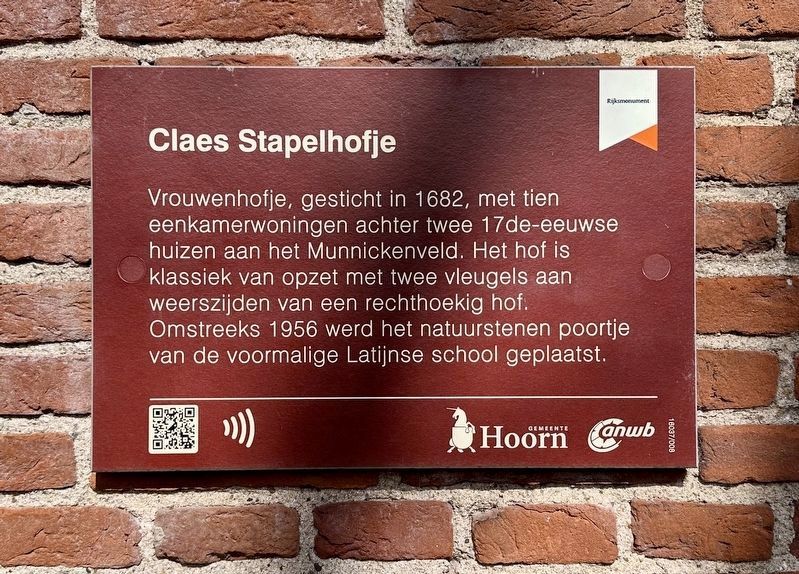
Photographed by Andrew Ruppenstein, March 22, 2025
1. Claes Stapel Almshouse Marker

Erected by Gemeente Hoorn, ANWB. (Marker Number 16037/008.)
Topics. This historical marker is listed in these topic lists: Architecture • Charity & Public Work • Women. A significant historical year for this entry is 1682.
Location. 52° 38.616′ N, 5° 3.473′ E. Marker is in Hoorn, Noord-Holland (North Holland). It is in Binnenstad Hoorn. It is on Munnickenveld, on the left when traveling east. Touch for map. Marker is at or near this postal address: Munnickenveld 21, Hoorn, Noord-Holland 1621 HM, Netherlands.
this page online

Regionally, it is in Europe, the European Union, Atlantic Europe, the Benelux Low Countries, the Schengen Area, Western Europe, and the Western World. Historically, it finds itself in what was once the Holy Roman Empire.
Other nearby markers. At least 8 other markers are within walking distance of this marker: Sint Pietershof (1692) (about 90 meters away, measured in a direct line); Ramen 34 (about 150 meters away); Doelengebouw / Shooting Guild Buildings (about 180 meters away); Ramen 1-3 (about 240 meters away); Lutherse Kerk / Lutheran Church (about 240 meters away); Graaf van Bossu (about 240 meters away); Ramen / “Frames” (about 240 meters away); Burgerweeshuis / Orphanage (approx. 0.2 kilometers away). Touch for a list and map of all markers in Hoorn.
Also see . . . Claes Stapelhofje (ErfgoedHoorn.nl). The QR code on the marker leads to a page with more information and several photos. Excerpt (in translation):
In almshouses, old or poor people could find shelter. They were therefore important social facilities and they were founded by wealthy families. This also applies to the Claes(Submitted on March 27, 2025.)Stapel almshouse, which was founded in 1682 by Jan Jansz. Koekebacker, Pieter Bos and Claes Stapel.Photographed by Andrew Ruppenstein, March 22, 20252. Claes Stapel Almshouse Marker - wide view
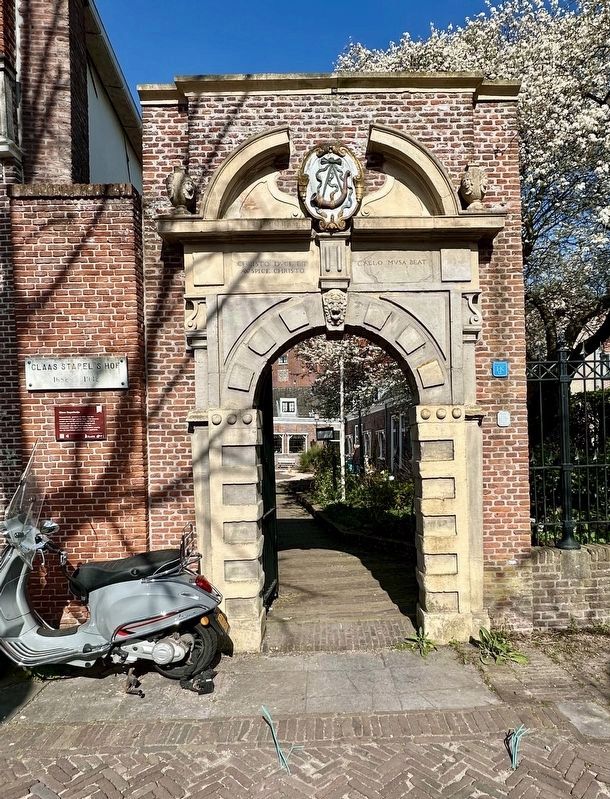
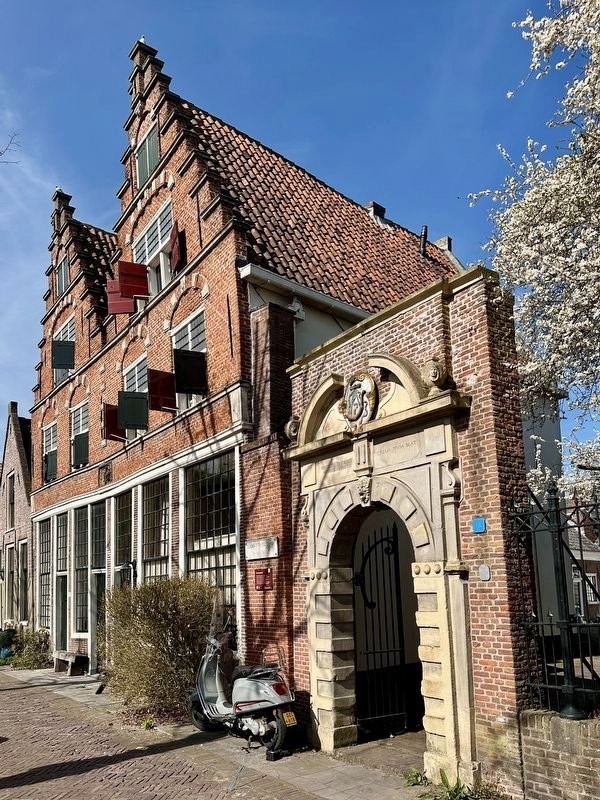
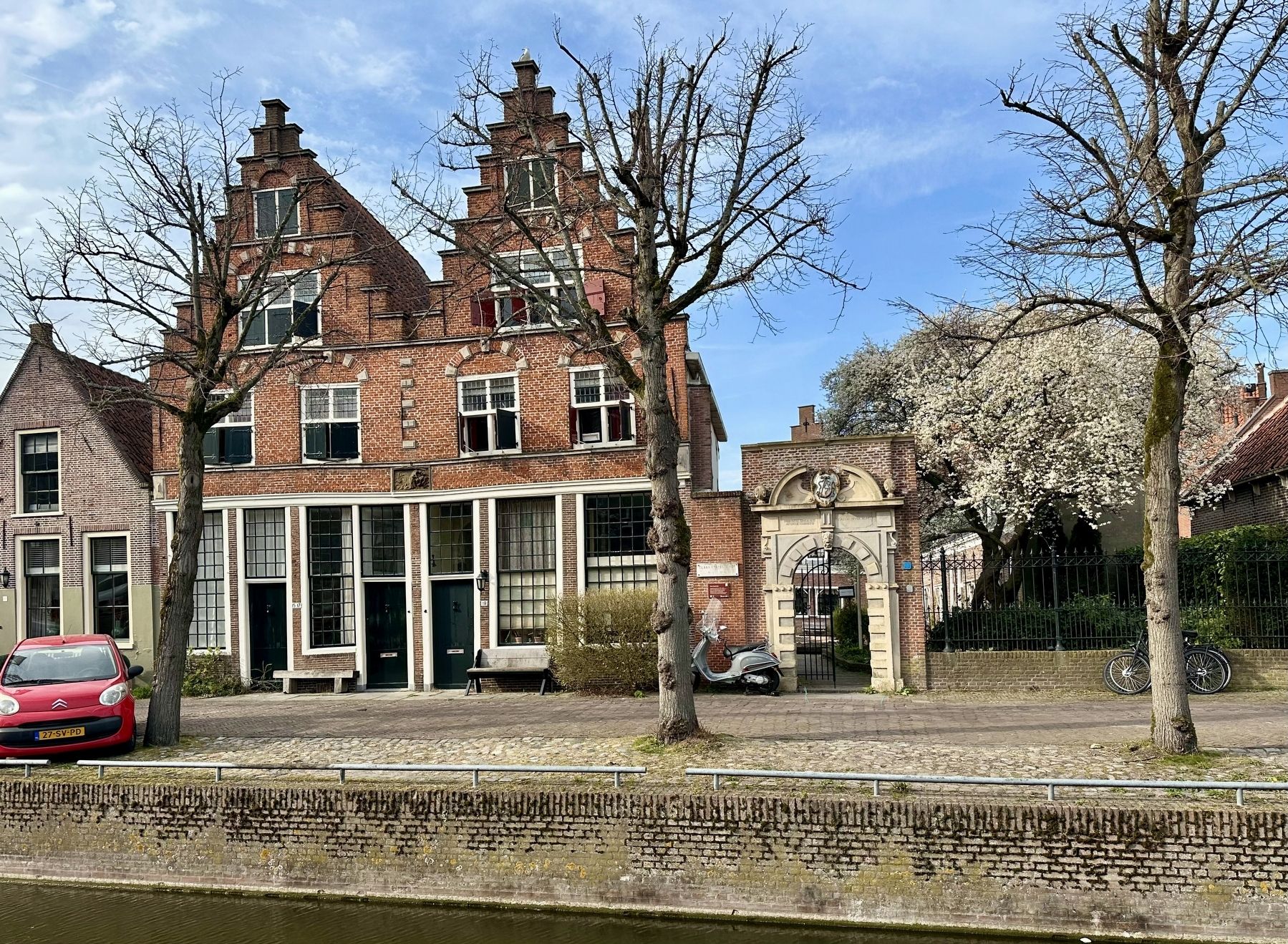
The almshouse was traditionally built around an inner courtyard. The bleaching plant, the water pump and a vegetable garden were located in the inner courtyard. The simple houses consisted of a room measuring 4x4 metres, which contained a box bed, a fixed corner cupboard and a fireplace. Each house had an attic that served as storage. The house of the almshouse lady or ‘hospes’ was somewhat more spacious and of course the regent’s room was also equipped with more conveniences. Because they had to meet modern requirements, the houses were renovated in 1954 and partly merged. The Latin Gate was placed here in 1956, as it used to belong to the Latin School. The courtyard was eventually purchased by the Hendrick de Keyser Association, which rents the houses to private individuals.
Photographed by Andrew Ruppenstein, March 22, 2025
3. Claes Stapel Almshouse Marker - wide view
Photographed by Andrew Ruppenstein, March 22, 2025
4. Claes Stapel Almshouse
Credits. This page was last revised on March 27, 2025. It was originally submitted on March 27, 2025, by Andrew Ruppenstein of Lamorinda, California. This page has been viewed 95 times since then and 13 times this year. Photos: 1, 2, 3, 4. submitted on March 27, 2025, by Andrew Ruppenstein of Lamorinda, California.
