Buckhannon in Upshur County, West Virginia — The American South (Appalachia)
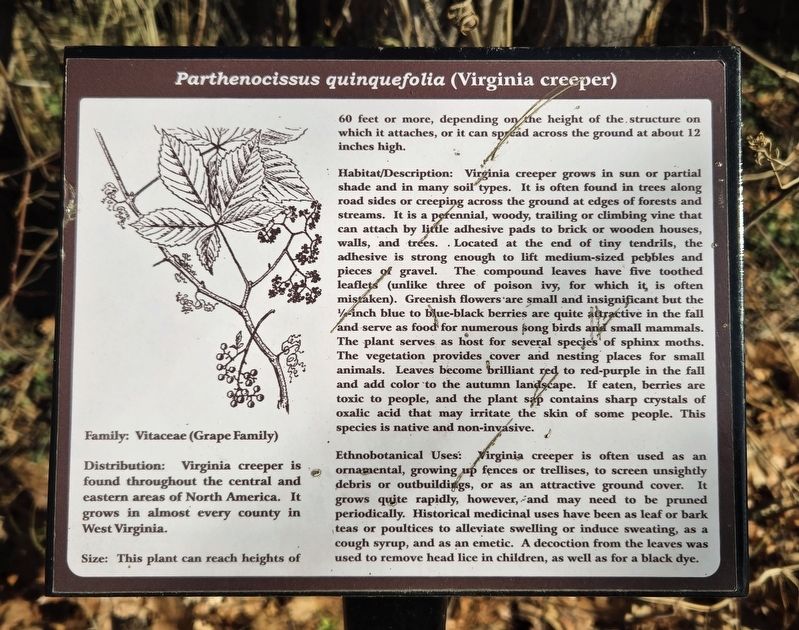
Parthenocissus quinquefolia (Virginia creeper)
Photographed by Bradley Owen, March 10, 2025
1. Parthenocissus quinquefolia (Virginia creeper) Marker
Family: Vitaceae (Grape Family)
Distribution: Virginia creeper is found throughout the central and eastern areas of North America. It grows in almost every county in West Virginia.
Size: This plant can reach heights of 60 feet or more, depending on the height of the structure on which it attaches, or it can spread across the ground at about 12 inches high.
Habitat/Description: Virginia creeper grows in sun or partial shade and in many soil types. It is often found in trees along road sides or creeping across the ground at edges of forests and streams. It is a perennial, woody, trailing or climbing vine that can attach by little adhesive pads to brick or wooden houses, walls, and trees. Located at the end of tiny tendrils, the adhesive is strong enough to lift medium-sized pebbles and pieces of gravel. The compound leaves have five toothed leaflets (unlike three of poison ivy, for which it is often mistaken). Greenish flowers are small and insignificant but the inch blue to blue-black berries are quite attractive in the fall and serve as food for numerous song birds and small mammals. The plant serves as host
this page online
Ethnobotanical Uses: Virginia creeper is often used as an ornamental, growing up fences or trellises, to screen unsightly debris or outbuildings, or as an attractive ground cover. It grows quite rapidly, however, and may need to be pruned periodically. Historical medicinal uses have been as leaf or bark teas or poultices to alleviate swelling or induce sweating, as a cough syrup, and as an emetic. A decoction from the leaves was used to remove head lice in children, as well as for a black dye.
Erected 2017 by West Virginia Wesleyan College Department of Biology.
Topics. This historical marker is listed in this topic list: Science & Medicine.
Location. 38° 59.577′ N, 80° 12.792′ W. Marker is in Buckhannon,
Photographed by Bradley Owen, March 10, 2025
2. Parthenocissus quinquefolia (Virginia creeper) Marker

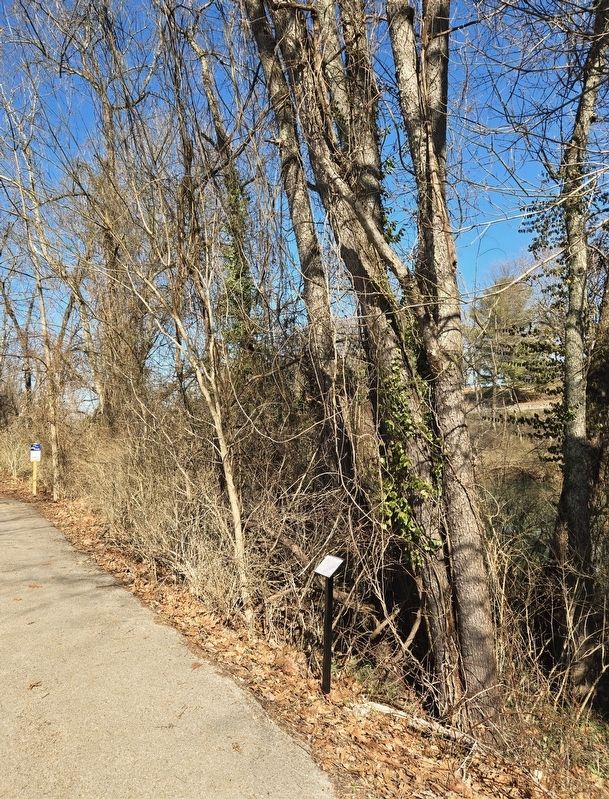
Regionally, this marker is in North Central West Virginia. It is also in the American South, specifically in the Upper South, in Appalachia, and specifically in Northern Appalachia. Globally, it is in North America, the Western Hemisphere, the Western World, and the Anglosphere. Historically, it finds itself in what was once the territory of the Mississippian Culture.
Other nearby markers. At least 8 other markers are within walking distance of this marker: Juglans cinerea (butternut, or white walnut) (within shouting distance of this marker); Juglans nigra (black walnut) (within shouting distance of this marker); West Virginia Wesleyan College (within shouting distance of this marker); Bob Wallace Bridge (about 300 feet away, measured in a direct line); Two Buddies & An Angel (about 300 feet away); Castanea dentata x mollissima (Dunstan chestnut) (about 500 feet away); Celastrus orbiculatus (Oriental bittersweet) (about 500 feet away); The Tannery (about 600 feet away). Touch for a list and map of all markers in Buckhannon.
Credits. This page was last revised on March 27, 2025. It was originally submitted on March 27, 2025, by Bradley Owen of Morgantown, West Virginia. This page has been viewed 91 times since then and 8 times this year. Photos: 1, 2. submitted on March 27, 2025, by Bradley Owen of Morgantown, West Virginia.
