East Florence in Lauderdale County, Alabama — The American South (East South Central)
Natural History

Photographed by Sandra Hughes Tidwell, March 26, 2025
1. Natural History Marker
Lamb's Ferry pool separated the Elk River Shoals from the Big Muscle Shoals. Further downstream, the Bainbridge pool separated the Big Muscle Shoals from the Little Muscle Shoals. These shoals developed when sand and sediment gradually accumulated into hardened formations along the riverbed.
The
this page online
Captions
(Photo #1) Before the 1890s, the narrow and rocky Muscle Shoals made river travel notoriously tricky. This picture shows what the shoals looked like when water levels were low. (Courtesy of the University of North Alabama, Collier Library Archives and Special Collections.)
(Photo #2) This diagram kartic process-forming throuht dissolution of soluble rocks-in-action. The many limestone caves beneath the ground are characteristic of the Tennessee River Basin. (Courtesy of the Muscle Shoals National Heritage Area.)
(Photo #3) Vast stretches of the Tennessee River give way to intermittent rocky shores along the banks. This section of the river between Florence and Sheffield shows one of these gravelly slopes. (Courtesy of the University of North Alabama, Collier Library Archives and Special Collections.)
(Photo #4) When TVA constructed Pickwick Landing Dam in the 1930s, flooding created many reservoirs along the Tennessee River. Bluff Creek, pictured above, was one of these reservoirs. It's now called PickWick Lake. (Courtesy of the University of Alabama Museums.)
(Photo #5) Tennessee River banks are often steep and rocky. Thousands of years of geological bedding have produced walls of dense, stratified rock along the water. (Courtesy of the University of North Alabama, Collier Library Archives and Special Collections.)
Erected by Florence
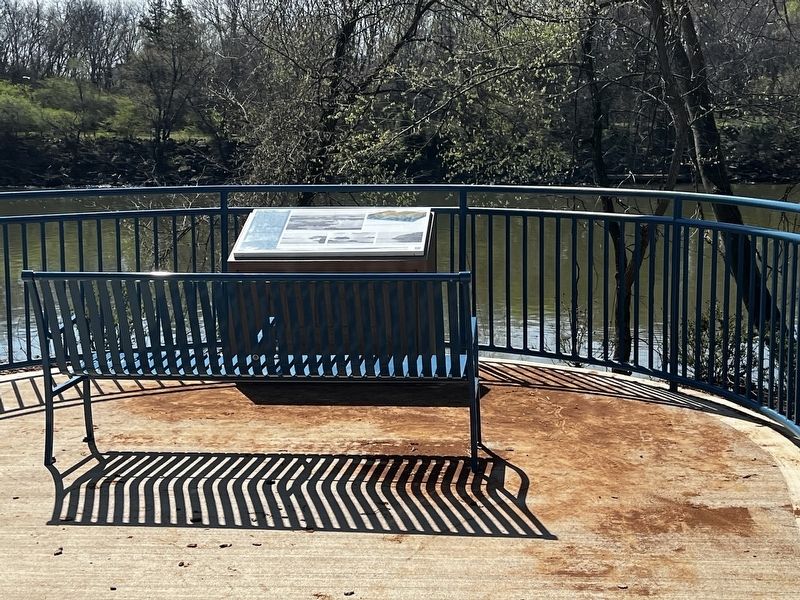
Photographed by Sandra Hughes Tidwell, March 26, 2025
2. Natural History Marker
Topics. This historical marker is listed in this topic list: Waterways & Vessels. A significant historical year for this entry is 1890.
Location. 34° 48.226′ N, 87° 38.021′ W. Marker is in Florence, Alabama, in Lauderdale County. It is in East Florence. It is on Blair Street. Touch for map. Marker is at or near this postal address: 819 Blair St, Florence AL 35630, United States of America. Touch for directions.

Regionally, this marker is in North Alabama and in the Shoals. It is also in the American South, specifically in the Deep South, in Appalachia, and specifically in Southern Appalachia. Globally, it is in North America, a Gulf of Mexico state, the Western Hemisphere, the Western World, and the Anglosphere. Historically, it finds itself in what was once the territory of the Mississippian Culture, one of the Confederate States of America, and the Antebellum South.
Other nearby markers. At least 8 other markers are within walking distance of this marker: Wilson Dam Lock (within shouting distance of this marker); Tennessee Valley Authority (approx. 0.2 miles away); Wilson Dam (approx. 0.2 miles

Photographed by Sandra Hughes Tidwell, March 26, 2025
3. Kartic process-forming
This diagram kartic process-forming throuht dissolution of soluble rocks-in-action. The many limestone caves beneath the ground are characteristic of the Tennessee River Basin.
(Courtesy of the Muscle Shoals National Heritage Area.)
Credits. This page was last revised on April 5, 2025. It was originally submitted on March 27, 2025, by Sandra Hughes Tidwell of Killen, Alabama, USA. This page has been viewed 233 times since then and 91 times this year. Photos: 1, 2, 3. submitted on March 27, 2025, by Sandra Hughes Tidwell of Killen, Alabama, USA. • James Hulse was the editor who published this page.
