East Florence in Lauderdale County, Alabama — The American South (East South Central)
Wilson Dam Lock
Photographed by Sandra Hughes Tidwell, March 26, 2025
1. Wilson Dam Lock Marker
Inscription.
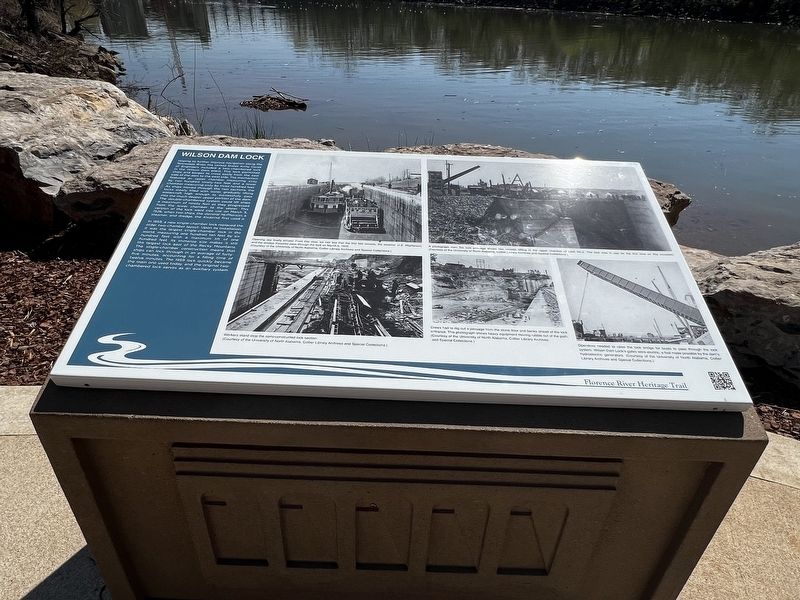
Wilson Dam Lock. . Hoping to further improve navigation along the Tennessee River, the United States Army Corps of Engineers included a two-chambered lock in the Wilson Dam plans. This lock permitted ships and barges to cross easily from the east side of the dam to the west side. The mechanism featured an upper chamber measuring sixty by two hundred ninety-two feet and a lower chamber measuring sixty by three hundred feet. As ships moved through the two sections, the locks slowly filled with water gradually lifting watercraft high enough to successfully pass into the much deeper upper portion of the dam. The double-chambered system could lift ships a maximum of ninety feet as they progressed from the lower chamber to the upper. This version of the lock went into use on March 5, 1926, when two ships, the General McPherson, a steamer, and the dredge Kwasind, first used it., In 1959, a new single-chamber lock replaced the older two-chamber layout. Upon its installation, it was the largest single-chamber lock in the world, measuring one hundred ten feet by six hundred feet with a maximum lift of one hundred feet. Its immense size makes it still the largest lock east of the Rocky Mountains. The single-chamber construction means that ships can lock through in an average of forty-five minutes, accounting for a filling time of twelve minutes. The 1959 lock quickly became the main one used today, and the original two-chamber lock serves as an auxiliary system. , Captions , (Photo #1) Opening day finally arrives! From this view, we can see that the first vessels, the steamer U.S. Mepherson, and the dredge Kwasind pass through the lock on March 5, 1926. (Courtesy of University of North Alabama, Collier Library Archives and Special Collections) , (Photo #2) Workers stand atop the semi-constructed lock section. (Courtesy of University of North Alabama, Collier Library Archives and Special Collections) , (Photo #3) A photograph from the lock passage shows two vessels sitting in the upper chamber of Lock No. 2. This lock was in use for the first time on three occasions. (Courtesy of University of North Alabama, Collier Library Archives and Special Collections) , (Photo #4) Crews had to dig out a passage from the stone floor and banks ahead of the lock entrance. This photograph shows heavy equipment moving rubble out of the path. (Courtesy of University of North Alabama, Collier Library Archives and Special Collections) , (Photo #5) Operators needed to raise the lock bridge for boats to pass through the lock system. Wilson Dam Lock's gates were electric, a feat made possible by the dam's hydroelectric generators. (Courtesy of University of North Alabama, Collier Library Archives and Special Collections)
Hoping to further improve navigation along the Tennessee River, the United States Army Corps of Engineers included a two-chambered lock in the Wilson Dam plans. This lock permitted ships and barges to cross easily from the east side of the dam to the west side.
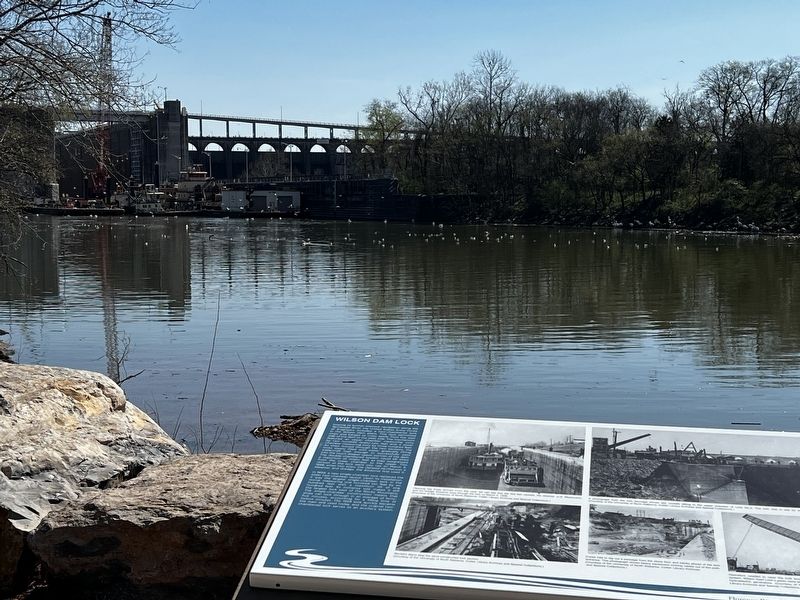
The mechanism featured an upper chamber measuring sixty by two hundred ninety-two feet and a lower chamber measuring sixty by three hundred feet. As ships moved through the two sections, the locks slowly filled with water gradually lifting watercraft high enough to successfully pass into the much deeper upper portion of the dam. The double-chambered system could lift ships a maximum of ninety feet as they progressed from the lower chamber to the upper. This version of the lock went into use on March 5, 1926, when two ships, the General McPherson, a steamer, and the dredge Kwasind, first used it.
In 1959, a new single-chamber lock replaced the older two-chamber layout. Upon its installation, it was the largest single-chamber lock in the world, measuring one hundred ten feet by six hundred feet with a maximum lift of one hundred feet. Its immense size makes it
Click or scan to see this page online
still the largest lock east of the Rocky Mountains.
The single-chamber construction means that ships can lock through in an average of forty-five minutes, accounting for a filling time of twelve minutes. The 1959 lock quickly became the main one used today, and the original two-chamber lock serves as an auxiliary system.
Captions (Photo #1)
Opening day finally arrives! From this view, we can see that the first vessels, the steamer U.S. Mepherson, and the dredge Kwasind pass through the lock on March 5, 1926. (Courtesy of University of North Alabama, Collier Library Archives and Special Collections) (Photo #2)
Workers stand atop the semi-constructed lock section.
(Courtesy of University of North Alabama, Collier Library Archives and Special Collections) (Photo #3)
A photograph from the lock passage shows two vessels sitting in the upper chamber of Lock No. 2. This lock was in use for the first time on three occasions.
(Courtesy of University of North Alabama, Collier Library Archives and Special Collections) (Photo #4)
Crews had to dig out a passage from the stone floor and banks ahead of the lock entrance. This photograph shows heavy equipment moving rubble out of the path.
(Courtesy of University of North Alabama, Collier Library Archives and Special Collections) (Photo #5)
Operators needed to raise the lock bridge for boats to pass through the lock system. Wilson Dam Lock's gates were electric, a feat made possible by the dam's hydroelectric generators. (Courtesy of University of North Alabama, Collier Library Archives and Special Collections)
Erected by Florence
Photographed by Sandra Hughes Tidwell, March 26, 2025
2. Wilson Dam Lock Marker
River Heritage Trail.
Topics. This historical marker is listed in this topic list: Waterways & Vessels. A significant historical date for this entry is March 5, 1926.
Location. 34° 48.209′ N, 87° 38.041′ W. Marker is in Florence, Alabama, in Lauderdale County. It is in East Florence. It is on Blair Street. Touch for map. Marker is at or near this postal address: 819 Blair St, Florence AL 35630, United States of America. Touch for directions.

Regionally, this marker is in North Alabama and in the Shoals. It is also in the American South, specifically in the Deep South, in Appalachia, and specifically in Southern Appalachia. Globally, it is in North America, a Gulf of Mexico state, the Western Hemisphere, the Western World, and the Anglosphere. Historically, it finds itself in what was once the territory of the Mississippian Culture, one of the Confederate States of America, and the Antebellum South.
Other nearby markers. At least 8 other markers are within walking distance of this marker: Natural History (within shouting distance of this marker); Tennessee Valley Authority (approx. 0.2 miles away); Wilson Dam (approx. 0.2 miles
Photographed by Sandra Hughes Tidwell, March 26, 2025
Credits. This page was last revised on April 1, 2025. It was originally submitted on March 27, 2025, by Sandra Hughes Tidwell of Killen, Alabama, USA. This page has been viewed 140 times since then and 37 times this year. Photos:1, 2, 3. submitted on March 27, 2025, by Sandra Hughes Tidwell of Killen, Alabama, USA. • James Hulse was the editor who published this page.
