
Old Port of Montreal in Montréal, Québec — Central Canada (French-Canadian)
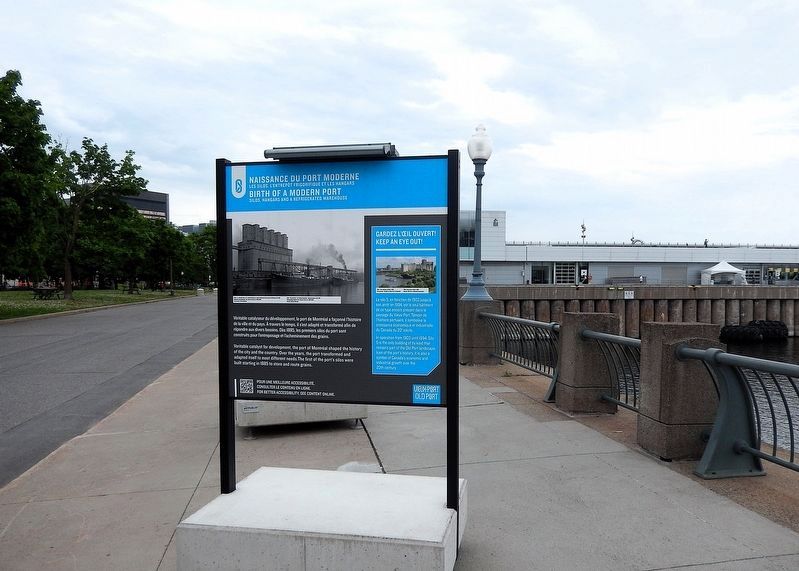
Naissance du port moderne
Vieux-Port
⎯⎯⎯
Birth of a Modern Port
Old Port
Photographed by Cosmos Mariner, May 21, 2024
1. Naissance du port moderne/Birth of a Modern Port Marker (north side)

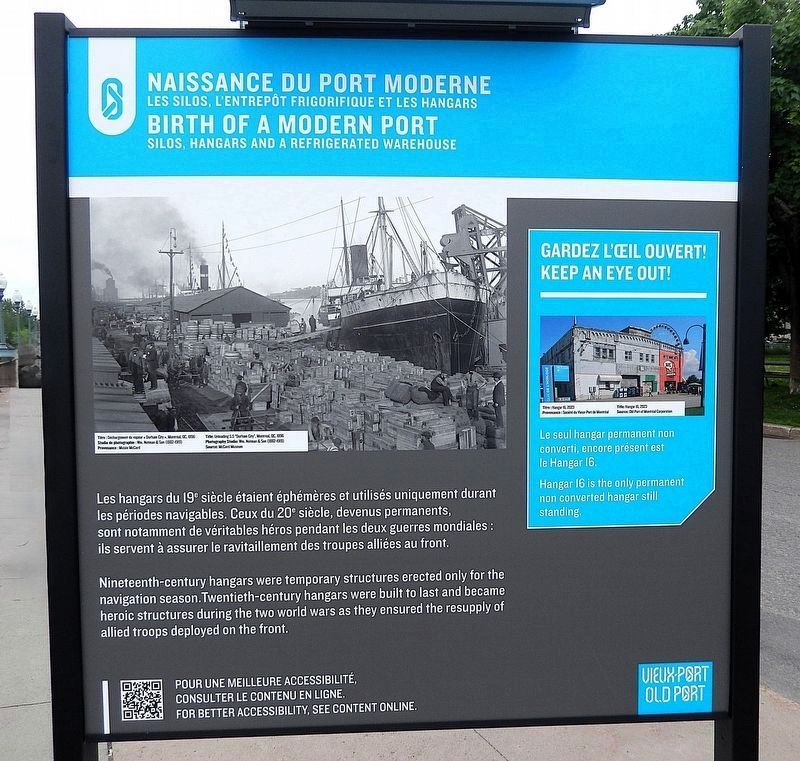
Les hangars du 19e siècle étaient éphémères et utilisés uniquement durant les périodes navigables. Ceux du 20e siècle, devenus permanents, sont notamment de véritables héros pendant les deux guerres mondiales : ils servent à assurer le ravitaillement des troupes alliées au front.
Véritable catalyseur du développement, le port de Montréal a façonné l'histoire de la ville et du pays. À travers le temps, il s'est adapté et transformé afin de répondre aux divers besoins. Dès 1885, les premiers silos du port sont construits pour l'entreposage et l'acheminement des grains.
Gardez l'œil ouvert !
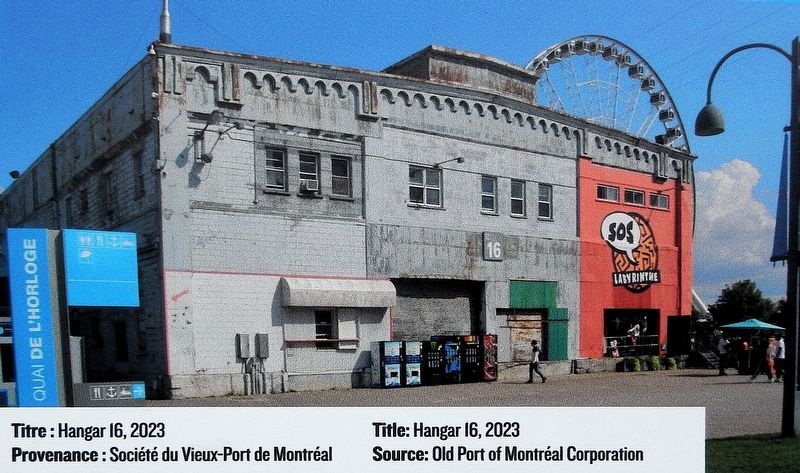
Le seul hangar permanent non converti, encore présent est le Hangar 16.
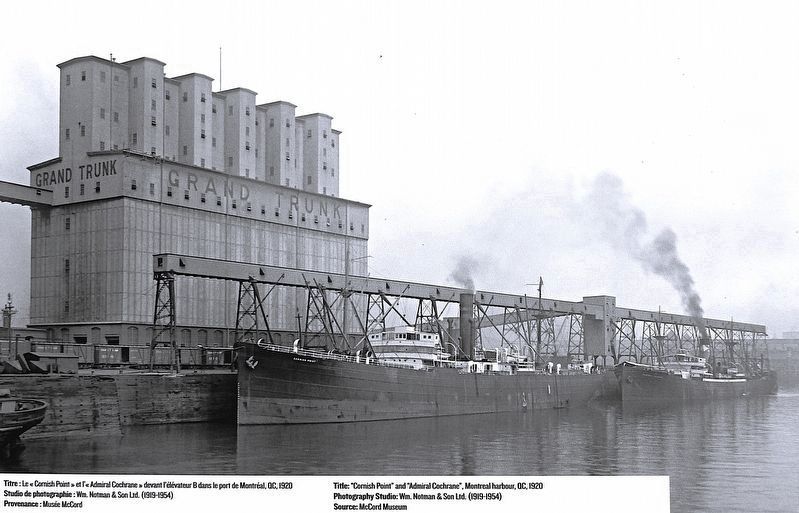
Le silo 5, en fonction de 1903 jusqu'à son arrêt en 1994, est le seul bâtiment de ce type encore présent dans le paysage du Vieux-Port. Témoin de l'histoire portuaire, il symbolise la croissance économique et industrielle du Canada du 20e siècle.
Nineteenth-century hangars were temporary structures erected only for the navigation season. Twentieth-century
this page online
Veritable catalyst for development, the port of Montréal shaped the history of the city and the country. Over the years, the port transformed and adapted itself to meet different needs. The first of the port's silos were built starting in 1885 to store and route grains.
Keep an eye out!
Hangar 16 is the only permanent non converted hangar still standing.
In operation from 1903 until 1994, Silo 5 is the only building of its kind that remains part of the Old Port landscape. Icon of the port's history, it is also a symbol of Canada's economic and industrial growth over the 20th century.
Topics. This historical marker is listed in these topic lists: Architecture • Industry & Commerce • Waterways & Vessels. A significant historical year for this entry is 1885.
Location. 45° 30.072′ N, 73° 33.158′ W. Marker is in Montréal, Québec. It is in Old Port of Montreal. It can be reached from Rue Quai Alexandra just east of Rue de la Commune Ouest, on the right when traveling east. The marker

Photographed by Cosmos Mariner, May 21, 2024
2. Naissance du port moderne/Birth of a Modern Port Marker (south side)

Regionally, this marker is in Central Canada. Globally, it is in North America, the Western Hemisphere, and the Western World. Historically, it finds itself in what was once a British colony, the Viceroyalty of New France, the Haudenosaunee (Iroquois) Confederacy, and Rupert’s Land.
Other nearby markers. At least 8 other markers are within walking distance of this marker: Porte d'entrée d'une autre époque / Gateway to a Different Time (here, next to this marker); a different marker also named Naissance du port moderne / Birth of a Modern Port (a few steps from this marker); Le plus grand port céréalier du monde / The World's Largest Grain Port (a few steps from this marker); Luttes contre l'eau et la glace / Battle with Waters and Ice (a few steps from this marker); Transformation Vieux-Port en site récréotouristique / Old Port Transformed into Recreational Tourism (a few steps from
Courtesy Musée McCord Museum
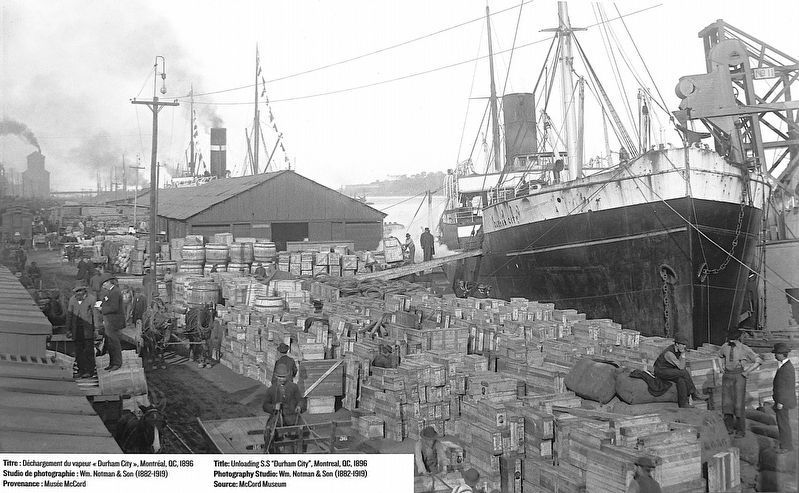
3. Marker detail: Unloading S.S "Durham City'', Montreal, QC, 1896
Déchargement du vapeur « Durham City », Montréal, QC, 1896
Studio de photographie : Wm. Notman & Son (1882-1919)
Studio de photographie : Wm. Notman & Son (1882-1919)
Related markers. Click here for a list of markers that are related to this marker. Vieux-Port/Old Port
Also see . . .
1. Silo No. 5 — Héritage Montréal.
Excerpt: By virtue of its size, siting and volume, Silo No. 5 creates a monumental alignment stretching nearly 400 metres along the Pointe-du-Moulin in Montréal’s Old Port. It consists of three distinct parts linked together by aerial galleries. With its floating elevators which allowed the offloading of grain from the holds of lakers and the simultaneous loading of transatlantic vessels without ever coming into contact with the quays, the silo demonstrates the technological prowess of a bygone era.(Submitted on March 29, 2025, by Cosmos Mariner of Cape Canaveral, Florida.)Silo No. 5 was completed in four stages (1906, 1913, 1924 and 1958).
Construction on Silo No. 5 was begun by the Grand Trunk Railway in 1903. In the late 19th century and for several decades thereafter, grain was the main export product transiting through the Port of Montreal. Competition from U.S. ports was strong, so the decision was made to equip Montreal’s with grain elevators and make it the world’s leading grain port by 1928.Courtesy Old Port of Montréal Corporation/Société du Vieux-Port de Montréal4. Marker detail: Hangar 16, 2023
2. The Former Glory of Grain (The McGill Daily).
Excerpt: Silo no. 5 is composed of three separate grain elevators, constructed between 1903 and 1957. The most impressive of these, Silo B1, dominates the local landscape with its sheer size and decaying splendor. It is an imposing array of 44 cylindrical grain silos, each one 40 metres tall, with a total length of 182 metres. The silo was built when Montreal was the main port of exit for wheat grown on the prairies and hauled eastward by freight rail. The site’s heyday was in the period after World War II, when Canada was referred to as the “breadbasket of the world”. At that time, Canada was tasked with feeding much of Europe, whose(Submitted on March 29, 2025, by Cosmos Mariner of Cape Canaveral, Florida.)agricultural economy was left in shambles following the second world war. In 1956 and 1957, the final expansion to Silo no. 5 was undertaken with the construction of the enormous Silo B1 complex, built to handle the inflated demand for Canadian wheat.Courtesy Musée McCord Museum5. Marker detail: “Cornish Point” and “Admirai Cochrane”, Montréal Harhour, QC, 1920Le « Cornish Point » et « Admirai Cochrane » devant l'élévateur B dans le port de Montréal, QC, 1920
Studio de photographie : Wm. Notman & Son Ltd. (1919-1954)

Photographed by Cosmos Mariner, May 21, 2024
6. Naissance du port moderne/Birth of a Modern Port Marker
Looking south along the Promenade du Vieux-Port.
Photographed by Cosmos Mariner, May 21, 2024
7. Naissance du port moderne/Birth of a Modern Port Marker
Looking north along the Promenade du Vieux-Port.

Photographed by Cosmos Mariner, May 21, 2024
8. Silo No. 5 — Old Port of Montréal
Credits. This page was last revised on April 5, 2025. It was originally submitted on March 27, 2025, by Cosmos Mariner of Cape Canaveral, Florida. This page has been viewed 152 times since then and 38 times this year. Photos: 1, 2, 3, 4, 5, 6, 7, 8. submitted on March 29, 2025, by Cosmos Mariner of Cape Canaveral, Florida.
