Oak Park in Cook County, Illinois — The American Midwest (Great Lakes)
Pleasant Home

Photographed by Sean P. Flynn, March 27, 2025
1. Pleasant Home Marker
John W. Farson engages architect George W. Maher to design Pleasant Home
Oak Park has a population of around 5,000
Erected 2012 by Park District of Oak Park.
Topics. This historical marker is listed in these topic lists: Architecture • Parks & Recreational Areas. A significant historical year for this entry is 1897.
Location. 41° 53.065′ N, 87° 48.128′ W. Marker is in Oak Park, Illinois, in Cook County. It is on South Marion Street 0.1 miles south of Pleasant Street, on the right when traveling north. The stone is a part of the labyrinth located on the western edge of Mills Park. Touch for map. Marker is at or near this postal address: 217 Home Avenue, Oak Park IL 60302, United States of America. Touch for directions.

Regionally, this marker is in Greater Chicago. It is also in the American Midwest. Globally, it is in North America, on the Great Lakes, in the Western Hemisphere, in the Western World, and in the Anglosphere. Historically, it finds itself in what was once the Viceroyalty of New France, the territory of the Mississippian Culture, and the Northwest Territory.
Other nearby markers. At
this page online

Photographed by Sean P. Flynn, March 27, 2025
2. Mills Park labyrinth
More about this marker. The stone is one of about 20 pavers in Mills Park that show the history of Oak Park from the dawn of the solar system through 2012. The pavers are part of a labyrinth embedded into the ground near the western entrance into Mills Park.
Pleasant Home is about 500 feet northeast of this labyrinth.
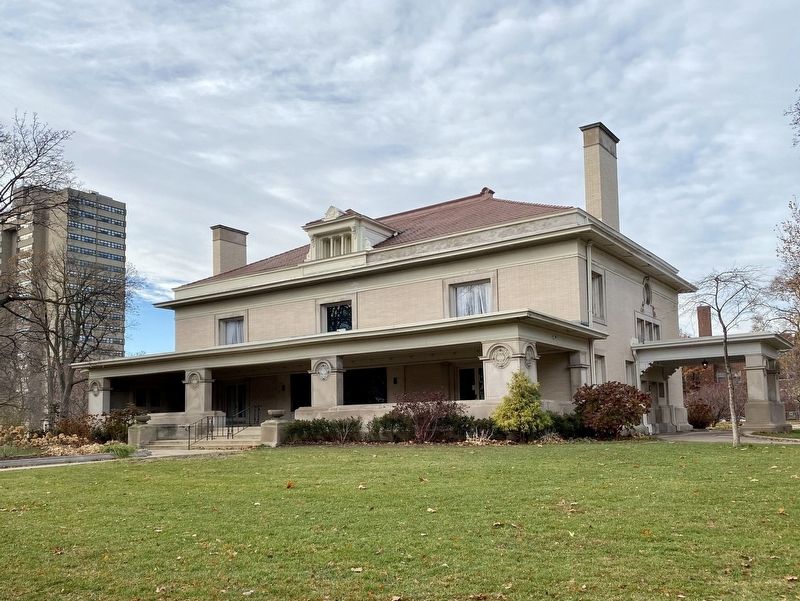
Regarding Pleasant Home. John Farson was an affluent banker who acquired a lot at the corner of Pleasant Street and Home Avenue for $20,000 in 1892, at that time the largest price ever paid for a residential lot in Oak Park. He later acquired adjacent lots for gardens, which today make up Mills Park. George Maher was a prominent Prairie Style architect. Farson's family

Photographed by Sean P. Flynn, March 27, 2025
3. Mills Park labyrinth
Related marker. Click here for another marker that is related to this marker. The Mills Park Labyrinth marker page includes a list of all 21 stones in the labyrinth in chronological order
Also see . . .
1. Pleasant Home history. Pleasant Home was added to the National Register of Historic Places in 1972, and was named a National Historic Landmark in 1996.
Excerpt: "The architect of Pleasant Home, George Washington Maher (1864-1926), was first listed in city directories in 1883 as a draftsman for Chicago architects Augustus Bauer and Henry W. Hill. Maher left their office by 1887 to take a position with architect Joseph Lyman Silsbee. There he worked with Frank Lloyd Wright, George Grant Elmslie, and Cecil Corwin. The commission from John Farson for Pleasant Home initiated a new period in his work, a series of grand houses set on large estates often appointed by the Midwest’s finest artists and craftsmen.(Submitted on March 28, 2025, by Sean P. Flynn of Oak Park, Illinois.)
"George Maher wrote about the need for a new American architecture. His work is aligned with the progressivearchitects in Chicago who developed a new approach to design free from historical references. Maher and his contemporaries, now known as the Prairie School, embraced many of the ideas of the arts and crafts movement: truth to materials, a belief in fine craftsmanship, and a desire to incorporate the local environment in their buildings and its details."Photographed by Sean P. Flynn, March 27, 20254. Mills Park labyrinthA nearby historical marker says that the labyrinth's artistic style was inspired by the architect George W. Maher, who designed the Pleasant Home, located in this park.

2. George W. Maher Society official site. (Submitted on March 28, 2025, by Sean P. Flynn of Oak Park, Illinois.)
December 4, 2021
5. Pleasant Home
Credits. This page was last revised on March 31, 2025. It was originally submitted on March 28, 2025, by Sean P. Flynn of Oak Park, Illinois. This page has been viewed 105 times since then and 19 times this year. Photos: 1, 2. submitted on March 28, 2025, by Sean P. Flynn of Oak Park, Illinois. 3, 4. submitted on March 27, 2025, by Sean P. Flynn of Oak Park, Illinois. 5. submitted on August 17, 2023, by Andrew Ruppenstein of Lamorinda, California.
