Jodenbuurt in Amsterdam, North Holland, Netherlands — Northwestern Europe
David Henriques de Castro Mz. (1826-1898)
Photographed by Andrew Ruppenstein, March 24, 2025
1. David Henriques de Castro Mz. (1826-1898) Marker

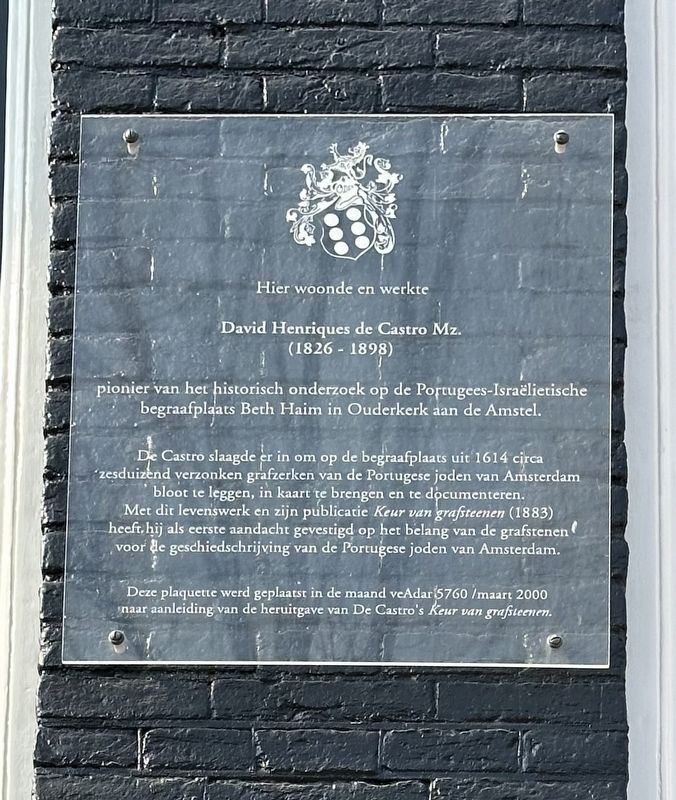
David Henriques de Castro Mz. (1826-1898)
pionier van het historisch onderzoek op de Portugees-Israëlietische begraafplaats Beth Haim in Ouderkerk aan de Amstel.
De Castro slaagde er in om op de begraafplaats uit 1614 circa zesduizend verzonken grafzerken van de Portugese joden van Amsterdam bloot te leggen, in kaart te brengen en te documenteren. Met dit levenswerk en zijn publicatie Keur van grafsteenen (1883) heeft, hij als eerste aandacht gevestigd op het belang van de grafstenen voor de geschiedschrijving van de Portugese joden van Amsterdam.
Deze plaquette werd geplaatst in de maand veAdar 5760 /maart 2000 naar aanleiding van de heruitgave van De Castro's Keur van grafsteenen.
Here lived and worked David Henriques de Castro Mz. (1826-1898), pioneer of historical research on the Portuguese-Israelite cemetery Beth Haim in Ouderkerk aan de Amstel. De Castro succeeded in uncovering, mapping and documenting approximately six thousand sunken gravestones of the Portuguese Jews of Amsterdam in the cemetery from 1614. With this life's work and his
this page online
This plaque was placed in the month of veAdar 5760 /March 2000 following the republication of De Castro's Keur van grafsteenen.
Erected 2000.
Topics. This historical marker is listed in these topic lists: Cemeteries & Burial Sites • Religion & Religious Structures. A significant historical date for this entry is October 10, 1898.
Location. 52° 22.068′ N, 4° 54.433′ E. Marker is in Amsterdam, Noord-Holland (North Holland). It is in Jodenbuurt. It is on Nieuwe Herengracht, on the right when traveling south. Touch for map. Marker is at or near this postal address: Nieuwe Herengracht 95HS, Amsterdam, Noord-Holland 1011, Netherlands. Touch for directions.

Regionally, it is in Europe, the European Union, Atlantic Europe, the Benelux Low Countries, the Schengen Area, Western Europe, and the Western World. Historically, it finds itself in what was once the Holy Roman Empire.
Other nearby markers. At least 8 other markers are within walking distance of this marker:
Photographed by Andrew Ruppenstein, March 24, 2025
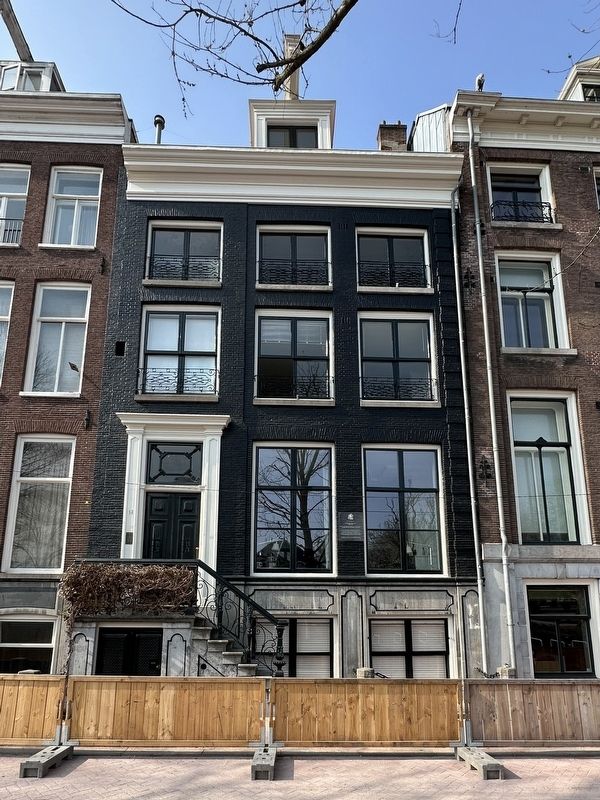
2. David Henriques de Castro Mz. (1826-1898) Marker - wide view
Also see . . . Castro, De, Family (Jewish Encyclopedia). As part of a larger article on the De Castro family, the Jewish Encyclopedia presents a biography of David Henriques Castro Mz. Excerpt:
Numismatist and author; born at Amsterdam, 1832; died there Oct. 10, 1898; son of Moses Henriques de Castro. He was a man of much learning, member of the board of directors of the Portuguese synagogue at Amsterdam, and president of the committee of the Portuguese Jews of the Netherlands. He possessed a rare collection of old coins and art treasures, and a library rich in Spanish and Portuguese manuscripts and printed works dealing with the history of the Jews, an elaborate catalogue of which appeared shortly after his death, under the title "Catalogue . . . de la Succession de Feu M. D. Henriques de Castro," Amsterdam, 1899 (with illustrations). The whole collection was sold at auction in April, 1899. De Castro was appointed knight of the Order of the Immaculate Conception by the king of Portugal. He was a member of the Royal Archeological Society at Amsterdam, the Netherlands Literary Society at Leyden, and the Zeeland Society of Arts and Science at Middelburg.(Submitted on March 28, 2025.)
De Castro took a keen interest in the history of the Spanish-Portuguese congregation of Amsterdam, in the renowned men identified with it, notably Spinoza, and in the inscriptions on the tombstones of the old cemetery at Oudekerk. He laid bare an entire section of this old burial-ground and unearthed costly tombstones. He was also interested in the Jewish cemetery at Middelburg near Flushing, where he resided for some time. The results of his investigations are embodied in the following works: "De Ṣynagoge der Portugeesch-Israelitische Gemeente te Amsterdam," 1675-1875, published on the occasion of its bicentenary; "Keur van Grafsteenen op de Nederl.-Portug.-Israel. Begraafplaats te Oudekerk aan den Amstel," Leyden, 1883 (text in both Dutch and German). De Castro was a contributor to several periodicals, such as the "Israelitische Weekblad."
Credits. This page was last revised on March 28, 2025. It was originally submitted on March 28, 2025, by Andrew Ruppenstein of Lamorinda, California. This page has been viewed 182 times since then and 36 times this year. Photos: 1, 2. submitted on March 28, 2025, by Andrew Ruppenstein of Lamorinda, California.
